Showing posts sorted by relevance for query positive steps. Sort by date Show all posts

Monday, June 1, 2009

Positive Steps

In which we see that school spirit can be dangerous to your dignity

The Felix Chronicles, # 30

They catch me as I walk by the reception room after getting my mail, my colleagues – previous victims looking for company – shouting for me as loudly as the members of the pep rally organizing committee. I had hoped to escape this meeting, but I’ve been caught. I won’t be the last. I see our Principal, Mary, is here as well. I remember she performed at last year’s pep rally, and swore never to again. Now she’s complaining and being teased like the rest of us as we await our orders from an impressively lively but focused senior who informs us that we’re to be the finale of this year’s rally and that she’s going to teach us a very simple dance. Yeah, right.

Twenty minutes and multiple playbacks of Rihanna's "Disturbia" later, I’m thinking this won’t be so hard, when she says, “OK, now we’re ready for the next part.” Al, the Senior Dean, seeing and sharing our collective alarm, kindly informs her that this as far as we’re going to go. Some protests from the girls, but quick agreement that we can simply repeat the routine we’ve been taught and that should be fine. After that, everyone is to improvise. There’s lots of joking as we leave the room with instructions to assemble two days later for the big event at the gym.

I am not looking forward to this. And yet I seem to find myself practicing my shovel step in front of the mirror after I put on my tie with school colors on the big day, and experiment with hand gestures later alone in the men’s room. At lunch I ask an older colleague, an alum of the school, if there were pep rallies back in the early seventies when she graduated. “Naaah,” she says. “We were way too cool for that, protesting the war and school policies.” I remark that teenagers somehow seemed older back then, and she demurs with the understated certainty of someone who knew that world too well to be impressed by it. She asks me if there were pep rallies in early eighties, when she correctly estimates I was in high school. It was a transitional time, I say. That kind of stuff was coming back, the reinvented nostalgia of the Reagan era.


By the time the school day is over, I’ve reached a state of positive dread. I wander over, late, to the old gym, which by this point is packed – not with only students, but administrators, staff, and parents. Great. The noise of the percussion ensemble – a string of snare drums pounding in unison – is deafening. I can feel my metabolism rising as I take a stand near my dancing partners, joking in each other’s ears like infantry waiting out the artillery barrage before the offensive assault. But I can’t help but be distracted by the festive air of the event. A towering arch of balloons has been set up at one end of the room, with a series of student emcees at the other. Each team is summoned to walk through the arch to the cheers of the gathering, and the players are ready for their moment. The field hockey team is dressed as Teenage Mutant Ninja Turtles, and pause at center court to wield their sticks like swords. The volleyball players are dressed as boxers, and stage brief matches. Boys Cross Country are all dressed like Eminem in Eight Mile, their captain – a tentative student of mine – rapping with verve as he calls out the members of the football team. When it’s their turn, the star quarterback executes his play involving the much beloved cafeteria lady, she catching his nerf-football pass at mid-court to the wild approval of the crowd. My son, donning his jersey and looking surprisingly buff, walks through the arch with two teammates, their deliberate pace reminding me of Johnny Cash. Oh boy, am I going to embarrass him.


We dancers get our cue. I turn my head and see Mary walking in the other direction – I can’t believe she’s ditched us! I’m tempted to call her out, but there’s no time. A few minutes earlier, I was helping my colleagues remember the routine, but once the music starts, I find myself hopelessly out of step. The sudden appearance of the school mascot beside me isn’t helping any, nor is the flash of a camera in my face. Before I know it, the routine is over and I’m thinking about making a beeline for the exit. But then I think: The hell with it. I’ve gone this far and I might as well enjoy it. I start dancing in the now-dated way I did when party music meant Kool and the Gang and Whitney Houston. By now whole clumps of people – the pep rally organizers, field hockey players, the emcee – have joined in the fun, and I find myself struck at just how good a dancer my contemporary Phil, a gray-haired math teacher, is. On my way out the door, I hear kind but insincere compliments on my performance.


Back at the administration building I run into Mary, and tell her that I’m deeply disappointed by her failed leadership. “I suddenly had to go to the bathroom,” she says, not even having the decency to suppress a smile. “I almost didn’t make it.” She pauses, finally rendering a mischievous grin. “But you, I see, were feeling pretty good, bustin’ a move out there. Who would have figured?”


“What the hell,” I reply, heading out the door for home. “You’re only middle-aged once.”

Wednesday, October 2, 2013

Place in Time (Part V)

The following post is part of series on the role of regionalism in American history. Previous posts are below.

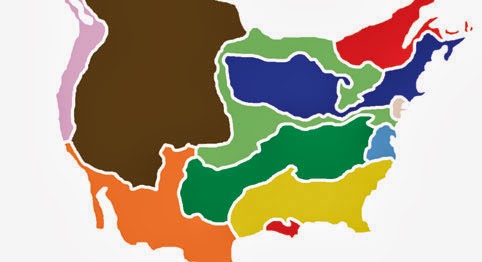
In recent decades, some scholars have been paying attention to regionalism again. The actual number they name ranges from as few as four to as many as eleven, but a few regions, and a few dynamics, are always apparent. Take New England, which always features prominently in these accounts. Most of the Puritan and Pilgrim settlers of the region hailed from the same part of (southeastern) England. This part of English North America was distinctive in any number of ways, among them the migration of whole families, their relative lack of racial and ethnic diversity and, especially, their dedication to their (dissident) religion. New Englanders were the most communitarian people on the eastern seaboard, and the most committed to their belief that people could govern themselves in the name of a greater good – which also meant they were more inclined to regulate the behavior of themselves and others. New Englanders were an expansive people; settlers to that part of the world pushed westward and occupied a series of future states across the continent, from Ohio to California. To this day, the people of this northern tier tend to share many attitudes, and evince a moralistic streak in their politics.

On the other side of the seaboard was the South – first Virginia, more specifically the Tidewater, in a culture that spread west and south to the Carolinas. (Some observers distinguish between Virginia and the Deep South, with the latter having more of a Caribbean orientation. Like New England, this region was marked by a shared religion, but it was the mainstream Church of England, about which settlers were generally less serious than their Northern counterparts. Here too the settlers tended to come from the same part of England (this time the southern and western coasts), but there was more racial diversity because the region relied much more on slavery than New England ever did. Both southerners and New Englanders prized their freedom, a goal that played an important role in their migration. But the former tended to think about it in positive terms – freedom to, as in freedom to worship as they pleased (with more of an emphasis on the collective pronoun). The latter tended to think about freedom in negative terms – freedom from, which among other things meant not having to conform to rules of the kind New Englanders were apt to make. Many New Englanders came to see slavery as the opposite of freedom, and took active steps to end it; many Southerners came to view slavery as the very essence of what freedom was: the right to acquire property, including human property, without interference.

In between these people – actually, more like behind these people, in terms of when they came, where they settled, and their relative status in American life – is a regional segment known by a variety of names, among them the Scotch-Irish, Borderlanders, or Appalachians, each of which that provides some indication of their identities. These people tended to come from the northern periphery of Great Britain and Ireland, but these Irish were Protestant (mostly Presbyterian) colonists from England’s conquests of Ireland during the age of Queen Elizabeth. They were, on the whole, poorer than other British migrants, one reason they tended to settle on the western periphery of the colonies, in hilly or mountainous terrain. They were also fiercely clannish in their family organization, devoted to their religion (especially the Baptist and Methodist sects that flowered in the early 19th century) and hostile to outsiders. Depending on the circumstances, this hostility was focused on Yankee-minded social reformers, who they regarded as control freaks, or Southern aristocrats, who they regarded as tyrants. Borderlands people, who became a large presence in a series of states from Pennsylvania to Texas, never managed to politically dominate any one of them for most of the eighteenth and nineteenth centuries, though they formed a powerful presence in national politics. (They put Andrew Jackson in the White House much to the horror of old-line Yankees and Tidewater aristocrats.) They split during the Civil War, some joining the Confederacy, others choosing to secede from the secessionists, as West Virginia did in breaking from Virginia in 1863. But these days such people tend to cast their lots with Southern bloc, whether they happen to live in northern Georgia, eastern Tennessee or most of Oklahoma.

The other major piece of the puzzle between New England and the South is the region that includes New York, New Jersey, and Pennsylvania, known collectively as the Mid-Atlantic region. Sometimes this is parsed as New York/northern Jersey and Pennsylvania/southern Jersey, with Delaware as an annex to Pennsylvania, reflecting the fact that metropolitan New York (originally New Amsterdam) was originally Dutch and Pennsylvania was English. The key point for our purposes is that this whole stretch of territory has always been highly diverse in just about every way we’ve been talking about – religious, racial, ethnic and political. When the English seized New Amsterdam without a shot in 1664 they kept its basic institutions intact, which is to say they respected its diversity Pennsylvania began as a haven for the far-out religious English Quakers, but the colony was quickly overrun with borderland settlers and immigrants from Central Europe. Pluralistic, commercial, and with a strong pacifist streak in Quaker Pennsylvania in particular that translated to skepticism about any kind of crusade, a Midlander ethos spread west from central Ohio into southeastern Colorado. Many of the states where such people are dominant, among them Missouri, are fiercely contested by their state political parties and are often up for grabs during presidential elections.

As is its wont, North American regionalism spills beyond U.S. national borders. The cultural remnants of New France are alive and well in Quebec, which features a French-speaking majority and a cultural sensibility at marked contrast with the rest of Canada (whose maritime provinces, like Nova Scotia, have a strong Yankee accent). The southwestern states of the United States – among them California, Arizona, New Mexico and Texas – retain strong elements of their Spanish and Mexican heritage. Indeed, some observers believe the residents of “El Norte” on either side of the Rio Grande have more in common with each other than their respective national citizenship; in this regard the fence the U.S. has been building is more like a Berlin Wall dividing a country rather wall dividing two nations.

I realize it’s possible to make too much of all of this. Besides, some of the nationalizing forces I’ve already mentioned, like the mass media, there are factors at work in U.S. life that are shaping the nation’s life and future at least as much as regionalism is. Immigration, for instance. It’s important to keep in mind, however, that the center of gravity for immigration has generally been centered in the Mid-Atlantic and its Borderland successors extending into the Midwest. There are two important exceptions to this rule. The first is New England, which first lost its ethnic uniformity almost 200 years ago when the Irish started swarming in, followed by Italians, Jews, and now Asians and Latinos. But New England has also shown a tremendous capacity for assimilating new arrivals to their ways, not so much in terms of things like language or expression as much as a belief in personal and collective self-improvement, something immigrants are likely to believe in anyway as a factor in their original decision to migrate.

The other exception is El Norte, where Latinos are becoming an ever-greater proportion of the population (Mexicans today are about the same proportion of the population that the Irish were in the late 19th century.) But this is less a new development than a reversion to the ethnic mean. Latino immigrants like to say that they didn’t cross the border; the border crossed them. Now it’s crossing back. What may be a more advanced stage of this process is underway in the northern Canadian province of Nunavut, where indigenous peoples broke away from the province of the Northwest Territories and are reasserting their control over the land for the first time in 500 years.

Next: Concluding remarks