Showing posts with label Aaron Burr. Show all posts

Friday, October 14, 2016

King's Survey: Dueling Legacies

In which we see one man die, but nobody win—though a nation survives

 —OK, Mr. K. It’s time for that happy ending.
What happy ending, Kylie?
—The one you said was coming. With Thomas Jefferson as president.
Did I say it was going to be a happy ending?
—Whatever, Mr. K. Just get on with it.
Yes, ma’am. Thomas Jefferson is re-elected, handily, in 1804. But things are beginning to get rocky again.
—Why?
Let’s go back to Aaron Burr. Also known as the Vice President of the United States, which is what he became after his failed attempt to seize the presidency from Jefferson in 1800.
—Yeah: whatever became of him?
Iceman. After what happened, Jefferson didn’t want to have anything to do with him. Burr was completely frozen out. And it was absolutely clear Jefferson wouldn’t have him aboard for his second term.
—Not surprising.
No. So Burr went back to New York, and ran for governor. He lost—thanks to his old frenemy Alexander Hamilton, who mounted a successful effort to stop him. Hamilton was mad at Burr for having snatched a senate seat from his father-in-law a few years earlier. Their contempt is now mutual and open. And then Hamilton says something about Burr.
—What?
It’s not clear what. Something critical. Burr hears about it third-hand, and sends a note to Hamilton demanding he apologize. Hamilton refuses. The feud escalates. And then Burr challenges Hamilton to a duel.
—You mean like with guns?
Pistols. Dueling is an old tradition, and one that had been common in the United States, especially in the South. (We’ll hear about it again when we talk about Andrew Jackson.) But it was fading a bit up North, and had become illegal in some states, New York among them. But people were still doing it, and among them Hamilton’s own son, who was killed in a duel in 1801.
Portrait of Alexander Hamilton
Alexander Hamilton

Hamilton didn’t want to duel Burr. But he felt he had no choice: he wasn’t going to back down to a scoundrel. Some people thought Hamilton had become a scoundrel by 1804. He had schemed, twice, to deprive his presumably Federalist ally, John Adams, of the presidency. He failed the first time, but the second, in which he published a pamphlet attacking Adams, may have played a role in Adams’s defeat (it certainly hurt Hamilton’s reputation). Much worse were rumors that Hamilton had abused his powers as Secretary of Treasury, rumors that arose after reports surfaced that he had used government money to pay bribes to a shadowy figure in Philadelphia society named James Reynolds. Faced with exposure, Hamilton wrote a different pamphlet in which he said, yes he had paid bribes, but with his own money—not because he was guilty of financial fraud, but because he was being blackmailed by Reynolds for adultery by with his wife, Maria Reynolds. In effect, he sacrificed his private reputation (and his wife’s feelings) to save his public reputation. So now we have a duel between a disgraced former Secretary of Treasury by a disgraced Vice President.
—Jesus.
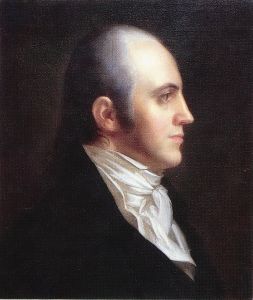
800px-Aaron_Burr-2
Aaron Burr
Well, let’s leave him out of it, Jonah. Since dueling is 
illegal in New York, Burr and Hamilton row across the Hudson River to Weehawken, New Jersey in the early morning hours of July 11, 1804. Hamilton, who at some level can’t quite believe this is happening, fires his shot in the air over Burr’s head. Not Burr: he shoots Hamilton in the gut. Hamilton takes two days to die. Once he does, Burr is wanted for murder in New Jersey.

—Jesus!
Ethan, I thought we agreed—
—Sorry.
—So what becomes of Burr?
He’s a fugitive from justice, wanted for murder in New Jersey. He also knows he has no future in Washington. He flees the country and hatches a plot with the Spanish government to found a new American republic in the neighborhood contemporary Arkansas.
—Jes—just kidding. Does it work?
No, Chris. Burr gets betrayed by one of his collaborators, James Wilkinson, a revolutionary war vet with a history of shadowy collaboration against General Washington. But after working with Burr for a while, Wilkinson gets cold feet and blows the whistle on Burr. He’s arrested and dragged back to Washington to be tried for treason. His treason trial is presided over by John Marshall, the chief justice of the Supreme Court. Marshall was appointed by Adams on his way out the door along with a bunch of other judges, which infuriated Jefferson. Marshall would run the court for 35 years, and turn it into a bastion of Federalist power. Oh, and one other thing: Marshall is related to Jefferson (they’re distant cousins). They loathe each other.
Jefferson really wants to stick it to Burr. But Marshall really wants to stick it to Jefferson. He does it with a rule that proves lastingly influential: Marshall insists that charges against an individual need to be corroborated by more than one source. Anything short of two is hearsay. There’s not enough evidence against Burr, who’s acquitted in 1807 (he goes on to live for another 29 years).
—I kinda can’t believe we had such a crazy country. Leaders killing each other, conspiracies to form alternative countries, crazy elections. You hear about these things in other places. But I didn’t know it happened here.
Right, Sadie. That’s exactly what I’ve been trying to emphasize these last few classes: that this is a country that had fragile beginnings. Every country always has intrigue. But the key point, and it’s one I want to return to now, is that a lot of this fragility is rooted in the fact that the nation is not entirely in control of its own destiny. To be sure, there are power struggles within: we’ve just been talking about those. But remember: the backdrop here is the global struggle between France and Britain. And in Jefferson’s second term, it bursts open again.
—So no happy ending then.
No ending at all yet, Kylie. We have a war to get to.
—Definitely no happy ending.
Well, it depends who you ask.
—I say you ask the dead.
Well, they tend not to talk much. But it’s fair to ask.
Next: the dumbest war

Monday, October 10, 2016

King's Survey: Burr in the Saddle

In which we see a schemer foiled by his enemy's enemy


We’re right smack in the middle of the election of 1800, kids, and Thomas Jefferson has a problem.
—I thought you said he was doing really well.
Well, yes, Kylie, I did say that the other day, more or less. I was talking about the political roller coaster for Jefferson was on. First he and his Republican allies were thrown on the defensive by supporting France just before the U.S. went to war with that country. Then his opponents, President Adams and the Federalists, pressed Alien and Sedition Acts, which backfired on the Federalists. So Republicans pressed their advantage with the Virginia and Kentucky Resolutions, in which they said they could ignore laws legislation considered unconstitutional. 
—I still don’t understand why that didn’t really hurt them. Saying they didn’t have to obey any laws they didn’t like.
—That’s a good question, Sadie, and I don’t have a straight answer for you. There are two things to keep in mind, though. The first is that President Adams finding his way to peace with the French reduced the overall stress level, even though he himself didn’t benefit much. And the reason, I think, that he didn’t benefit much—the second thing to keep in mind—is that the Federalists had just been in power too long. Their brand of strong government, a government that favored high taxes to support a large military, became increasingly wearisome to a country that was founded in suspicion of big government, hatred of taxes, and fear of armies. Alexander Hamilton had given the country a strong foundation. But with his mentor, George Washington, gone—Washington died in December of 1799, widely mourned by his countrymen—Hamilton was a loose cannon. And since he and Adams didn’t really get along, the road was open for an alternative.
—Like I said, you said Jefferson was in a good position. So what’s the problem?
Well, yes, he was. But you may also remember that I said New York had been the key in 1796: Adams had the North, Jefferson had the South, and the Empire State had swung Federalist. So going into the election of 1800, Jefferson knew he had to secure New York if he wanted to win. And he wasn’t sure he could. He needed an insurance policy. And that insurance policy’s name was Aaron Burr.
—I’ve heard that name.
I’ll bet you have. Do you know anything about him?
—No.
—Wait: didn’t shoot somebody? Was it Hamilton?
As a matter of fact, yes. But that happened later. Before that, Burr shot Jefferson, too.
—Really?
Well, I mean that metaphorically. Burr was a guy with a remarkable pedigree. His grandfather was Jonathan Edwards. Do you remember him?
Anyone?
Ugh. The First Great Awakening?
—The preacher guy?
Right. The preacher guy. Burr came from a really illustrious family. He served in the Revolution, and was a prominent New York City attorney. Worked alongside Hamilton, in fact, during the war and afterward. They were friendly. Sort of. It was never really clear who Burr’s friends were (especially to those “friends”). Or where his political loyalties were. That’s why the Jefferson camp was a little nervous about him. But they believed he could deliver the state to the Republicans, and so they offered him a deal: if he ran with Jefferson, he’d be vice president.
—So what happened?
He accepted the offer.
—So he became vice president?
No. Burr ended up in a tie. With Jefferson. For president.
—How the hell did that happen?
I don’t really know. New York was a big state, with a big haul. Political fixers sometimes arranged for electors in the Electoral College to choose someone other than their top candidate, so that the number two person would move up and lock in the VP slot. Remember: under the terms of the Constitution, the runner-up became vice president, so it made sense to split votes if it would mean you could keep your opponent out. (Remember that Adams and Jefferson, who finished first and second in 1796, were opponents—not an optimal way to govern.) This was a big flaw with the whole system, and after this was all over, the Congress passed, and the states ratified, the 12th amendment to the Constitution, which created slates—president and vice president—to run together as a team. But that’s not helping here.
—So what happened in 1800?
What happened in 1800 is what happens when nobody gets a majority in the Electoral College.
—Amd that is?
Warm my heart, someone. Tell me what the Constitution says.
Anyone?
Ugh. The election goes to the House of Representatives. Each state gets one vote. So the congressmen in a given state confer to choose.
—So what happened with Jefferson and Burr?
It took six days and 35 votes. A lot of the Federalists voted for Burr.
—Why?
To stick it to Jefferson, for one. Because they hoped Burr would really be better, for another.
—Would he have been?
No one knows for sure. But after a certain point, you kinda have to be suspicious of someone who never really tips his hand. Although in one way, Burr did tip his hand: once there was a tie, he put the VP deal he cut with Jefferson aside. He wanted to be president and pushed for it.
—So how did it get resolved?
Ironically, a key figure in all of this was our old friend Alexander Hamilton, who in effect had the power to choose between options he considered truly awful. By this point, he had been out of power for a few years, and had made plenty of enemies. But he still had influence. Hamilton hated Jefferson. And he thought Jefferson was a wooly-headed idiot. But Hamilton was afraid of Burr, afraid of what he might to do the country. Hamilton considered Jefferson an idiot, but at least he had principles. But Burr was a snake. Smart, likeable, even a guy he could work with. But not someone he ever wanted to see run the country. Hamilton urged his fellow Federalists to vote for Jefferson. And in they end, enough of them did to put Jefferson over the top.
—Wow. That’s really quite a story.
And it isn’t over yet, Sadie.
—Woo hoo. What happens next?
Jefferson enters his first term as president.
—So is that a happy ending?
More like a happy middle. We’ll get to it tomorrow.

Next: Jefferson in the saddle