In which we students struggle with kinds of slavery, and different kinds of freedom
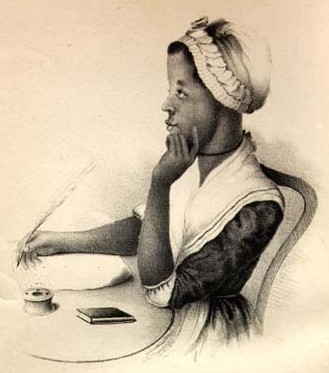
—Another poem on the Smart Board.
That’s right, Emily.
—In History class.
Yup.
—You a poetry guy, Mr. K?
A little. You know I like Anne Bradstreet; we read a poem of hers earlier this semester. I also like Emily Dickinson; I hope we’ll get to her, maybe next semester.
—This one here is another woman. Strange spelling of her first name, though.
She was named after the slave ship that transported her to Boston. Go ahead and read it for us, Em.
—Okay:
On Being Brought from Africa to America
BY PHILLIS WHEATLEY

'Twas mercy brought me from my Pagan land,
Taught my benighted soul to understand
That there's a God, that there's a Saviour too:
Once I redemption neither sought nor knew.
Some view our sable race with scornful eye,
"Their colour is a diabolic die."
Remember, Christians, Negros, black as Cain,
May be refin'd, and join th' angelic train.
—That’s a weird poem.
Why do you say that, Adam?
—She’s saying she’s glad to be a slave.
Is that what she’s saying?
—She says that it was “mercy” that she came here.
Is that the mercy? Coming over here?
—I agree with Mr. K.
—Really, Jonah? Am I saying anything to agree with?
—I mean that it isn’t being a slave that’s the mercy. It’s that she believes in God.
—This is kind of a dumb argument. She wouldn’t believe in God if she hadn’t come here. So that means she is glad she’s a slave.
Is that so, Em? Do you agree with Adam that the poem weird?
—It’s more than weird. It’s disturbing. It’s offensive.
At the risk of sounding dumb, I’ll ask you: what is it that’s offensive?
—It’s that she would be grateful to be a slave. For any reason.
I understand. But let me push a little further: stipulating that you find it unacceptable, what is her reason?
—Like Jonah said: it’s God.
Yes. But what about God? You want to weigh in, Sadie?
—Redemption. She’s saved.
Right. The reality of God and the savior, Jesus Christ, means that’s she’s saved. She has eternal life.
—Who would want eternal life as a slave?
—She won’t be a slave once she’s dead, Brianna. She’ll live forever. But she’ll be dead as a slave.
—That doesn’t make any sense, Sadie.
—I mean her spirit will live after her body dies. I have a question, Mr. K.
Shoot.
—When was this poem written? Can you give us a little background?
Phillis Wheatley was born in the early 1750s. She was from somewhere around modern-day Gambia or Senegal, in West Africa. She came to Boston in 1761 and was bought by a wealthy couple, the Wheatleys. Their daughter taught her to read. This poem was written in the late 1760s.
—She was writing poetry within a few years of arriving here and learning English?
Wheatley was a prodigy. Her owners were as amazed as you are. They arranged with some English friends to publish Poems on Various Subjects, Religious and Moral, in 1773. Actually, there was widespread disbelief that a Negro slave could write a book. That’s why they also arranged for her to meet with a distinguished panel of Bostonians that included John Hancock, Thomas Hutchinson, and a series of other luminaries, many of them soon to be avowed enemies in the Revolution. After interviewing her, they signed a document attesting to her talent, a testimonial included in her book.
—That’s pretty incredible.
Yes, Kylie, it was. Wheatley was taken to London, where she met Ben Franklin, who was impressed. When the Revolution broke out, she wrote a poem in honor of George Washington, who invited her to meet him, something she did just before he left Boston for New York in 1776. About the only person who didn’t believe Wheatley was for real was Thomas Jefferson, who rejected the notion that a Negro could possibly produce a work of art.
—What did she say about Washington?
Here, I’ll call it up on the Smart Board. I’ll read the last stanza:
Proceed, great chief, with virtue on thy side,
Thy ev’ry action let the goddess guide.
A crown, a mansion, and a throne that shine,
With gold unfading, WASHINGTON! be thine.
—I don’t know if I like this, either.
Like what, Em?
—The poem.
What don’t you like?
—It’s not so much what it says. It just seems … stiff. “Proceed great chief!” It’s so phony.
Well, the tone is typical of 18th century poetry. Actually, Wheatley has been criticized for being a little too derivative, too imitative, of poets like Alexander Pope, the leading British poet of the time. But again, this tendency is indicative of what we’ve been discussing: her uncanny ability to pick up language. Yes, Adam.
—I still think it’s a little sick that she’s saying she’s OK with slavery.
I understand that view. And indeed, many African Americans in the last two centuries have shared it. The black literary critic Henry Louis Gates has called this piece “the most reviled poem in African American literature.” But I don’t think that’s the whole story here. Here: let me call up yet another Wheatley poem. This one was written in honor of the Earl of Dartmouth, the man who ran the effort to defeat the American Revolution (and the man for whom Dartmouth College is named):
I, young in life, by seeming cruel fate
Was snatch'd from Afric's fancy'd happy seat:
What pangs excruciating must molest,
What sorrows labour in my parent's breast?
Does this change your mind any, Adam?
—Doesn’t really change I think about the other poem.
Fair enough. Let’s go back to that. So far we’ve been focusing on the first half. Now let’s look at the rest of it. The next line is
Some view our sable race with scornful eye,
"Their colour is a diabolic die."
What does this mean?
—She’s saying other people are racist. That they view black people as evil.
Good, Jonquil. See that she uses quotation marks: she’s speaking in someone else’s voice, presumably a white person. Now let’s zero in on the final lines:
Remember, Christians, Negros, black as Cain,
May be refin'd, and join th' angelic train.
So what is she saying here?
—She’s saying that even black people can go to heaven.
Yes, Jonquil. Negroes black as Cain can be refined and join the angelic train. Question: Who was Cain?
—That’s from the Bible.
Correct, Jonah. Can you be more specific? Anyone?
—Wasn’t there a brother thing? Cain and Abel?
—Cain killed Abel.
Right. Cain and Abel were the sons of Adam and Eve. Cain was a farmer, Abel a shepherd. They both made offerings to God, but God was more impressed with Abel’s gift than he was with Cain’s. A jealous Cain killed Abel. When God asked Cain were Abel was, he replied, “Am I my brother’s keeper?” (The correct answer, of course, was yes.) God cursed Cain by forcing him to wander the earth. So what does Wheatley mean when she describes “Negroes black as Cain?”
—That they’re cursed. To wander across the ocean.
—Yeah, but even though they’re cursed they can still be saved.
Good. Oh, by the way: “Cane” here is also a pun. Can you figure out what for?
—Candy cane?
Close.
—Sugar cane?
Right! Why is that relevant here?
—Because sugar is sweet?
Not exactly. What do you know about slavery? What kind of work did slaves do?
—They picked cotton.
Well yes, but that was later. I guess we didn’t really cover this. Slaves in the Caribbean in particular processed sugar cane. It was backbreaking work. Remember how we talked about the colonists’ mania for tea? A lot of them had sugar with that tea. Sugar was relatively new in the western world in the 18th century. People were crazy about it. So it fueled the slave trade. Sweetness rested on a foundation of brutality. So you’re right in that there is (ironic) relevance here. And another thing: what color is sugar?
—White.
Yes. But that’s after it’s processed—or, to use Wheatley’s term, “refined,” which is what we typically use in everyday life even now. But what color is sugar first?
—Brown?
Yes.
—That’s pretty funny.
—It isn’t funny, Jonah.
—No, I mean it’s cool. I mean clever. It’s cool symbolism. She’s a good writer.
Now let’s approach this from another angle. That second to last line has four commas. There’s one after each of the first three words: “remember,” “Christians,” and “Negroes.” What does a comma do?
—It makes you stop.
—No that’s a period. A comma more like makes you slow down.
It can also change the way you read a line. Is Wheatley telling Christians to remember Negroes? Or Negroes to remember Christians?
—There’s also italics.
That’s a good point, Kylie. I should have mentioned that. Both Christians and Negroes are italicized. So is Cain. Who is it that Wheatley is comparing to Cain? Are Negroes black as Cain? Or are Christians (which is to say born sinners) black as Cain?
—Both?
You think so, Kylie?
—No?
Kylie, tell me what you really think. Don’t take your cue from the content or tone of my question.
—I think she’s saying both. I think she’s saying that both black and white people are like Cain.
Is she also saying that black and white people can “join the angelic train?”
—Yeah.
And where is that train going?
—To heaven?
Are you asking me or telling me, Kylie?
—Um, telling you, I guess. Both Negroes and Christians—I mean white Christians and black Christians—can go to heaven.
Understood. One more question, Kylie: Do you like this poem?
—Do I like it?
Yes. I’m asking if you like it.
—I don’t know.
Good.
—Why is her saying “I don’t know” good?
Because, Adam, she’s giving me her honest judgment. It appears that figuring out what she thinks and saying so doesn’t come naturally to her. It does seem to come naturally to you. You’ve been clear from the start that you don’t like this poem. Is that still the case?
—Yeah, it is.
Even though I’ve given you evidence that Wheatley is not the uncritical advocate of slavery you fear that she is?
—I still don’t like it.
Is that because the quantity of the evidence is insufficient? Or is it because the quality of that evidence is insufficient?
—I’m not sure. I think what may bother me is the way she uses her religion to justify slavery.
Is that what she’s doing?
—Basically, yeah. I get that she is critical of slavery, but she’s basically saying that doesn’t matter. It’s not important. Believing in God is what matters.
Is believing in God a problem?
—Well, hey, people can believe what they want. I just think people sometimes use religion as a crutch.
A crutch.
—Yeah. When they can’t deal with reality they turn to God.
Which is counterproductive. Might even make it easier to enslave people.
—Exactly.
Brianna, you’re nodding your head.
—I think he’s right.
And Emily, you’ve been in the Adam camp from the start of class. Are you still are, right?
—Right.
Fair enough. Do the rest of you? Are we agreed that the Phillis Wheatley we meet in this poem is a talented, but sadly misguided, girl of about your age?
—I’m not sure I want to say that.
Why not, Yin?
—It seems harsh. She’s doing the best she can with a bad situation. Doesn’t seem fair to say she’s making things worse.
—I’m not saying she’s making things worse.
—You just said she’s making it easier to enslave people, Adam.
—Mr. K. said that. I didn’t.
—But you agreed.
—I meant more that the people who are enslaving her are taking advantage of her.
They’re taking advantage of her emotional vulnerability, Adam? They’re exploiting her faith?
—Yeah, I guess you could say that.
And her faith is a form of weakness?
—I dunno. That’s a tough one. But yes, I guess it is.
—I think it’s really wrong to judge.
Don’t we have to, Yin?
—Why do we have to judge? We don’t know what she was dealing with.
Well, that’s certainly true. None of us are eighteenth century slaves. And this of course is a poem; by definition the portrayal here has been edited, has been manipulated, in some way. (I’m assuming the voice we’re hearing here is that of Wheatley herself, which might be a mistake.) In fact, we know this isn’t the whole story in the World of Wheatley: I’ve shown you that she has expressed different sentiments about slavery in a different poem that was published in the same book. So we can’t jump to any conclusions. That’s exactly what I’ve been working toward trying to get some of your classmates to avoid. And yet …
—And yet what?
Well, I don’t know that you’re dealing with either, Yin.
—I don’t understand your point.
Well, look: I’m your teacher. You’re my student. As such, I’m expected to treat you like every other student. But at the same time, in talking with you, in dealing with you, I have to make decisions about who I think you are: what you want to hear from me, what you need to hear from me, what I think will work best in educating you within the boundaries set by the law, by the school, and the limits of our respective abilities. (“You,” by the way can be a particular student, the particular set of students I have in the room, adolescents generally, or some other group of people.) I have to make judgments based on incomplete information. This is something every single one of us does every single day. Right now it’s my job to do it. You can see I handled Kylie differently a minute ago than I handled Adam. And you’ll note that I haven’t asked Paolo over there, who’s been silent today, and can remain so if he’d like, any questions. I’m guessing that this is not the right moment to put him on the spot by demanding he say something. But I’m guessing it is the right moment to remind him that I know he’s here, and to refocus what may or may not be his flagging attention. I’m exercising my professional judgment here to the best of—dare I say?—God-given ability.
Might I make mistakes in making these various choices? There’s no doubt about it. Maybe I’m selling Kylie a little short in my estimation of her willingness to take a firm position—or maybe, as you’re arguing, my insistence on taking a position is misplaced. Maybe I’ve hurt Adam’s feelings in ways I failed to anticipate or will never realize. And maybe Paolo is bursting at the seams ready to say something, or maybe I’ve made it less likely, rather than more likely, that he’ll do his homework tonight. Care to weigh in, Paolo? You can just shake your head.
That’s a no. Back to our friend Phillis Wheatley. There are lots of ways to read this poem, and to go back to Emily’s initial observation, we’re reading it in a History class rather than an English class. I mentioned the English poet Alexander Pope in passing, but the truth is that I’m not interested in the aesthetics of this poem. I’m much more interested in it as a snapshot of a life in motion—a life in the past that we’re making a necessarily partial effort to understand. I told you that as a teacher I have to exercise my professional judgment. Right now I’m trying to get you to exercise your personal judgment. Note that key verb: exercise. My hope is that by asking you to do this regularly, in this figurative gymnasium we call a classroom, you’ll get better at doing it when you leave. But let me replace that word “hope” with a different one: faith. It’s my faith that this little ritual we’re doing will allow us to get better—in multiple senses of that term. Perhaps that’s my crutch, Adam.
—Mr. K., what became of Phillis Wheatley?
The story is not an especially happy one, Sadie. She did receive her freedom, but that appears to have been something of a mixed blessing, because she struggled to survive. She tried, and failed to get a second book published. (So many of her poems were written in honor of prominent people, I suspect, because she depended on patronage, as so many artists do in one form or another.) In 1778 Wheatley married a man named John Peters, about whom not much is known, although he was apparently frequently in debt. Phillis Wheatley, now Peters, had three children with whom, all of whom died in childhood. The third died in childbirth, taking the poet with her, in 1784. She would have been about 35 years old.
—That’s so sad.
Yes, in some ways it was. On the other hand, a slave who wrote her way to freedom and produced work that’s still being read centuries later ain’t a bad lifetime’s work. Many of us would consider ourselves lucky and satisfied to have done the same, whether or not we were slaves.
Of course, there were other ways a slave could do meaningful work. We don’t know the names of most of the people who participated in the Stono slave rebellion of 1739 in South Carolina (it was apparently led by a man named Jemmy), or the New York uprising of 1741, or the followers of Gabriel Prosser who led another revolt in Virginia in 1800. Many of them died in unsuccessful fights for freedom. Which would eventually come. Their voices may be a little harder to hear. But with a discerning ear, you might be able to apprehend them, and evaluate their stories like we just did Wheatley’s. Or the far more ordinary voices of those around you. They might prove to be more interesting and unexpected than you might think.
See you—I mean hear you—tomorrow.
Next: Speculating on the new republic


