Showing posts with label fugitive slaves. Show all posts

Monday, November 28, 2016

King's Survey: Runaway Policy (II)

In which we see that one man’s crime wave is another woman’s path to freedom. (Note: this is the second of two posts on the subject, which can be read independently or as a pair.)
The_Underground_Railroad_by_Charles_T._Webber,_1893
Charles T. Webber, "The Underground Railroad" (1893)
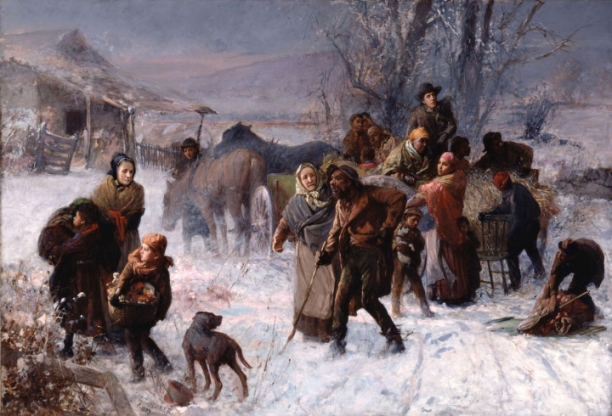
O.K. kids. So we’ve been looking at the issue of runaway slaves, and whether on not we need a stronger fugitive slave law, from the point of view of slave owners. Now let’s shift our gaze to those who aren’t. Chris, we’ll start with you. Your name is Joshua Freeman, and you live in Toronto. Actually that’s your name now. Previously you were known as Cicero. You lived on Robert Baron’s plantation in Mississippi. How does it feel, Chris, to be living in freedom.
—Pretty good. Cold, though. This place is freezing.
—Yeah, well, Mississippi was hotter than hell, wasn’t it, Chris? I mean Cicero. I mean…
Joshua Freeman. By the way, what to you make of that name?
—Duh. “Freeman.” Real subtle, Mr. K.
Fair enough, Emily. But what about “Joshua”? Anybody know where that comes from?
—The Bible?
Well, yes. But where in the Bible? Does anybody know?
Nobody? Ouch. Here’s a hint. Think Book of Exodus.
—Oh, well, now it’s obvious! Book of Exodus! Of course!
You have no idea.
—Correct.
Ugh. You’ve heard of Moses, yes?
—Yeah. Promised Land.
Right. But here’s the thing: Moses never actually made it to the Promised Land. God wouldn’t let him go. That job was given to Moses’s successor, whose name was….
—Joshua.
Brilliant.
—Heavy on the symbolism there, Mr. K.
Hey, it isn’t me. Joshua Freeman himself chose the name. He’s a devout member of the African Methodist Episcopal Church. Cicero here has been reborn a free man. Seems only natural to give himself a new name. Right, Mr. Freeman?
—Whatever you say, Mr. K.
Well, I admit, I have been saying a lot. Let’s get some other voices in here. Brianna, you’re Robert Baron. How do you feel knowing that your former slave has escaped to Canada?
—Hey. Fine with me. Truth is, I was never comfortable with the slave owner thing you assigned me.
I understand. But we all have roles to play, Mr. Baron. And we don’t always get to choose what they are.
—Yeah, well, I want to write my own play.
A good idea. Go right ahead. Let me turn my attention here to Emily, who is actually Charity Wright of Cincinnati, a member of the American Tract Society, which as we all know publishes religious tracts by the millions (Cincinnati, by the way is an important publishing center in the United States). Miss Wright, we all know you to be a shy, retiring soul. So we’re glad you’re willing to talk with us.
—That’s me. Ms. Shy.
Well no, that’s Miss Wright. How long have you been a member of the ATS?
—Oh, I reckon twenty years now.
I had no idea it was that long.
—Well, you wouldn’t now, would you. I look very young and beautiful, I know.
Indeed. However there is something about you I do know, Miss Wright, that I’m now going to reveal to the class: you are a conductor for the Underground Railroad!
Go ahead kids, you can gasp.
—Oh!

—I’m horrified!
—I’m impressed!
—What’s a conductor for the Underground Railroad?
Good question. If you walk into the main parlor of Miss Wright’s Cincinnati home, you’ll see a rug in the middle of the floor. Lift that rug, and you’ll see a panel you can pull up. It leads to a small cellar with a bed, shelves, and a chamber pot.
—What’s a chamber pot?
—A place to pee.
—Or poop.
None other than our friend Joshua Freeman made a stop at Charity Wright’s home on his way from Mississippi to Toronto. Anything you want to say to Miss Wright, Mr. Freedman?
—Thanks.
That’s it? This woman risked her life for you.
—Thanks a lot.
—That’s all right, Mr. K. I’ll send him a bill.
Well, Mr. Freeman’s wife is pregnant. Maybe she’ll have a daughter and name her “Charity.” In any case, you’re among friends here, Miss Wright. We won’t reveal your identity as a conductor, as we know you want to continue freeing slaves.
Keeping a low profile is not a goal for our friend Jonquil, who we will now know as Fred Burns. Mr. Burns is a Garrisonian abolitionist, which is to say that he’s a follower of William Lloyd Garrison, a militant opponent of slavery. Back in 1844, a mere four years ago, Mr. Garrison stood on the steps of Faneuil Hall in Boston and burned a copy of the Constitution, saying Massachusetts should not belong to a Union of slaveholders. You were there, weren’t you, Mr. Burns?
—Yeah, I was.
And you endorse these radical views? You would secede from this Union?
—Yes, I would. Slavery is evil.
Hmmm. Miss Wright, I wonder what you make of Mr. Burns. Do you endorse his radical views?
—As we all know, I’m sby and retiring. But yes, I agree with Mr. Burns.
—Damn straight. I’m down with Burns.
No shock there, Mr. Freeman. Ah, I see Mr. Evinrude has something to say. As you will recall, kids, Sadie is this small farmer from Missouri.
—I am sickened by this extremism. No respect for authority. They keep this up and there will be a Civil War.
—Calm down, honey. No need to get excited.
Glad to see Mrs. Evinrude try to calm you, sir.
—Shut up, woman!
—Hank! I am your wife! Treat me with respect!
—Sorry, sweetheart. It’s just that these abolitionists get me so mad sometimes.
—I understand. They are perfectly awful. Miss Wright, you should be ashamed of yourself. Breaking the law by helping the slaves escape. It’s wrong, gosh darn it!
—Gosh darn it? I think marrying this guy has messed up your brain, Kylie—I mean Mrs. Evinrude.
All right, all right no more name calling. We have one other person to hear from. And that’s Adam, also known as Alphonius Green. Mr. Green runs a New York insurance brokerage with a large Southern clientele.
—Alphonius? What kind of name is Alphonius?
It rhymes with “felonious.”
—What does “felonious” mean?
It means “criminal.” But never mind that. Mr. Green, you issue insurance policies to slaveholders that pays them back if their slaves run away. I wonder if you would be in favor of a stronger fugitive slave law.
—Of course.
And why would that be?
—It’s obvious. Runaway slaves cost me money.
Would it be fair to say, Mr. Green, that you are a New Yorker with Southern views?
—I’m a New Yorker with money views.
Understood. It has been estimated that forty cents of every cotton dollar comes through New York City. New York banks lend slaveholders money. New York newspapers take advertising for lost slaves. New York shipping houses arrange for the transportation of cotton across the ocean to Great Britain. And of course New York brokerages like yours insure slaves. Under such circumstances, Mr. Green, do you think slavery will ever end?
—Not if I have anything to say about it.
There you have it kids. But one more voice. Yin here is Mary Deed, a free black woman from Philadelphia. Hello, Mary.
—Hello.
Mary, I understand your family has lived in Philadelphia for for many generations.
—That’s right.
And what do you do for a living, Mary?
—I’m a teacher. I teach Negro children.
Wonderful. We’ll give you the last word, Mary. What should we do about a fugitive slave law?
—Nothing.
Next: Compromising situation

Friday, November 25, 2016

King's Survey: Runaway Policy

In which we see a crime wave involving property with a distressing tendency to go underground and run away
BountyNoticeSlaves
Bounty notice for escaped slaves

Brianna, your name is Robert Baron. It’s 1849, you have a plantation in Mississippi and you own 200 slaves. You’re one of the great planters in the state, and your mansion, Twelve Oaks, is regarded as among the most beautiful. You’re legendary for your hospitality.
—Oh that’s just great. I’m so proud.
Well, I can understand your enthusiasm. A lot of people think you have reason to proud. After all, you came to this county thirty years ago with little more than a strong back. You worked hard, saved up some money, and used it to buy a farm. When the farm started to prosper, you bought slaves. As you continued to succeed, you added land, and slaves, and, eventually, overseers. Your shrewd investments have made you rich. Your friends call you a self-made man.
—More like a self-made slaveholder.
As you wish. Of course, part of what makes you successful is the way you take care of the small things, because the small things, good and bad, have a way of becoming big things. And right now you have a small problem that seems to be growing larger. That problem is runaway slaves.
—Can’t imagine why that would be a problem.
Well, a lot of your friends would agree with you. You’re known as a kind master. Your slaves are well fed and housed. You’ve instructed your overseers not to use force unless they really need to—not like those “white trash” types, wretched brutes who, drunk with power, are prone to crack the whip (one reason why they’re known as “crackers”). Actually, there’s some speculation that your slaves are running away because you’re too kind to them.
—Well of course I am. We slaveholders are a very, very gentle group of people.
Not sure I can agree with you there. Seems to me there are two types: slaveholders who regard, and treat, their slaves as savages, and those who treat them as children. You apparently fall into the latter camp. Of course, in the end, I’m not sure how much it matters. Some would say that the real problem is abolitionist agitators who keep making noise and whispering in the ears of northern negroes, who of course whisper into the ears of the ones down here. That’s bad enough. What’s even worse is this so-called Underground Railroad, which actively aids and abets runaway slaves through a series of checkpoints and safe houses until they reach Canada, where they can’t be retrieved. It’s rumored that Paolo here—a.k.a. Robin Capeheart—is a member of the Underground Railroad, though we can’t prove that. Would you care to comment, Robin Capeheart?
—Uh, no.
Didn’t think so. You folks keep a low profile.
—Right.
But let me turn back to you, Robert Baron. Clearly, you have a problem. What do you think the best way is to deal with that problem?
—Free the slaves.
Won’t work.
—Why not?
Well, for one thing, you’ll go broke. Your whole economic way of life is leveraged on slavery.
—Fine. I’ll go broke.
Which brings us to the second problem. You can’t free your slaves by going broke. They’ll be sold to settle your debts (that’s what happened to Thomas Jefferson, and why George Washington was so ruthless about keeping his finances in good order so that he could free his slaves when he died, something he knew would anger his relatives). I hear the slaveholder down the road is legendary in his severity. You want him to get yours?
—Well then I’ll help them escape.
Good luck with that. A runaway slave is one thing; a clutch of them another. But you really think 200 runaways are going to go unnoticed? Or a steady stream that you release gradually? And who do you think your fellow slaveholders are going to blame when they find out ? How do you think they’re likely to treat a peer who does something like that? Friends, I’m afraid Robert Baron isn’t thinking too clearly. He needs help. Does anyone else have a suggestion?
—I think he needs you to turn her into an abolitionist.
Huh. Funny how that didn’t happen. My magical powers are curiously limited. Who woulda thunk Brianna's classroom destiny would be a plantation owner named Robert Baron? Chalk it up to the ironies of history, I guess. As it turns out, we do have abolitionists in the room.
—We do?
Yes. A couple. We’ll get to them. But first we need to come up with a proposal to assist poor Robert Baron. Channel your inner slaveholder, kids. What will help him?
—Police?
Hmmm. A fascinating idea. Elaborate, Sadie. Or, should I say, Hank Evinrude.
—Hank Evinrude?
Yes. You’re a small farmer in Missouri. You don’t own slaves—yet. But you have your dreams, just like Robert Baron. You clearly think law enforcement would be a good approach. Here’s the problem with that: when slaves run away, they don’t stay within state lines. They in fact cross a bunch of them on their way to Canada. So local sheriffs, or even state ones, aren’t really a solution, because of the Tenth Amendment to the Constitution, which protects states' rights. There is a fugitive slave provision in the Constitution that says errant property has to be returned, but clearly that isn’t working. So maybe we need a new federal law, a national approach to this crime wave.
—Sounds good to me.
I imagine it does. There is wee bit of a problem, in that Southerners like yourself don’t typically like a powerful federal government. But I guess in this case you’re willing to make an exception.
—Right.
Can’t resist asking: how does your wife, Kylie, a.k.a. Amanda Evinrude, who’s sitting right next to you, feel about this fugitive slave law idea?
—Me?
—My wife doesn’t trouble her pretty little head about politics.
—Oh, Hank is right. I always do whatever he says, the way a woman should.
—That’s right, my dear.
Well, Mrs. Evinrude, there are some who say that slavery is wrong, and that since a woman is the repository of moral values in any household, she has an obligation to speak out for what is right. What do you say about that idea?
—Well, like Hank says, I stay out of politics.
But I’m not talking politics. I’m talking morality. Do you believe slavery is wrong?
—Look, Mister, whoever you are. Leave my wife alone!
My apologies, Mr. Evinrude. I didn’t mean to be too aggressive. I was just trying to ask a question I know has multiple answers. There are those who say that slavery violates Christian teachings. And there are those who say that the Bible sanctions it. Saint Paul said, “Masters, obey your slaves.” In the Old Testament, Ham sees his father, Noah, naked, and God condemns his heirs to be servants. But I will respect your and Mrs. Evinrude’s wishes. Maybe this would be a good time to turn our attention to Jonah, who we will now know as Frank Berger. Frank is a farmer not far from Hank Evinrude. Hank, as I mentioned, is in Missouri. But Frank here comes from the other side of the Missouri River in Kansas. He doesn’t own slaves. Missouri is a slave state. But is Kansas?
—I think that’s a trick question.
Excellent, Ethan. Now tell me why.
—Dunno.
—Because Kansas isn’t a state at all, Ethan.
—What do you mean?
—He asked if Kanas is a slave state or a free state. You’d think that it would have to be one or the other. But if he also said it’s a trick question, it means it isn’t a state at all.
Bravo, Adam! Excellent reasoning. So if Kansas isn’t a state, what is it?
—A territory.
Correct. Have a look at this map, which shows the Kansas territory. Based on what you know, do you think Kansas is positioned to be a free slate or a slave state?
—Hmmm. That’s a tough one.
—Missouri Compromise.
What did you say, Yin?
—There’s the Missouri Compromise, right? Kansas is above the line, so it’s free.
Well, well, well. You kids really are cooking with gas!
—Cooking with gas? What the hell is that supposed to mean?
It’s an old expression from about 60 years ago, Emily. I like it, but I never really have occasion to use it.
—Mr. K., you are a serious dork.
Thank you very much. OK, back to Frank Berger. Mr. Berger, you don’t own slaves, and it doesn’t look like you’re going to be able to. How much does that matter to you.
—I dunno. Not much, I guess. I guess if it did I’d move to Missouri or something.
Makes sense to me. So if you don’t have slaves, but Hank Evinrude across the border gets them, how are you going to feel about that?
—Well, I don’t like slavery, I think it’s wrong, but it looks like it isn’t any of my business.
Funny you should say that. Because while you’re a farmer, you are also, to some degree, in business. You raise food for yourself, but you hope to raise more than you need so you can sell it. And you may be able to run the farm for yourself, but chances are there will be times you’re going to need help—for getting in the harvest, for example. How are you going to do that?
—Hire someone, I guess.
Probably. Here’s the thing: If Hank has slaves, he doesn’t have to hire anybody. And he doesn’t have to pay anybody. Think about Robert Baron with all those slaves. He doesn’t pay any of them. Gives him a pretty big advantage, dontcha think?
—Well, if you put it that way, I guess it does.
Frank Berger, there are more and more people who are coming to the same conclusion. As you said, guys like you don’t like slavery, though you haven’t really felt you can (or, in truth, want to) do much about it. But now you’re more and more concerned about the economic problem with slavery, the way it gives a big advantage to the people who have a chunk of cash they can use to buy their way out of the labor market. In a way, the objection to the slaveholders is a little like contemporary objections to bankers and other kinds of big businessmen, who can use their access to money to set up a system that really makes it hard for the little guy.
—Yeah, but isn’t it expensive to buy the slaves, and then feed and house them? A person who hires workers doesn’t have to worry about that.
That’s true, Adam. As a matter of fact, it’s actually quite difficult to finally determine if slavery really pays or not as an economic system from the point of view of the people in power. There are lots of pros and cons, and there was a lively argument about this by the time the nation reached 1850.
But of course the argument over slavery wasn’t only an economic one. So the next thing we’re going to do is shift our gaze to those abolitionists I mentioned.
—Oh, good.
Let’s weigh how good.
Next: The other side of the runaway problem