Showing posts with label regionalism. Show all posts

Wednesday, October 2, 2013

Place in Time (Part V)

The following post is part of series on the role of regionalism in American history. Previous posts are below.

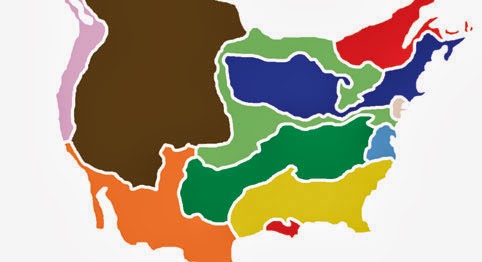
In recent decades, some scholars have been paying attention to regionalism again. The actual number they name ranges from as few as four to as many as eleven, but a few regions, and a few dynamics, are always apparent. Take New England, which always features prominently in these accounts. Most of the Puritan and Pilgrim settlers of the region hailed from the same part of (southeastern) England. This part of English North America was distinctive in any number of ways, among them the migration of whole families, their relative lack of racial and ethnic diversity and, especially, their dedication to their (dissident) religion. New Englanders were the most communitarian people on the eastern seaboard, and the most committed to their belief that people could govern themselves in the name of a greater good – which also meant they were more inclined to regulate the behavior of themselves and others. New Englanders were an expansive people; settlers to that part of the world pushed westward and occupied a series of future states across the continent, from Ohio to California. To this day, the people of this northern tier tend to share many attitudes, and evince a moralistic streak in their politics.

On the other side of the seaboard was the South – first Virginia, more specifically the Tidewater, in a culture that spread west and south to the Carolinas. (Some observers distinguish between Virginia and the Deep South, with the latter having more of a Caribbean orientation. Like New England, this region was marked by a shared religion, but it was the mainstream Church of England, about which settlers were generally less serious than their Northern counterparts. Here too the settlers tended to come from the same part of England (this time the southern and western coasts), but there was more racial diversity because the region relied much more on slavery than New England ever did. Both southerners and New Englanders prized their freedom, a goal that played an important role in their migration. But the former tended to think about it in positive terms – freedom to, as in freedom to worship as they pleased (with more of an emphasis on the collective pronoun). The latter tended to think about freedom in negative terms – freedom from, which among other things meant not having to conform to rules of the kind New Englanders were apt to make. Many New Englanders came to see slavery as the opposite of freedom, and took active steps to end it; many Southerners came to view slavery as the very essence of what freedom was: the right to acquire property, including human property, without interference.

In between these people – actually, more like behind these people, in terms of when they came, where they settled, and their relative status in American life – is a regional segment known by a variety of names, among them the Scotch-Irish, Borderlanders, or Appalachians, each of which that provides some indication of their identities. These people tended to come from the northern periphery of Great Britain and Ireland, but these Irish were Protestant (mostly Presbyterian) colonists from England’s conquests of Ireland during the age of Queen Elizabeth. They were, on the whole, poorer than other British migrants, one reason they tended to settle on the western periphery of the colonies, in hilly or mountainous terrain. They were also fiercely clannish in their family organization, devoted to their religion (especially the Baptist and Methodist sects that flowered in the early 19th century) and hostile to outsiders. Depending on the circumstances, this hostility was focused on Yankee-minded social reformers, who they regarded as control freaks, or Southern aristocrats, who they regarded as tyrants. Borderlands people, who became a large presence in a series of states from Pennsylvania to Texas, never managed to politically dominate any one of them for most of the eighteenth and nineteenth centuries, though they formed a powerful presence in national politics. (They put Andrew Jackson in the White House much to the horror of old-line Yankees and Tidewater aristocrats.) They split during the Civil War, some joining the Confederacy, others choosing to secede from the secessionists, as West Virginia did in breaking from Virginia in 1863. But these days such people tend to cast their lots with Southern bloc, whether they happen to live in northern Georgia, eastern Tennessee or most of Oklahoma.

The other major piece of the puzzle between New England and the South is the region that includes New York, New Jersey, and Pennsylvania, known collectively as the Mid-Atlantic region. Sometimes this is parsed as New York/northern Jersey and Pennsylvania/southern Jersey, with Delaware as an annex to Pennsylvania, reflecting the fact that metropolitan New York (originally New Amsterdam) was originally Dutch and Pennsylvania was English. The key point for our purposes is that this whole stretch of territory has always been highly diverse in just about every way we’ve been talking about – religious, racial, ethnic and political. When the English seized New Amsterdam without a shot in 1664 they kept its basic institutions intact, which is to say they respected its diversity Pennsylvania began as a haven for the far-out religious English Quakers, but the colony was quickly overrun with borderland settlers and immigrants from Central Europe. Pluralistic, commercial, and with a strong pacifist streak in Quaker Pennsylvania in particular that translated to skepticism about any kind of crusade, a Midlander ethos spread west from central Ohio into southeastern Colorado. Many of the states where such people are dominant, among them Missouri, are fiercely contested by their state political parties and are often up for grabs during presidential elections.

As is its wont, North American regionalism spills beyond U.S. national borders. The cultural remnants of New France are alive and well in Quebec, which features a French-speaking majority and a cultural sensibility at marked contrast with the rest of Canada (whose maritime provinces, like Nova Scotia, have a strong Yankee accent). The southwestern states of the United States – among them California, Arizona, New Mexico and Texas – retain strong elements of their Spanish and Mexican heritage. Indeed, some observers believe the residents of “El Norte” on either side of the Rio Grande have more in common with each other than their respective national citizenship; in this regard the fence the U.S. has been building is more like a Berlin Wall dividing a country rather wall dividing two nations.

I realize it’s possible to make too much of all of this. Besides, some of the nationalizing forces I’ve already mentioned, like the mass media, there are factors at work in U.S. life that are shaping the nation’s life and future at least as much as regionalism is. Immigration, for instance. It’s important to keep in mind, however, that the center of gravity for immigration has generally been centered in the Mid-Atlantic and its Borderland successors extending into the Midwest. There are two important exceptions to this rule. The first is New England, which first lost its ethnic uniformity almost 200 years ago when the Irish started swarming in, followed by Italians, Jews, and now Asians and Latinos. But New England has also shown a tremendous capacity for assimilating new arrivals to their ways, not so much in terms of things like language or expression as much as a belief in personal and collective self-improvement, something immigrants are likely to believe in anyway as a factor in their original decision to migrate.

The other exception is El Norte, where Latinos are becoming an ever-greater proportion of the population (Mexicans today are about the same proportion of the population that the Irish were in the late 19th century.) But this is less a new development than a reversion to the ethnic mean. Latino immigrants like to say that they didn’t cross the border; the border crossed them. Now it’s crossing back. What may be a more advanced stage of this process is underway in the northern Canadian province of Nunavut, where indigenous peoples broke away from the province of the Northwest Territories and are reasserting their control over the land for the first time in 500 years.

Next: Concluding remarks

Monday, September 16, 2013

Place in Time (Part I)


The following is the first of a series of post on regionalism in U.S. history.

Maps, like movies, tell such wonderfully true lies. That’s “true lies” in the sense of certifiable falsehood as opposed to a half-truth or statement that can’t be proven, like “drinking alcohol will kill you,” (yes, under some circumstances) or “Michael Jordan is the best basketball player to ever play the game” (what’s the definition of “best,” and how do you measure it?) The assertion that there were weapons of mass destruction in Iraq on the eve of the U.S. invasion of 2003: that’s truly a lie, one uttered repeatedly by officials in the Bush administration to mislead the American people to support a war against Iraq.

“True lies” can also refer to statements that are not factually correct but reveal a larger truth.  It is untrue – a true falsehood, as it were – to say that the character of Ilsa Lund ever utters the words “Play it again, Sam” to the piano player in the classic 1942 movie Casablanca, even though generations of film lovers have associated the line with the movie. But this fictive line, which refers to a song called “As Time Goes By,” that Ilsa really does want Sam to play, is the only real way – which is to say a way rooted in history – that she can express her now-secret attachment to Rick Blaine. At the end of that movie, Blaine will lie to Ilsa’s husband Victor Laszlo about his relationship with her as an act of kindness and as a way of honoring his true self. (If you don’t know what I mean you must see this movie!) In the world of Casablanca, which in some respects remains the world in which we live, facts don’t get in the way of truth, and on those occasions when they threaten it, as when a gambler asks Karl, an employee at Rick’s café, if its casino is honest, Karl answers by saying “as honest as the day is long.” That, truly, is a non-lie.

Maps are never as clever as Hollywood movies, however. They can’t afford to be – their existence is premised on an unwritten assertion of accuracy, of describing the boundaries of the world as it is, and no one will pay any attention to them unless they’re perceived as trustworthy. They do this often enough that we take their accuracy for granted. But maps also conceal, distort, and omit all kinds of things – in a way, that’s the essence of what a map is, i.e. a simplification of the world that helps people get their bearings. And yet even the most scrupulous maps get dated, even falsified, as facts on the ground change.

The maps that I’ve tended to find the most fascinating are political maps – maps that mark the boundaries cities, regions, and states. These of course are lies in some sense because in real life such boundaries are almost always invisible, at best marked by posted signs that signal you’re crossing lines you wouldn’t otherwise know exist. No flora or fauna change when you move between New York City and Westchester County, for example. Even when maps denote actual physical features on a landscape, it’s hard to say with any certainty where they begin and end.  What spot marks the rise of the Andes Mountains? The beginning of the Sahara Desert? Where is the mouth of the Nile River? (If you assume there are actually answers to these questions – there are more than one, depending on which direction from which you approach them – they’re subject to changes in climate and topography.) At best, maps are approximations, like so much else in our daily lives.

The other kind of maps I’ve tended intriguing are – surprise, surprise – historical ones, especially those that depict dramatic shifts in boundaries, like battlefield maps or those that mark the rise and fall of empires. Such maps are masterpieces of compression. Even those that illustrate changes that take place over a relatively short period of time (like, say, the conquests of Alexander the Great between 334 and 323 BC) convey years of action into a glance that can be absorbed in seconds. And yet, paradoxically, a small shape on a few inches of paper can capture the conquest of a vast continent or more.

Such maps have a way of leading me to suspend my usual ideological or political beliefs. I don’t really believe it would have been good for Europe as a whole for Napoleon to retain the territory his armies overran in the first dozen years of the nineteenth century, but I find myself oddly rooting for him when looking at maps that reconstruct his surge into Russia in 1812. More bizarre – and troubling – is the way I marvel over the comparable terrain engulfed by the German army in World War II. It doesn’t take long for even a novice map reader to appreciate how hard it is for any military force to dominate a continental stretch on the face of the earth, and to feel a thrill at the scale of conquest by a Genghis Khan or Tamerlane. Are these maps revealing lies I tell myself about who I really am and where my loyalties are? I wouldn’t think so. But maybe I am a little imperialist at heart.

In the space of a simple diagram, maps seem capture the fates of millions. But again, such pictures can be misleading at best. How accurate is it, really, is it to designate this or that sliver of central Asia as part of the Mongolian empire, given the vast distances, limited communication, and the avowedly hands-off approach of Mongolian civil administration that was one of the keys to its success? Were there any challenges, implicit or explicit, to such authority? Can it tell us anything meaningful about the lives of the people who lived in a fragment that’s shaded this way or that? Who makes these maps, anyway? And by whose authority have they ended up in our hands?

  These questions become more pressing when we get closer to home – if we pause to think about them. Which, often, we don’t. There are so many maps in our lives that we take for granted. Those of our hometowns, for example. Or our home states. And those of the United States. None of the boundaries in these maps are arbitrary. Sometimes they’re geographic, in the sense that a river, coast, or mountain range determines them. Kansas, for example, would be a neat rectangle, except that it gets nicked in the corner by the Missouri River, which determines is northeastern boundary. But the significance of that river in the shaping of Kansas was a decision that somebody made – there are plenty of rivers that run right through the middle of cities, for example – after a battle or some kind of meeting (or a meeting that was some kind of battle). We may not know or care about those meetings or battles, which as likely as not took long ago. But they nevertheless determine the taxes we pay, the kind of commute we have to work or school, or why we live in one place and not another. 

Next: Mapping American history

Friday, November 19, 2010

Integration in shades of gray


James C. Cobb depicts a Dixie as American as . . . Lynyrd Skynyrd

The following review was posted earlier this week on the Books page of the History News Network site. 

Is the South -- still -- a place apart? Thirty years ago, in Place Over Time, Carl Degler argued for the persistence of a distinctive regional identity notwithstanding the successive waves of modernity that followed the "New South" of the post-Civil War era. Earlier in this decade, in Still Fighting the Civil War, David Goldfield argued that many Southerners insisted on seeing themselves as apart from the of the Union. Meanwhile, an array of scholars from Bruce Schulman to Michael Lind see recent American history as essentially a process of Southernization. In this ably written synthetic account of the region, veteran University of Georgia professor James C. Cobb shows how all these views can be seen as credible in a narrative trajectory that moves from that of a backward, isolated region to an assertive national presence. But for Cobb, the region and the nation have always been deeply intertwined.

The first half of The South and America moves at a brisk pace, describing the quickening effect of the Second World War on the region, the dawn of the Civil Rights movement, and the emergence of a steady -- and increasingly sophisticated -- strategy of resistance to it. We meet a familiar gallery of characters, from Gunnar Myrdal to Emmett Till, and a political spectrum that runs from the daring novels of Lilian Smith to the whites who said of their returning veterans, "Our heroes didn't die in Europe to give Negroes the right to marry our wives." (Those Negroes, for their part, had their own ideas about what they were fighting for.)

Cobb pays particular attention to the economic dimensions of the Civil Rights movement and its aftermath. He notes that the business community was anxious lest segregationist intransigence interfere with commerce, and that this concern played a factor in the willingness of many whites to accept, though not embrace, what was ultimately seen as an inevitable move toward racial integration.  It did not take long, however, for corporate leaders to conclude that the new status quo was not only acceptable, but necessary for the maintenance of a low-wage, low-regulation economic climate. A full-throated liberal, Cobb is insistent -- and convincing -- in tracing a persistent double standard on the part of white Southerners, who disproportionately benefit from federal spending while remaining reluctant to tax themselves, and warning about the corrosive effects of welfare for the poor while distributing lots of pork to the rich.  This hypocrisy is not unique to the South, but notably widespread there.

The second half of The South and America takes more a thematic approach, covering cultural, gender, and racial history. What this part of the book lacks in cohesion it makes up for in useful segmentation. It is also notably up to date, covering topics like controversies over the Confederate flag, gay rights, and the growing Latino presence in the region. Cobb occasionally betrays his generational roots (he's much better on pop music of the fifties than later, for example, omitting what would seem to be a necessary discussion of soul music, though OutKast does make a cameo). But there's plenty of grist for an undergraduate mill here. Cobb also shows a sharp eye for the resonant detail. It's moving for example, to learn that while supporters of the vicious segregationist U.S. Senator James O. Eastland could not raise the funds for his portrait to hang in the U.S. Capitol, the once obscure Fanny Lou Hamer is rightly lionized as one of the true heroes of American history (there's a Bronx high school named for her a few miles away from where this review has been written, where her legacy -- and the social inequality that made her labors necessary -- live on).

By this point, the discourse on the place of the South, in the broadest sense of that phrase, is vast. Indeed, Cobb has spent the better part of a lifetime mastering it. The South and America is a useful place for the neophyte to begin.