In Families and Faith: How Religion Is Passed Down Across Generations, sociologist Vern L. Bengtson traces paths of transmission -- and broken signals
The following review has been posted on the Books page of the History News Network site
One of the major findings of Robert Putnam and David Campbell's important 2011 study American Grace: How Religion Divides and Unites Us is the rise of what scholars of religion call "the nones": a rising tide of religiously unaffiliated Americans, which is now in the neighborhood of 20% of the U.S. population. (See my review here.) Such a statistic is often cited as an example of how, amid the prominence and evident power of evangelical Christians in U.S. society (who, by the way, tend to see themselves as beleaguered), the nation is becoming increasingly secular. But in Families and Faith, sociologist Vern Bengtson and collaborators Norella Putney and Susan Harris report that the picture is somewhat more complicated. To be sure, they say, there has been significant churn in religious identity since 1970. But there's also been a lot more continuity than you might think.
Families and Faith is a brief distillation of The Longitudinal Study of Generations (LSOG), a 35-year project begun by Bengtson in 1970 drawing on over 2,000 respondents in over 350 multi-generational families. The goal of the study was to analyze patterns of religious transmission, or lack thereof, across four generations. In the broadest sense, what Bengtson found is that about six in ten children kept to the religious tradition of their parents -- more for Mormons and Jews, less for Catholics and mainline Protestants.
You can interpret that as a glass that's a little more than half full or almost half-empty, depending on your predilections. But Bergston leans toward the former, for a number of reasons. One is that many of those who have not maintained faith traditions in any formal sense nevertheless profess loyalty to them and eventually return to them (the so-called prodigals). Another is that non-religious affiliation is itself significantly a matter of generational transmission. Contrary to a widespread perception that unaffiliated Americans (only a small percentage of whom are avowed atheists) typically drift away from or rebel against family traditions, about two-thirds of such people very are very often affirming active or implicit family non-practice. Perhaps most fundamentally, while the rate of transmission may not seem all that impressive, it's essentially unchanged since 1970 -- which is to say that the tremendous social transformations that have occurred since that time (e.g. race, gender, sexuality) have had little impact on the underlying rhythms of religious continuity.
An early chapter of Family and Faith discerns a distinctly generational flavor in patterns of religious conception and intensity -- Americans born in early decades of the twentieth century, for example, tend to consider religiosity and spirituality as essentially interchangeable, while those born later in the century increasingly distinguish between the two (and place greater emphasis on personal spirituality than collective religiosity). But in general, the study shows that the single most important influence on outcomes for children is the tenor of parental commitment. In general, if you want to have religious kids, you should marry someone in the same faith, actively practice that faith in a religious community, and demonstrate that faith in your everyday life. That's not surprising. Nor is it surprising that life events like divorce or family stress weaken religious ties. Or that remote or hypocritical parenting has obvious implications for whether or not children keep the faith.
But here's something that is surprising: It's fathers more than mothers who tip the balance (except among Jews for whom inheritance is matrilineal). A remote or authoritarian father is one of the surest ways to snuff out religious feeling among children. Here's something else: grandparents play a major and growing role in shaping outcomes. Though if you think about it for a moment it's easy to see why -- not only are they living longer, but they in many cases are doing a significant amount of child-rearing.
If there's one thing that's clear in Families and Faith, however, it's that there's no sure-fire formula for having your children follow your preferred path. Except, perhaps this: exhibiting an element of tolerance toward your kids, of making clear that the decision to choose the faith of their fathers is just that: a choice. Whether or not that's a typically American approach to God, it seems to be the one works best on these shores.
Wednesday, November 6, 2013
Sunday, November 3, 2013
Unfinished rhapsody
Linda Ronstadt's Simple Dreams: A Musical Memoir has too many silent notes
The following review has been posted on the Books page at the History News Network
When I was a kid in the 1970s, I always kinda liked Linda Ronstadt, even though she was a "mere" pop singer rather than a "serious" rock artist known for pop ballads like "You're No Good" and "Blue Bayou." By the 1980s, I had come to appreciate the sheer power of Ronstadt's voice, which she fused with a wonderful sense of theater and an impeccable sense of taste in her choice of material, which seemed to range across every idiom of American popular song. In the decades since, that appreciation for her work has only grown. My genuine affection for pop ingenues from Alanis Morrisette to Taylor Swift -- and respect for their songwriting talents -- notwithstanding, the sheer beauty of Ronstadt's voice is one I turn to again and again in the solitude of my car, about the only time I can seem to carve out for music in my middle-aged ears.
It was with a sense of deep disappointment, then, that I read Ronstadt's new published Simple Dreams: A Musical Memoir. Ronstadt does worse than simply give the years of her best-known work short shrift: she actively dismisses them. "I never felt that rock and roll defined me," she explains at one point in one of the rare moments she really engages with the key phase of her career in the latter half of the 1970s. "There was an unyielding attitude that came with the music that involved being confrontational, dismissive, and aggressive -- or as my mother would say, ungracious." It's not that Ronstadt is wrong in such an assessment, necessarily, or that she didn't produce work of considerable value in her recordings with the legendary arranger Nelson Riddle in albums like What's New (1983) or her wonderful collaborations with Emmylou Harris and Dolly Parton like Trio (1987). But really: does this sum up her feelings about Chuck Berry, whose version of "Back in the USA" was the cornerstone of Ronstadt's 1978 album of the same name, which prompted her friend, New York Times critic John Rockwell, to pen a classic essay for the Greil Marcus collection Stranded: Rock & Roll for a Desert Island (1982)? About Buddy Holly and her version of "That'll Be the Day"? Warren Zevon's "Poor Poor Pitiful Me" (and her more obscure, but magnificent, rendition of "Mohammed's Radio")? Ronstadt gives a chapter to her work with New York theater impresario Joseph Papp. Fair enough. But is there nothing to be said of the making of Simple Dreams and the exceptional crew of session musicians like Waddy Wachtel and Russ Kunkel who enlivened her most commercially successful work?
It's not that Rondstadt has no stories to tell. We get some fine sketches of the leading figures form the Los Angeles rock scene of the early seventies like Jackson Browne and members of the Eagles (who at one point were her backup band). We also get unexpected glimpses of less predictable personalities like Keith Richards (Ronstadt tells a funny story about getting stranded as the only sober person at a west-coast mansion with no one to take her home). And she shows real gifts as a writer. She describes the 64 year-old Atlantic Records founder Jerry Wexler -- another surprise cameo -- as speaking like "a Jewish bopper with a Jesuit education."
But she simply holds too much back. I wasn't seeking or expecting a tell-all autobiography. But really: can she reveal nothing about how she crossed paths, and began a romance with, California governor Jerry Brown? New York journalist Pete Hamill? We hear more about Ronstadt's relationship with her childhood horse than we do these people. Actually, the evocation of her Tucson youth -- in effect, the reassertion of her Latina identity -- is skillful and welcome. But as it became increasingly clear just how much Ronstadt was going to withhold, I couldn't help but a feeling growing resentment. In one sense, she of course is under no obligation to tell me anything. But when she literally makes it her business to sell her life story, I would have liked to see a more active and generous attempt to calibrate what she would choose to relate.
After finishing this book, I went to Amazon.com and bought a recent compilation of Ronstadt recordings from 1975-80. I probably should have done instead of reading this book. No hard feelings, Ms. Ronstadt. I would be worse than a fool to let this episode in our relationship linger. Thanks for the memories, even if they don't mean as much to you as they do to me.
The following review has been posted on the Books page at the History News Network
When I was a kid in the 1970s, I always kinda liked Linda Ronstadt, even though she was a "mere" pop singer rather than a "serious" rock artist known for pop ballads like "You're No Good" and "Blue Bayou." By the 1980s, I had come to appreciate the sheer power of Ronstadt's voice, which she fused with a wonderful sense of theater and an impeccable sense of taste in her choice of material, which seemed to range across every idiom of American popular song. In the decades since, that appreciation for her work has only grown. My genuine affection for pop ingenues from Alanis Morrisette to Taylor Swift -- and respect for their songwriting talents -- notwithstanding, the sheer beauty of Ronstadt's voice is one I turn to again and again in the solitude of my car, about the only time I can seem to carve out for music in my middle-aged ears.
It was with a sense of deep disappointment, then, that I read Ronstadt's new published Simple Dreams: A Musical Memoir. Ronstadt does worse than simply give the years of her best-known work short shrift: she actively dismisses them. "I never felt that rock and roll defined me," she explains at one point in one of the rare moments she really engages with the key phase of her career in the latter half of the 1970s. "There was an unyielding attitude that came with the music that involved being confrontational, dismissive, and aggressive -- or as my mother would say, ungracious." It's not that Ronstadt is wrong in such an assessment, necessarily, or that she didn't produce work of considerable value in her recordings with the legendary arranger Nelson Riddle in albums like What's New (1983) or her wonderful collaborations with Emmylou Harris and Dolly Parton like Trio (1987). But really: does this sum up her feelings about Chuck Berry, whose version of "Back in the USA" was the cornerstone of Ronstadt's 1978 album of the same name, which prompted her friend, New York Times critic John Rockwell, to pen a classic essay for the Greil Marcus collection Stranded: Rock & Roll for a Desert Island (1982)? About Buddy Holly and her version of "That'll Be the Day"? Warren Zevon's "Poor Poor Pitiful Me" (and her more obscure, but magnificent, rendition of "Mohammed's Radio")? Ronstadt gives a chapter to her work with New York theater impresario Joseph Papp. Fair enough. But is there nothing to be said of the making of Simple Dreams and the exceptional crew of session musicians like Waddy Wachtel and Russ Kunkel who enlivened her most commercially successful work?
It's not that Rondstadt has no stories to tell. We get some fine sketches of the leading figures form the Los Angeles rock scene of the early seventies like Jackson Browne and members of the Eagles (who at one point were her backup band). We also get unexpected glimpses of less predictable personalities like Keith Richards (Ronstadt tells a funny story about getting stranded as the only sober person at a west-coast mansion with no one to take her home). And she shows real gifts as a writer. She describes the 64 year-old Atlantic Records founder Jerry Wexler -- another surprise cameo -- as speaking like "a Jewish bopper with a Jesuit education."
But she simply holds too much back. I wasn't seeking or expecting a tell-all autobiography. But really: can she reveal nothing about how she crossed paths, and began a romance with, California governor Jerry Brown? New York journalist Pete Hamill? We hear more about Ronstadt's relationship with her childhood horse than we do these people. Actually, the evocation of her Tucson youth -- in effect, the reassertion of her Latina identity -- is skillful and welcome. But as it became increasingly clear just how much Ronstadt was going to withhold, I couldn't help but a feeling growing resentment. In one sense, she of course is under no obligation to tell me anything. But when she literally makes it her business to sell her life story, I would have liked to see a more active and generous attempt to calibrate what she would choose to relate.
After finishing this book, I went to Amazon.com and bought a recent compilation of Ronstadt recordings from 1975-80. I probably should have done instead of reading this book. No hard feelings, Ms. Ronstadt. I would be worse than a fool to let this episode in our relationship linger. Thanks for the memories, even if they don't mean as much to you as they do to me.
Wednesday, October 30, 2013
Continental drift
In The Lowland, Jhumpa Lahiri renders another rich family saga spanning two worlds
The following review has been posted on the Books page of the History News Network
Jhumpa Lahiri is the patron saint -- or perhaps I should say goddess -- of the Indian-American Dream. Other writers, notably Mohsin Hamid, have explored the myth of upward mobility as experienced on the Asian subcontinent as well as in North America in prose that swings scintillatingly between fable and novelistic detail. But no one has done it with the consistency -- and the abiding affection for America -- that Lahiri has. This is surely one reason her books have been so popular here; her latest, The Lowlands, is currently ensconced on the New York Times bestseller list. Lahiri is widely considered a master of the short story, as showcased in her Pulitzer-Prize winning debut, Interpreter of Maladies (1999) and Unaccustomed Earth (2008). Her first (and only previous) novel, The Namesake (2004), was made into a well-received film directed by Mira Nair. Reviews of The Lowlands have not been as good, but it's still a worthwhile read.
The Lowlands is narrated from multiple points of view, but its pivotal figure is Subhash Mitra, the eldest of two brothers born at the dawn of Indian independence in the suburbs of Calcutta. Fifteen months apart, the boys are extremely close, and the description of their childhoods in the lingering shadow of postcolonialism is rendered movingly and economically. Alas, they grow apart: Subhash's brother Udayan is drawn into radical politics, to the alarm of their parents, while Subhash directs his ambitions toward the United States, where he migrates for graduate work in science at the University of Rhode Island. When Udayan's life choices end in disaster, Subhash takes responsibility for his widow, Guari, who is pregnant with a daughter, Bela, who become the two other major voices in the story.
Lahiri makes the striking choice of rendering so much of the story from the point of view of these women, because Gauri in particular is an unsympathetic character, and the motive for her behavior, insofar as it's ever really clear, is narrated in periodic flashbacks, emerging only gradually. This doesn't become a problem until Bela reaches adulthood -- her actions curiously echo, in paler form, those of her parents -- when the narrative energy of the story seems to go slack. It picks up again at the end, when there is a memorable encounter between mother and daughter, and in a coda in which Udayan gets to say his piece.
The Lowlands does not rank among Lahiri's best work. But there are few novelists on the contemporary scene with as strong a sense of place, or as an acute feel for the emotional trajectory of a lifetime, East or West. Lahiri is well on her way to building a body of work that make her among the most important writers in the world in the twenty-first century.
The following review has been posted on the Books page of the History News Network
Jhumpa Lahiri is the patron saint -- or perhaps I should say goddess -- of the Indian-American Dream. Other writers, notably Mohsin Hamid, have explored the myth of upward mobility as experienced on the Asian subcontinent as well as in North America in prose that swings scintillatingly between fable and novelistic detail. But no one has done it with the consistency -- and the abiding affection for America -- that Lahiri has. This is surely one reason her books have been so popular here; her latest, The Lowlands, is currently ensconced on the New York Times bestseller list. Lahiri is widely considered a master of the short story, as showcased in her Pulitzer-Prize winning debut, Interpreter of Maladies (1999) and Unaccustomed Earth (2008). Her first (and only previous) novel, The Namesake (2004), was made into a well-received film directed by Mira Nair. Reviews of The Lowlands have not been as good, but it's still a worthwhile read.
The Lowlands is narrated from multiple points of view, but its pivotal figure is Subhash Mitra, the eldest of two brothers born at the dawn of Indian independence in the suburbs of Calcutta. Fifteen months apart, the boys are extremely close, and the description of their childhoods in the lingering shadow of postcolonialism is rendered movingly and economically. Alas, they grow apart: Subhash's brother Udayan is drawn into radical politics, to the alarm of their parents, while Subhash directs his ambitions toward the United States, where he migrates for graduate work in science at the University of Rhode Island. When Udayan's life choices end in disaster, Subhash takes responsibility for his widow, Guari, who is pregnant with a daughter, Bela, who become the two other major voices in the story.
Lahiri makes the striking choice of rendering so much of the story from the point of view of these women, because Gauri in particular is an unsympathetic character, and the motive for her behavior, insofar as it's ever really clear, is narrated in periodic flashbacks, emerging only gradually. This doesn't become a problem until Bela reaches adulthood -- her actions curiously echo, in paler form, those of her parents -- when the narrative energy of the story seems to go slack. It picks up again at the end, when there is a memorable encounter between mother and daughter, and in a coda in which Udayan gets to say his piece.
The Lowlands does not rank among Lahiri's best work. But there are few novelists on the contemporary scene with as strong a sense of place, or as an acute feel for the emotional trajectory of a lifetime, East or West. Lahiri is well on her way to building a body of work that make her among the most important writers in the world in the twenty-first century.
Wednesday, October 23, 2013
Worldly lessons
In The Smartest Kids in the World and How They Got That Way, journalist Amanda Ripley offers a message of hope rooted in experience
The following review has been posted on the Books page at the History News Network
History is not destiny: this is the message of journalist Amanda Ripley in her foray into secondary education. We all know that the United States has been struggling comparatively in international rankings of academic performance as measured by standardized tests -- and has been for some time. Most of us are also aware that the reigning educational superpowers are Finland and South Korea. We tend to assume the reasons for a nation's place in the academic world are relatively static: material prosperity, cultural values, ethnic homogeneity (or lack thereof). But, Ripley argues, global performance has in fact been quite fluid. South Korea and Finland were educational backwaters until relatively recently -- as was Poland until even more recently. But, showing more confidence in the efficacy of government than Americans have been able to do, each of these nations has taken proactive steps that have made a difference (even as other nations, among them Italy and Norway, have slipped, for some of the same reasons the U.S. has lagged).
Ripley rests her case on two foundations. The first is empirical: her standard of measurement is the Program for International Assessment Exam (PISA), a standardized test developed at the turn of this century by the Organization for Economic Co-operation and Development, an NGO based in Paris. Though PISA is subject to the same skepticism and limits of many standardized tests, it is more analytical and real-world based than most, particularly those administered in the United States. But the bulk of Ripley's analysis is anecdotal: she follows three American students as they journey to rural Finland, urban South Korea, and western Poland, contextualizing accounts of their experiences with thick descriptions of the political, social, and cultural milieu in each.
As one might expect, the portraits that emerge from each of these places is starkly different. South Korean students are subject to a brutal academic grind in which most of their learning takes place under the auspices of private tutors who drill their charges late into the evening. (The government actually launches police raids to enforce a recently implemented curfew on study.) Polish students learn amid the shadows of the Nazi and Soviet past, which linger in ugly buildings and material deprivation. Finnish students, by contrast, learn under much sunnier conditions -- but that's a decidedly metaphorical statement (the American student there, who hails from Oklahoma, struggles with depression, some of which stems from the cold, dark climate). Residents of these countries find things to complain about -- perhaps a source of solace for anxious Americans -- but all have seen demonstrable success in their striving, not simply in the realm of test scores, but also in their economic fortunes.
Most important for Ripley is that for all their differences, these countries are alike in one important particular: "everyone -- kids, parents, and teachers -- [sees] getting an education as a serious quest, more important than sports or self-esteem." (Ripley's "The Case Against High School Sports" is the cover story in the current issue of the Atlantic.) American education reformers, she says, think they can improve education by improving teacher quality. But they get the equation wrong: rather than help teachers get better, they should focus on getting better teachers in the first place, and the way to do that is to make teaching a prestigious profession in which only the most qualified candidates may get in the classroom. She illustrates the point that it's all too easy to become a teacher in the United States with a story of a man who wants to become a football coach and so trains to become a math teacher. And she devotes a chapter to a Korean tutor who earns $4 million annually -- enough to beguile a college student out of a career in investment banking.
Along the way, Ripley challenges a series of conventional wisdoms. Yes, money matters, but students from rich countries often do poorly, and while those from poor countries often do well. (Poland has about the same child poverty rate as the United States.) Yes, parental involvement counts, but only the right kind -- the evidence suggests that boosterism and brownie-baking actually hurts student performance, while reading to your children is a telling indicator of future success. Yes, children need encouragement and support -- roughly half of Finnish children receive some form of special education at some point in their careers -- but lowering expectations and tracking students does more harm than good. Yes, racial and ethnic diversity is a complication, but Finnish immigrants do at least as well as natives do. (This point is among the least convincing, given the relatively small proportion of Finnish immigrants, and the growing anxiety among natives about schooling their children with them.)
This is a fast, provocative read. And the book's message is optimistic -- really: we can improve. And yet as the government shutdown of 2013 makes clear, American society is suffering from a paralysis of will in the ability of the government to take decisive action in the realm of social welfare. Maybe there will come a day when the work of reform will begin again. If and when it does, Ripley's work may point the way toward progress.
The following review has been posted on the Books page at the History News Network
History is not destiny: this is the message of journalist Amanda Ripley in her foray into secondary education. We all know that the United States has been struggling comparatively in international rankings of academic performance as measured by standardized tests -- and has been for some time. Most of us are also aware that the reigning educational superpowers are Finland and South Korea. We tend to assume the reasons for a nation's place in the academic world are relatively static: material prosperity, cultural values, ethnic homogeneity (or lack thereof). But, Ripley argues, global performance has in fact been quite fluid. South Korea and Finland were educational backwaters until relatively recently -- as was Poland until even more recently. But, showing more confidence in the efficacy of government than Americans have been able to do, each of these nations has taken proactive steps that have made a difference (even as other nations, among them Italy and Norway, have slipped, for some of the same reasons the U.S. has lagged).
Ripley rests her case on two foundations. The first is empirical: her standard of measurement is the Program for International Assessment Exam (PISA), a standardized test developed at the turn of this century by the Organization for Economic Co-operation and Development, an NGO based in Paris. Though PISA is subject to the same skepticism and limits of many standardized tests, it is more analytical and real-world based than most, particularly those administered in the United States. But the bulk of Ripley's analysis is anecdotal: she follows three American students as they journey to rural Finland, urban South Korea, and western Poland, contextualizing accounts of their experiences with thick descriptions of the political, social, and cultural milieu in each.
As one might expect, the portraits that emerge from each of these places is starkly different. South Korean students are subject to a brutal academic grind in which most of their learning takes place under the auspices of private tutors who drill their charges late into the evening. (The government actually launches police raids to enforce a recently implemented curfew on study.) Polish students learn amid the shadows of the Nazi and Soviet past, which linger in ugly buildings and material deprivation. Finnish students, by contrast, learn under much sunnier conditions -- but that's a decidedly metaphorical statement (the American student there, who hails from Oklahoma, struggles with depression, some of which stems from the cold, dark climate). Residents of these countries find things to complain about -- perhaps a source of solace for anxious Americans -- but all have seen demonstrable success in their striving, not simply in the realm of test scores, but also in their economic fortunes.
Most important for Ripley is that for all their differences, these countries are alike in one important particular: "everyone -- kids, parents, and teachers -- [sees] getting an education as a serious quest, more important than sports or self-esteem." (Ripley's "The Case Against High School Sports" is the cover story in the current issue of the Atlantic.) American education reformers, she says, think they can improve education by improving teacher quality. But they get the equation wrong: rather than help teachers get better, they should focus on getting better teachers in the first place, and the way to do that is to make teaching a prestigious profession in which only the most qualified candidates may get in the classroom. She illustrates the point that it's all too easy to become a teacher in the United States with a story of a man who wants to become a football coach and so trains to become a math teacher. And she devotes a chapter to a Korean tutor who earns $4 million annually -- enough to beguile a college student out of a career in investment banking.
Along the way, Ripley challenges a series of conventional wisdoms. Yes, money matters, but students from rich countries often do poorly, and while those from poor countries often do well. (Poland has about the same child poverty rate as the United States.) Yes, parental involvement counts, but only the right kind -- the evidence suggests that boosterism and brownie-baking actually hurts student performance, while reading to your children is a telling indicator of future success. Yes, children need encouragement and support -- roughly half of Finnish children receive some form of special education at some point in their careers -- but lowering expectations and tracking students does more harm than good. Yes, racial and ethnic diversity is a complication, but Finnish immigrants do at least as well as natives do. (This point is among the least convincing, given the relatively small proportion of Finnish immigrants, and the growing anxiety among natives about schooling their children with them.)
This is a fast, provocative read. And the book's message is optimistic -- really: we can improve. And yet as the government shutdown of 2013 makes clear, American society is suffering from a paralysis of will in the ability of the government to take decisive action in the realm of social welfare. Maybe there will come a day when the work of reform will begin again. If and when it does, Ripley's work may point the way toward progress.
Friday, October 18, 2013
Ulysses's Sister
In Someone, Alice McDermott (once again) resurrects the soul of the Irish diaspora
The following review has been posted on the Books page at the History News Network.
Not much happens in Alice McDermott's fiction. We usually have a woman -- her age narrated fluidly, though not chronologically, à la Toni Morrison -- at weddings, wakes, and conversing at Sunday afternoon tables with coffee and danish. Character unspools slowly, its outlines often unfamiliar to the narrator herself, whether because circumstances are murky, insight is limited, or both. But as a social historian, McDermott's prose is astonishing in its clarity, capturing working-class New York with the cinematic clarity of John Patrick Shanley or Martin Scorsese. Take this opening passage from McDermott's new novel, Someone:
Poor Pegeen. The product of what used to be called a mixed marriage, in this case an Irish woman with a Lebanese man, she will not be long for this world, her dishevelment a foreshadows a coming fall. Here as in so all McDermott novels, death hovers, an inescapable, and sometimes longed for, presence.
For over a quarter of a century now, McDermott has staked out her turf as the chronicler of the New York Irish in the twentieth century. Her books circle obsessively around the children and grandchildren of the children of Eire as they disperse across the five boroughs and (especially) Long Island, dreams of upward mobility incrementally carrying them on tides of affluence even as their memories and their Catholicism holds them fast. This sense of place crystallizes in the language, clothing, foodways, and interior decorations of these people -- from the aspiring lace-curtain Irish to their shanty skeptics -- and achieves its apotheosis in mid-century, gradually disintegrating as their suburban children assimilate, move away, and regard their begetters as incomprehensible if not laughable. This is a world I happen to know well, and reading a McDermott novel always seems to conjure up childhood memories I barely realized I had.
Someone tells the story of Marie Commeford, a thoroughly ordinary woman born who is born in Brooklyn in the 1920s and comes of age during World War II, when she works as a kind of professional mourner at a local funeral parlor. She marries a veteran and spends the remainder of the American Century in Queens, the mother of four. Marie has poor eyesight, but her sensory acuity (particularly in her sense of smell, a McDermott specialty) is extraordinary.
In an important sense however, Someone is a sibling story, focusing on the relationship Marie has with her older brother, Gabe, the apple of his parents' eyes who enters -- but soon leaves -- the priesthood. Nowadays, we're almost surprised to encounter a priest who is not obviously or likely gay, but in Marie's day such realities were unspeakable. Yet McDermott shows the attitudes of the working-class Irish were perhaps not quite as benighted as is sometimes supposed. To call them homophobic is not only anachronistic but incomplete. Fear, compassion and brutality mingle, expressed through a language of gesture more often spoken with hands than words.
In a funny way, McDermott's fiction is a bit like that of Alan Furst, he of the noirish spy novels set in Europe in the early years of World War II. Both writers are saturated in atmosphere, and their books tend to run together in your memory after you've read them. Yet both are extraordinary at evoking a particular time and place in ways that historians can only envy. In decades come, such writers will be be among the most important in helping us understand what it was really like to be alive in those middle decades of the twentieth century.
The following review has been posted on the Books page at the History News Network.
Not much happens in Alice McDermott's fiction. We usually have a woman -- her age narrated fluidly, though not chronologically, à la Toni Morrison -- at weddings, wakes, and conversing at Sunday afternoon tables with coffee and danish. Character unspools slowly, its outlines often unfamiliar to the narrator herself, whether because circumstances are murky, insight is limited, or both. But as a social historian, McDermott's prose is astonishing in its clarity, capturing working-class New York with the cinematic clarity of John Patrick Shanley or Martin Scorsese. Take this opening passage from McDermott's new novel, Someone:
Pegeen Chebab walked up from the subway in the evening light. Her good spring coat was powder blue; her shoes were black and covered the insteps of her long feet. Her hat was beige with something dark along the crown, a brown feather or two. There was a certain asymmetry to her shoulders. She had a loping, hunchbacked walk. She had, always, a bit of black hair along her cheek, straggling to her shoulder, her bun coming undone.
Poor Pegeen. The product of what used to be called a mixed marriage, in this case an Irish woman with a Lebanese man, she will not be long for this world, her dishevelment a foreshadows a coming fall. Here as in so all McDermott novels, death hovers, an inescapable, and sometimes longed for, presence.
For over a quarter of a century now, McDermott has staked out her turf as the chronicler of the New York Irish in the twentieth century. Her books circle obsessively around the children and grandchildren of the children of Eire as they disperse across the five boroughs and (especially) Long Island, dreams of upward mobility incrementally carrying them on tides of affluence even as their memories and their Catholicism holds them fast. This sense of place crystallizes in the language, clothing, foodways, and interior decorations of these people -- from the aspiring lace-curtain Irish to their shanty skeptics -- and achieves its apotheosis in mid-century, gradually disintegrating as their suburban children assimilate, move away, and regard their begetters as incomprehensible if not laughable. This is a world I happen to know well, and reading a McDermott novel always seems to conjure up childhood memories I barely realized I had.
Someone tells the story of Marie Commeford, a thoroughly ordinary woman born who is born in Brooklyn in the 1920s and comes of age during World War II, when she works as a kind of professional mourner at a local funeral parlor. She marries a veteran and spends the remainder of the American Century in Queens, the mother of four. Marie has poor eyesight, but her sensory acuity (particularly in her sense of smell, a McDermott specialty) is extraordinary.
In an important sense however, Someone is a sibling story, focusing on the relationship Marie has with her older brother, Gabe, the apple of his parents' eyes who enters -- but soon leaves -- the priesthood. Nowadays, we're almost surprised to encounter a priest who is not obviously or likely gay, but in Marie's day such realities were unspeakable. Yet McDermott shows the attitudes of the working-class Irish were perhaps not quite as benighted as is sometimes supposed. To call them homophobic is not only anachronistic but incomplete. Fear, compassion and brutality mingle, expressed through a language of gesture more often spoken with hands than words.
In a funny way, McDermott's fiction is a bit like that of Alan Furst, he of the noirish spy novels set in Europe in the early years of World War II. Both writers are saturated in atmosphere, and their books tend to run together in your memory after you've read them. Yet both are extraordinary at evoking a particular time and place in ways that historians can only envy. In decades come, such writers will be be among the most important in helping us understand what it was really like to be alive in those middle decades of the twentieth century.
Tuesday, October 15, 2013
Man kind
In Zealot: The Life and Times of Jesus of Nazareth, Reza Aslan illustrates the limits of scripture (and the limits of limits)
The following review has been posted on the Books page at the History News Network.
I'm one of those people who was prompted to read this book after I saw, live, the author's interview on FOX News where his interlocutor insinuated that Aslan, as a Muslim, had ulterior motives in writing about Christianity other than that of a historian. (The anti-intellectual subtext was as strong as the implied invitation to religious bigotry). The exchange, which went viral, launched Zealot onto the New York Times bestseller list, something unlikely to have happened without out it, notwithstanding Aslan's previous well regarded book on Islam, No God but God. So it is that FOX demonstrates its perverse market power.
In terms of the book's argument, Zealot rests on a syllogism that goes something like this:
Perhaps the most concise statement of Aslan's argument comes when he reinterprets Jesus's famous injunction in the Gospel of Matthew to "render unto Caesar what is Caesar's," which is generally regarded as a statement of accommodation to secular rule while keeping one's eye focused on the spiritual realm. Instead, Azlan's preferred translation -- "Give back to Caesar the property that belongs to Caesar, and give back to God the property that belongs to God" -- is actually a demand that the Romans return to the kingdom of Israel to the Jews. For Aslan, the "milquetoast" misreading of scripture "perfectly accommodates the perception of Jesus as a detached, celestial spirit wholly unconcerned with material matters, a curious assertion about a man who not only lived in one of the most politically charged periods in Israel's history, but who claimed to be the promised messiah sent to liberate the Jews from Roman occupation."
Aslan believes the detachment of Jesus from his immediate political context was greatly facilitated by the apostle Paul, who, despite never knowing Jesus personally, managed to wrest control of the movement away from those (notably Jesus's brother, James) who did, and who tried to keep the Judaic dimension of his life central. It was Paul who made Jesus of Nazareth Jesus Christ, Hellenizing him for a broader (and often more educated) audience. Aslan, however, clearly prefers Jesus the man, who he concludes is "every bit as compelling, charismatic and praiseworthy as Jesus the Christ. He is, in short, someone worth believing in."
This of course is not a new argument. (In an American context, I call this the Woody Guthrie school of Christianity -- Jesus as proto-communist.) But every bit as compelling? For a secular imagination, maybe. As Aslan recognizes, the miracles of Jesus are things that must be accommodated historically not because they're factual, but because they were so widely believed -- and so widely believed so early -- that they must be taken into account. For some, a Jesus stripped of spiritual dimensions may be sufficient. I don't really know how to explain to such a person why it isn't for believers in the resurrection except perhaps to suggest that such an argument would be like telling a gay person that sexual feelings are acceptable as long as you don't regard them as important.
But if Aslan isn't going to change many minds, he does provide a wealth of information in a surprisingly compact volume. The writing is limpid and is marked by a complex narrative structure (at one point I got confused about why he was telling us so much about what happened in Israel and Judah after Christ's death, but it does comport with his larger argument). His doctorate is in the sociology of religions, and he teaches creative writing at the University of California at Riverside, facts which suggest he's more of a popularizer than biblical scholar. Still, the book's utility is likely to be greater than its limits. Bless him for his labors.
The following review has been posted on the Books page at the History News Network.
I'm one of those people who was prompted to read this book after I saw, live, the author's interview on FOX News where his interlocutor insinuated that Aslan, as a Muslim, had ulterior motives in writing about Christianity other than that of a historian. (The anti-intellectual subtext was as strong as the implied invitation to religious bigotry). The exchange, which went viral, launched Zealot onto the New York Times bestseller list, something unlikely to have happened without out it, notwithstanding Aslan's previous well regarded book on Islam, No God but God. So it is that FOX demonstrates its perverse market power.
In terms of the book's argument, Zealot rests on a syllogism that goes something like this:
- Jesus of Nazareth was born into a time and place of extraordinary political instability stemming from the seething religious and social tensions in Jewish Palestine.
- After the death of Jesus, these tensions, which had periodically erupted into insurrection under Roman rule, finally provoked an overwhelming military response in 70 CE that discredited militant Judaism in the eyes of followers and outsiders alike.
- Jesus therefore had to be sanded down for mass consumption, his sharp political edges softened as part of a larger process of transforming him from a Jewish messiah to a universal savior.
Perhaps the most concise statement of Aslan's argument comes when he reinterprets Jesus's famous injunction in the Gospel of Matthew to "render unto Caesar what is Caesar's," which is generally regarded as a statement of accommodation to secular rule while keeping one's eye focused on the spiritual realm. Instead, Azlan's preferred translation -- "Give back to Caesar the property that belongs to Caesar, and give back to God the property that belongs to God" -- is actually a demand that the Romans return to the kingdom of Israel to the Jews. For Aslan, the "milquetoast" misreading of scripture "perfectly accommodates the perception of Jesus as a detached, celestial spirit wholly unconcerned with material matters, a curious assertion about a man who not only lived in one of the most politically charged periods in Israel's history, but who claimed to be the promised messiah sent to liberate the Jews from Roman occupation."
Aslan believes the detachment of Jesus from his immediate political context was greatly facilitated by the apostle Paul, who, despite never knowing Jesus personally, managed to wrest control of the movement away from those (notably Jesus's brother, James) who did, and who tried to keep the Judaic dimension of his life central. It was Paul who made Jesus of Nazareth Jesus Christ, Hellenizing him for a broader (and often more educated) audience. Aslan, however, clearly prefers Jesus the man, who he concludes is "every bit as compelling, charismatic and praiseworthy as Jesus the Christ. He is, in short, someone worth believing in."
This of course is not a new argument. (In an American context, I call this the Woody Guthrie school of Christianity -- Jesus as proto-communist.) But every bit as compelling? For a secular imagination, maybe. As Aslan recognizes, the miracles of Jesus are things that must be accommodated historically not because they're factual, but because they were so widely believed -- and so widely believed so early -- that they must be taken into account. For some, a Jesus stripped of spiritual dimensions may be sufficient. I don't really know how to explain to such a person why it isn't for believers in the resurrection except perhaps to suggest that such an argument would be like telling a gay person that sexual feelings are acceptable as long as you don't regard them as important.
But if Aslan isn't going to change many minds, he does provide a wealth of information in a surprisingly compact volume. The writing is limpid and is marked by a complex narrative structure (at one point I got confused about why he was telling us so much about what happened in Israel and Judah after Christ's death, but it does comport with his larger argument). His doctorate is in the sociology of religions, and he teaches creative writing at the University of California at Riverside, facts which suggest he's more of a popularizer than biblical scholar. Still, the book's utility is likely to be greater than its limits. Bless him for his labors.
Saturday, October 12, 2013
Measured prose
In Nine Inches, Tom Perrotta returns to familiar terrain (amid fading light)
The following review has been posted on the Books page at the History News Network.
This summer I taught a class of largely minority students facing varying degrees of academic challenges. Seeking to give them a diet of adolescent-friendly fare for discussion and writing, I turned to figures like Chicago rapper Lupe Fiasco and the Dominican-American writer Junot Diaz, to whom I was confident they could relate. Although I was less confident about it, I also decided to use Tom Perrotta's 1994 debut collection of short stories, Bad Haircut, which traces the life of a 1970s adolescent named Buddy from middle school through his high school graduation. (The juxtaposition with Diaz, another New Jersey chronicler of the suburbs whose fiction also includes subjects like coming to terms with the homosexuality of friends, proved to be quite arresting.) I'm happy to say my students loved Bad Haircut.
Having followed Perrotta through a half-dozen subsequent novels -- among them the bestselling Little Children (which was made into a movie) and The Leftovers (soon to be an HBO series) -- I was pleased to learn that his new book, Nine Inches, would be his second story collection. Unlike Bad Haircut, which followed a single character, these stories, many set in the fictional town of Gifford, (presumably not far from the imaginary Cranwood of Bad Haircut), depict a range of people, from high school students to senior citizens, policemen to doctors, solid citizens to small-time criminals. It's inevitable, then, that this collection would not have quite have the narrative cohesion of the first one.
Thematically, however, Nine Inches is surprisingly tight -- and surprisingly grim. Perrotta has been called "an American Chekov" and "the Steinbeck of suburbia," but the mood of this book is closer to the early James Joyce of The Dubliners, where protagonists have negative epiphanies in which they confront limitations they'd managed to avoid recognizing they have. Those limitations include character defects, like the math teacher of "Grade My Teacher," who, in disclosing more than she should to a student, hesitates "long enough to realize she was making a mistake, then kept going" (and going). They also include recognizing dreams that will never be fulfilled, like those of the regretful, abusive father of "The Smile on Happy Chang's Face"or the amateur blues guitarists of "One-Four-Five," who know they can never compensate for the families they have lost.
This sense of despair infects even 21st century Perrotta adolescents, of whom he writes with same assured air that he does of nineties kids in Election or seventies teens in Bad Haircut (he acknowledges his late-adolescent children as the source of anecdotes that "blossomed into stories"). Perrotta was far too satirical -- and far too realistic -- to ever suggest that the intensity of Tracy Flick in Election or the passivity of Dave Raymond in The Wishbones would ever be transformed much later in their lives. Still, you could have a sense of hope for them that's harder to feel for the concussion-stricken football player of "Senior Season" or the cynical protagonist of "The Test Taker," who impersonates his fellow students on the SATs. "I honestly didn't mind cheating for strangers," he explains. "If somebody wanted to pay me to help them get into a good college, I didn't see anything wrong with that. It wasn't all that different from hiring an expensive tutor, or getting a doctor diagnose a learning disability so you could buy yourself some extra time. That was just the way the system worked." He gets his comeuppance (and strikes back in ways that may make you feel complicit in your satisfaction), just as the retired narrator of "Kiddie Pool" is repaid for trespassing in his neighbor's garage with an unwelcome discovery.
To at least some extent, the downbeat mood of Nine Inches is offset by the sheer narrative invention in some of these stories. Donald, the narrator of "Backrub," who somehow managed to not to get into one of the twelve colleges to which he applied, finds himself stopped repeatedly by a policeman, who makes an unexpected demand (to which the Donald responds in an unexpected way before making an unexpected revelation). "The Smile on Happy Chang's Face" is a particularly intricate story, weaving a father's confession and adult psychodrama through an exciting rendition of a Little League championship game. The title story, which refers to the distance eighth graders must maintain at a middle school dance, is marked by a notably graceful contrapuntal style of storytelling that is Perrotta's trademark.
Perrotta's last book, The Leftovers, was very clearly an attempt to break new creative ground by venturing into the world of science fiction -- and bending the genre in a distinctly literary direction. In that light, it's possible to see Nine Inches as a retreat onto more familiar terrain. But for my money this is a more satisfying book, because it showcases a writer on his home turf, working within a familiar framework with uncommon power.
Though he ends the book on a lighter note with a redemptive story of second chances, I'm nevertheless saddened by the receding sense of possibility that seems to mark Perrotta's vision. Or maybe like the characters of these stories, I too am belatedly waking up to the reality he's been describing all along. The historical context for Nine Inches is worth noting: demographers are telling us that the suburbs are less attractive than they used to be for young people, who are returning to cities in numbers that have not been seen in close to a century. (One of the more memorable stories of Bad Haircut was "You Learn to Live," about the great adolescent ritual of learning to drive, which teenagers are doing less frequently now.)
I find the angst here a little curious because at least superficially, it would seem that Perrotta, himself a product of New Jersey, ripened artistically on a suburban vine. Of course it would be stupid to suggest hypocrisy -- as an artist, he has to call 'em as he sees 'em, and it's likely that a Perrotta story set in a high-rise or on a farm would also be marked by negative epiphanies. As someone who has also staked his ground in the suburbs, I can't help but hope that a future filing from the village will be more promising. But maybe that's another way I'm like the people of those stories, waiting for my train to come in.
The following review has been posted on the Books page at the History News Network.
This summer I taught a class of largely minority students facing varying degrees of academic challenges. Seeking to give them a diet of adolescent-friendly fare for discussion and writing, I turned to figures like Chicago rapper Lupe Fiasco and the Dominican-American writer Junot Diaz, to whom I was confident they could relate. Although I was less confident about it, I also decided to use Tom Perrotta's 1994 debut collection of short stories, Bad Haircut, which traces the life of a 1970s adolescent named Buddy from middle school through his high school graduation. (The juxtaposition with Diaz, another New Jersey chronicler of the suburbs whose fiction also includes subjects like coming to terms with the homosexuality of friends, proved to be quite arresting.) I'm happy to say my students loved Bad Haircut.
Having followed Perrotta through a half-dozen subsequent novels -- among them the bestselling Little Children (which was made into a movie) and The Leftovers (soon to be an HBO series) -- I was pleased to learn that his new book, Nine Inches, would be his second story collection. Unlike Bad Haircut, which followed a single character, these stories, many set in the fictional town of Gifford, (presumably not far from the imaginary Cranwood of Bad Haircut), depict a range of people, from high school students to senior citizens, policemen to doctors, solid citizens to small-time criminals. It's inevitable, then, that this collection would not have quite have the narrative cohesion of the first one.
Thematically, however, Nine Inches is surprisingly tight -- and surprisingly grim. Perrotta has been called "an American Chekov" and "the Steinbeck of suburbia," but the mood of this book is closer to the early James Joyce of The Dubliners, where protagonists have negative epiphanies in which they confront limitations they'd managed to avoid recognizing they have. Those limitations include character defects, like the math teacher of "Grade My Teacher," who, in disclosing more than she should to a student, hesitates "long enough to realize she was making a mistake, then kept going" (and going). They also include recognizing dreams that will never be fulfilled, like those of the regretful, abusive father of "The Smile on Happy Chang's Face"or the amateur blues guitarists of "One-Four-Five," who know they can never compensate for the families they have lost.
This sense of despair infects even 21st century Perrotta adolescents, of whom he writes with same assured air that he does of nineties kids in Election or seventies teens in Bad Haircut (he acknowledges his late-adolescent children as the source of anecdotes that "blossomed into stories"). Perrotta was far too satirical -- and far too realistic -- to ever suggest that the intensity of Tracy Flick in Election or the passivity of Dave Raymond in The Wishbones would ever be transformed much later in their lives. Still, you could have a sense of hope for them that's harder to feel for the concussion-stricken football player of "Senior Season" or the cynical protagonist of "The Test Taker," who impersonates his fellow students on the SATs. "I honestly didn't mind cheating for strangers," he explains. "If somebody wanted to pay me to help them get into a good college, I didn't see anything wrong with that. It wasn't all that different from hiring an expensive tutor, or getting a doctor diagnose a learning disability so you could buy yourself some extra time. That was just the way the system worked." He gets his comeuppance (and strikes back in ways that may make you feel complicit in your satisfaction), just as the retired narrator of "Kiddie Pool" is repaid for trespassing in his neighbor's garage with an unwelcome discovery.
To at least some extent, the downbeat mood of Nine Inches is offset by the sheer narrative invention in some of these stories. Donald, the narrator of "Backrub," who somehow managed to not to get into one of the twelve colleges to which he applied, finds himself stopped repeatedly by a policeman, who makes an unexpected demand (to which the Donald responds in an unexpected way before making an unexpected revelation). "The Smile on Happy Chang's Face" is a particularly intricate story, weaving a father's confession and adult psychodrama through an exciting rendition of a Little League championship game. The title story, which refers to the distance eighth graders must maintain at a middle school dance, is marked by a notably graceful contrapuntal style of storytelling that is Perrotta's trademark.
Perrotta's last book, The Leftovers, was very clearly an attempt to break new creative ground by venturing into the world of science fiction -- and bending the genre in a distinctly literary direction. In that light, it's possible to see Nine Inches as a retreat onto more familiar terrain. But for my money this is a more satisfying book, because it showcases a writer on his home turf, working within a familiar framework with uncommon power.
Though he ends the book on a lighter note with a redemptive story of second chances, I'm nevertheless saddened by the receding sense of possibility that seems to mark Perrotta's vision. Or maybe like the characters of these stories, I too am belatedly waking up to the reality he's been describing all along. The historical context for Nine Inches is worth noting: demographers are telling us that the suburbs are less attractive than they used to be for young people, who are returning to cities in numbers that have not been seen in close to a century. (One of the more memorable stories of Bad Haircut was "You Learn to Live," about the great adolescent ritual of learning to drive, which teenagers are doing less frequently now.)
I find the angst here a little curious because at least superficially, it would seem that Perrotta, himself a product of New Jersey, ripened artistically on a suburban vine. Of course it would be stupid to suggest hypocrisy -- as an artist, he has to call 'em as he sees 'em, and it's likely that a Perrotta story set in a high-rise or on a farm would also be marked by negative epiphanies. As someone who has also staked his ground in the suburbs, I can't help but hope that a future filing from the village will be more promising. But maybe that's another way I'm like the people of those stories, waiting for my train to come in.
Monday, October 7, 2013
A Place in Time (VI--final)
This is the final installment of a series of posts on regionalism in U.S. history. (Previous posts below.)What does all this talk of regional identity mean for you? That of course depends at least a bit on who “you” are, i.e. where you’re coming from in some literal or figurative way. (I, for my part, am the grandson of an Italian immigrant whose extended family, much of it Irish, is almost exclusively Mid-Atlantic by birth. But by marriage, education, and temperament, I am decidedly a Yankee in cultural affiliation.) Insofar as these regional themes I’m talking about have any reality, they include plenty of exceptions. You can find Chinese food in Tulsa (maybe not good Chinese food), and hear good bluegrass music in Manhattan (maybe not real bluegrass). Even overwhelmingly Republican Texas has Democratic pockets – which may soon become more than pockets as the racial complexion of the state changes. There are plenty of reasons, and ways, the nation-state will hold. Like our motto says, e pluribus unum (“out of many, one”).
On the other hand, there’s no reason to think the borders of the United States will remain permanent. Considered solely as a matter of topography, there’s nothing particularly cohesive about a stretch of continent that’s marked by large stretches of forest, plains, desert, and mountains, and which over the course of the last few thousand years has been the home of a wide variety of peoples who interacted with each other was well as lived in relative isolation. And many of our state boundaries – consider the rectangles that constitute the Dakotas, for example – are really matters of fictive convenience. Should the pressures, internal or external, become great enough, different pieces of the nation could break off or recombine in ways that are hard to foresee, but not exactly random, either.
Does that thought sadden you? At times it saddens me, though I’ll confess I find myself exasperated enough with the kinds of things I hear or see coming out of South Carolina and find myself thinking our lives would be a lot easier if we went our separate ways. I get annoyed at the way Idahoans complain about the intrusiveness of the federal government, even as they depend on it for the roads, jobs, and markets that keep it afloat. In recent years I’ve heard secessionist noise coming out of Texas, to which I feel inclined to say, “erring sisters, go in peace,” especially since I regard the circumstances by which Texas entered the Union to be highly dubious. On the other hand, I’m not sure any of the rest of the nation was much, if any, less so as a matter of moral legitimacy.
The real point of this particular conversation is less about making predictions or arguing for the value of one part of the country over the other than it is asking you to consider what you consider important about your national identity. What do you think it means to be an American? Is it a landscape, a set of habits, or a series of ideas? Are the things you value rooted more in one part of the continent than another? How bad would you feel if some part of it were to break off? And lastly, and more importantly: where – and how – do you want to live? If you’re lucky, you may have some choice in the matter. Try and exercise it wisely.
Wednesday, October 2, 2013
Place in Time (Part V)
The following post is part of series on the role of regionalism in American history. Previous posts are below.
Next: Concluding remarks
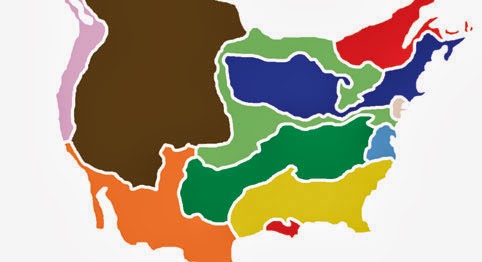
In recent decades, some scholars have been paying attention to regionalism again. The actual number they name ranges from as few as four to as many as eleven, but a few regions, and a few dynamics, are always apparent. Take New England, which always features prominently in these accounts. Most of the Puritan and Pilgrim settlers of the region hailed from the same part of (southeastern) England. This part of English North America was distinctive in any number of ways, among them the migration of whole families, their relative lack of racial and ethnic diversity and, especially, their dedication to their (dissident) religion. New Englanders were the most communitarian people on the eastern seaboard, and the most committed to their belief that people could govern themselves in the name of a greater good – which also meant they were more inclined to regulate the behavior of themselves and others. New Englanders were an expansive people; settlers to that part of the world pushed westward and occupied a series of future states across the continent, from Ohio to California. To this day, the people of this northern tier tend to share many attitudes, and evince a moralistic streak in their politics.
On the other side of the seaboard was the South – first Virginia, more specifically the Tidewater, in a culture that spread west and south to the Carolinas. (Some observers distinguish between Virginia and the Deep South, with the latter having more of a Caribbean orientation. Like New England, this region was marked by a shared religion, but it was the mainstream Church of England, about which settlers were generally less serious than their Northern counterparts. Here too the settlers tended to come from the same part of England (this time the southern and western coasts), but there was more racial diversity because the region relied much more on slavery than New England ever did. Both southerners and New Englanders prized their freedom, a goal that played an important role in their migration. But the former tended to think about it in positive terms – freedom to, as in freedom to worship as they pleased (with more of an emphasis on the collective pronoun). The latter tended to think about freedom in negative terms – freedom from, which among other things meant not having to conform to rules of the kind New Englanders were apt to make. Many New Englanders came to see slavery as the opposite of freedom, and took active steps to end it; many Southerners came to view slavery as the very essence of what freedom was: the right to acquire property, including human property, without interference.
In between these people – actually, more like behind these people, in terms of when they came, where they settled, and their relative status in American life – is a regional segment known by a variety of names, among them the Scotch-Irish, Borderlanders, or Appalachians, each of which that provides some indication of their identities. These people tended to come from the northern periphery of Great Britain and Ireland, but these Irish were Protestant (mostly Presbyterian) colonists from England’s conquests of Ireland during the age of Queen Elizabeth. They were, on the whole, poorer than other British migrants, one reason they tended to settle on the western periphery of the colonies, in hilly or mountainous terrain. They were also fiercely clannish in their family organization, devoted to their religion (especially the Baptist and Methodist sects that flowered in the early 19th century) and hostile to outsiders. Depending on the circumstances, this hostility was focused on Yankee-minded social reformers, who they regarded as control freaks, or Southern aristocrats, who they regarded as tyrants. Borderlands people, who became a large presence in a series of states from Pennsylvania to Texas, never managed to politically dominate any one of them for most of the eighteenth and nineteenth centuries, though they formed a powerful presence in national politics. (They put Andrew Jackson in the White House much to the horror of old-line Yankees and Tidewater aristocrats.) They split during the Civil War, some joining the Confederacy, others choosing to secede from the secessionists, as West Virginia did in breaking from Virginia in 1863. But these days such people tend to cast their lots with Southern bloc, whether they happen to live in northern Georgia, eastern Tennessee or most of Oklahoma.
The other major piece of the puzzle between New England and the South is the region that includes New York, New Jersey, and Pennsylvania, known collectively as the Mid-Atlantic region. Sometimes this is parsed as New York/northern Jersey and Pennsylvania/southern Jersey, with Delaware as an annex to Pennsylvania, reflecting the fact that metropolitan New York (originally New Amsterdam) was originally Dutch and Pennsylvania was English. The key point for our purposes is that this whole stretch of territory has always been highly diverse in just about every way we’ve been talking about – religious, racial, ethnic and political. When the English seized New Amsterdam without a shot in 1664 they kept its basic institutions intact, which is to say they respected its diversity Pennsylvania began as a haven for the far-out religious English Quakers, but the colony was quickly overrun with borderland settlers and immigrants from Central Europe. Pluralistic, commercial, and with a strong pacifist streak in Quaker Pennsylvania in particular that translated to skepticism about any kind of crusade, a Midlander ethos spread west from central Ohio into southeastern Colorado. Many of the states where such people are dominant, among them Missouri, are fiercely contested by their state political parties and are often up for grabs during presidential elections.
As is its wont, North American regionalism spills beyond U.S. national borders. The cultural remnants of New France are alive and well in Quebec, which features a French-speaking majority and a cultural sensibility at marked contrast with the rest of Canada (whose maritime provinces, like Nova Scotia, have a strong Yankee accent). The southwestern states of the United States – among them California, Arizona, New Mexico and Texas – retain strong elements of their Spanish and Mexican heritage. Indeed, some observers believe the residents of “El Norte” on either side of the Rio Grande have more in common with each other than their respective national citizenship; in this regard the fence the U.S. has been building is more like a Berlin Wall dividing a country rather wall dividing two nations.
I realize it’s possible to make too much of all of this. Besides, some of the nationalizing forces I’ve already mentioned, like the mass media, there are factors at work in U.S. life that are shaping the nation’s life and future at least as much as regionalism is. Immigration, for instance. It’s important to keep in mind, however, that the center of gravity for immigration has generally been centered in the Mid-Atlantic and its Borderland successors extending into the Midwest. There are two important exceptions to this rule. The first is New England, which first lost its ethnic uniformity almost 200 years ago when the Irish started swarming in, followed by Italians, Jews, and now Asians and Latinos. But New England has also shown a tremendous capacity for assimilating new arrivals to their ways, not so much in terms of things like language or expression as much as a belief in personal and collective self-improvement, something immigrants are likely to believe in anyway as a factor in their original decision to migrate.
The other exception is El Norte, where Latinos are becoming an ever-greater proportion of the population (Mexicans today are about the same proportion of the population that the Irish were in the late 19th century.) But this is less a new development than a reversion to the ethnic mean. Latino immigrants like to say that they didn’t cross the border; the border crossed them. Now it’s crossing back. What may be a more advanced stage of this process is underway in the northern Canadian province of Nunavut, where indigenous peoples broke away from the province of the Northwest Territories and are reasserting their control over the land for the first time in 500 years.
Next: Concluding remarks
Sunday, September 29, 2013
Place in Time (Part IV)
The following post is part of a series on the role of regionalism in American history. Preceding posts are below.
Next: Surveying the regions of North America
Because they’ve never been formally
codified the way the boundaries of an American state like Wyoming or Alabama
has, their number, size and shape have been contested. Some observers have made
distinctions, for example, between the Tidewater south (the lowlands along the
coast) and the Piedmont south (the hillier land leading to the Appalachian
mountains), or distinguished between the West (an area that spans from about
Colorado to California) and the Pacific Rim (a narrow strip along the coast
that encompasses San Diego and Seattle). These regions or sections are not
respecter of state or even national boundaries – Canadian Vancouver in many
ways has more in common with coastal Portland than it does the province of
British Columbia to which it belongs. Nor is demography isn’t the only
misleading thing about our state boundaries. Many of us associate Colorado with
the Rocky Mountains, for the very good reason that they are indeed a dominant
feature of its landscape. But eastern Colorado is as flat as Kansas. So is
eastern Montana. Texas has arid plains, a tropical coast, and blazing desert.
We all understand that lots of different
kinds of people – different races, different sexual orientations, different
classes, different politics – live in these places, and that in the United
States it’s relatively easy to move between them temporarily or permanently.
But we also know that there are relatively stable traits associated with them:
accents, cuisine, and local celebrations. And that they tend to vote alike in
elections. New England, for example, has pledged its allegiance to different
political parties over the course of the last two centuries. But it almost
always votes as a bloc. So does the Deep South. There are places that vary in
their allegiance – these days, we call them swing counties or states. But as
we’ll see, that’s because they’re places where regional cultures overlap (and
cross borders). So it is, for example, that southern Ohio has more in common
with Indiana than it does the rest of Ohio.
As I think we all understand, geography
is a major factor in shaping the behavior of people living in the United
States. Living in a place that doesn’t have a lot of water, for example,
reduces population density, which means the people who live in such are place
are going to be spread out and tend to believe in value, even necessity, of
self-sufficiency in their everyday lives. On the other hand, different groups
of people can impose their values on any given landscape, which can often
support more than one lifestyle. The Eastern Woodlands of North America worked
pretty well for the Algonquin peoples who inhabited them for centuries, as it
has for their Euro successors. Yes, those Euros altered those woodlands, rather
dramatically, but did the Algonquins. (Actually, much of the region has more
trees now than it did in the nineteenth century, when large tracts of which
were cleared for farming – Indians would recognize at least part of the region
more easily today than they did 150 years ago.) Human beings, for better and
worse, are always colonizing land in one way or another within limits that
nature sometimes imposes in gradual or spectacular ways. But whatever the cause
and effect, like-minded people tend to live together, reinforcing habits and
folkways, even in highly mobile societies. Sometimes this seems to transcend
geography – American cities, however far apart they may be, often have more in
common with each other than the countryside around them. But regional accents
never disappear entirely.
One of the people who realized all of
this most acutely was our friend Frederick Jackson Turner. As I mentioned,
Turner became vastly influential for a theory that emphasized the primacy of the
West in American history, depicting it the frontier a process of that seemed to
transcend place in favor of a process of democratization and development. But
toward the end of his life Turner began paying attention to what he called the
sectional dimension of American history, and the way the persistent traits of
older sections of the national state affected the development of newer ones.
Turner understood that even in his time, the forces of modernization seemed
more important than older regional patterns. Still, he said, “Improvements in
communication, such as the automobile, the telephone, the radio, and movie
pictures have diminished localism rather than sectionalism.”
Next: Surveying the regions of North America
Wednesday, September 25, 2013
Place in Time (Part III)
The following post is part of a series on the role of regionalism in U.S. history. Previous posts are below.
Next: Continuity and Change in American regions
The United States began as a group of
colonies launched by people from a series of countries – England, of course,
but also Ireland the central European region of Germany, which until 1870
lacked political or geographic continuity even as it had a cohesive regional culture. The U.S. became a nation with the
Declaration of Independence in 1776. It was formally recognized as a state in
1783, when its territorial boundaries were drawn as part of the Treaty of
Paris. We think of the “nation” part of this equation as stable, largely
because the U.S. has been a republic governed by a Constitution since 1789.
(Before that it was more a federation of states.) But even that was tenuous;
until the Civil War, people spoke of the U.S. as plural – “these United States”
– rather than singular. Many foreigners, perhaps reflecting their own
experiences, still do, referring to the U.S. as “the states.”
For a long time, the most obvious
feature of the United States was its shifting frontier boundary. Indeed, a
century ago a lot of people thought this was the most significant thing about
it. A big part of the reason why was a gifted historian by the name of
Frederick Jackson Turner, who in an 1893 delivered a speech at an American
Historical Association conference in Chicago that distilled his (and a lot of
other people’s) thinking into a single sentence: "The
existence of an area of free land, its continuous recession, and the advance of
American settlement westward, explain American development."
Here
in the 21st century, it may be hard to appreciate just how unusual
an assertion this really was. Turner, born in 1861 was a native of Wisconsin –
which is to say he was from the edge of the American world – got his doctorate
(among the first people to ever get one) at Johns Hopkins, where he was taught the
then-dominant "germ" theory, which argued that western civilization
owed its origins to the forests of Germany, out of which emerged a Teutonic
seed that brought down the Roman empire, spread across western Europe, jumped
to America, and now dominated the world. Like so much academic thought of the
time, this approach to history was modeled on science, both in its emphasis on primary
source research and its use of a biological model—more specifically a (Social)
Darwinian model—to explain historical change.
Turner embraced a process-driven
approach to History—colleagues and students remember him as an obsessive
collector of data and maps—and he too embraced scientific ideas. But when it
came to evolution, Turner was decidedly on the environmental side of the
Darwinian equation: he was fascinated not by the fixed, but rather the
adaptable. The frontier was a place that did
something to people, he said: it made them Americans. Which is to say it turned
them into something new. And that's because they had lots of room to evolve
through a renewable cycle. First would come the scouts, who explored a new
region, wrangling with the natives as necessary. They would be followed traders (think furs), and then
farmers, and tradesmen. Once an area got settled, a new wave of scouts would
push west, and the whole process would repeat in a new location. The process
continued until 1890, Turner said, by which point the frontier as Americans had
known it had disappeared. (They would have to come up with new frontiers, like
a space program.)
Over
the course the next fifty years or so, the Turner Thesis became common sense. Textbooks
at the time gave more space to western expansion than they do today, describing
the settlement of places like Tennessee and Arkansas. Even a historian like
Charles Beard, who in fact was skeptical of Turner’s ideas and had his own
about that nature of American history (one rooted in class conflict) still gave
a chapter to the rise of new states in his classic 1927 book The Rise of American Civilization. These
days, when textbooks do talk about
western expansion, they almost always mention that the addition of new states,
whose voting rules opened them up to mass participation (at least for white
men) pressured older states to follow suit.
But
in the second half of the century the Turner thesis came under increasing
attack. Some scholars questioned Turner's data, others his findings, especially
his assertions that the frontier was the engine of U.S. democracy. The most
serious challenge came from those historians, notably the modern historian Patricia
Limerick, who rejected the assumptions underlying the very idea of the frontier
and Turner’s tendency to describe land as "empty" when he really
meant it didn’t have white people on it. To Limerick, Turnerism was little more
than a racist fantasy, at one point joking that for her and like-minded
scholars the frontier had become “the f-word.”
Besides, there were other things –
immigration, industrialization, efforts for social reform in ways that ranged
from votes for women to rights for workers – that seemed more obvious in terms
of determining the real boundaries of
the United States. Whatever considerable regional or political differences
remained in the nation in the decades following the Civil War, it still seemed
to be inexorably stitching together. Nothing did a better job of this than the
World Wars, which promoted mass migration (especially black people to Northern
cities), the growth of industry in previously remote areas (like Los Angeles,
but also places like Nevada and New Mexico), and a sense of national identity
in combating the challengers like Communists or Nazis across the globe. Never
before or since was the federal – which is to say, national, or central –
government stronger.
But I want you to pay attention to that
word “federal,” which I’m actually using for the first time in this
conversation. It’s a word that has a lot of different meanings, but at the
heart of all of them is some kind of alliance or partnership among a set of
entities. In the U.S., as in many nations, there are subdivisions in the form
of provinces, or in our case, fifty states, each of which has a measure of
political autonomy. Those states, in turn, are subdivided into counties,
cities, villages.
But there is another kind of geographic
unit in the United States that doesn’t often make it onto maps, even though it
might help explain ourselves to ourselves better than most maps do. This unit
is closer to the concept of country than it is nation or state, because it
reflects a set of attitudes and practices of large sets of people independent
of whatever political system happens to be in place, or wherever state or
municipal boundaries that happen to be drawn. Unlike some places where
country/nation/state may once have been aligned, these never managed to gain
recognition as discrete entities in North America. We know them as “regions” or
“sections,” and give them names like “New England,” “the Midwest,” and “the
South.”
Thursday, September 19, 2013
Place in Time (Part II)
The following is the second of a series of posts on regionalism in American history. (Previous post below).
Next: A sense of place -- and its contenders
If you managed to stay awake for some of
your high school U.S. history classes, you have at least a vague sense of the
country’s story as a series of maps. The only really fixed parameter on maps of
the colonial era has been the Atlantic seaboard, which provided the dominant
feature on each of the original thirteen colonies, whose westward boundaries
were, as a matter of settlement, measured in dozens of miles, and whose northern
and southern boundaries were often represented as straight lines understood to
extend indefinitely. Such maps were often more aspiration than reality, because
at the very moment they were being produced by the English, the French had their
own maps that occupied some of the same territory. And though they weren’t
published in any modern or conventional sense of the term, Indian tribes had
their own maps that also portrayed
them as occupying (or, at any rate, claiming) the same territory.
With the end of the American Revolution
and a complex series of negotiations that culminated in the Treaty of Paris in
1783, the newly created United States of America was now depicted by itself and
Europeans as a solid slab of land bounded by two bodies of water: Atlantic
Ocean in the east and the Mississippi River in the west. The boundaries of the
states themselves within that slab
(augmented by the admission of Kentucky and Vermont in 1791, followed by
Tennessee five years later) remained vague and contested in the early republic.
The government of Connecticut acknowledged the existence of New York and
Pennsylvania to its west, but claimed all territory due west of its territorial
boundaries all the way to California – a cheeky claim in all kinds of ways. One
of the few things the weak national U.S. government of the 1780s got right was
convincing such states to relinquish their claims in exchange for the national
government assuming their debts, and in passing a series of laws we have come
to know as the Northwest Ordinances. These laws, written by Thomas Jefferson,
laid down an orderly process by which new states could be created from the
unorganized pocket of the country that we typically consider the Middle West:
the five states of Ohio (1803), Indiana (1816), Illinois (1818), Michigan
(1837) and Wisconsin (1848). I find it interesting that while the maps that
created these states also effectively created the justification by which a
series of Native Americans could be shoved out of this real estate, the names
of these places reflect the language of their previous inhabitants to this day
(Michigan, for instance, is a Chippewa term that translates to “great water,”
which does a pretty good job of describing a place whose contours are defined
by a series of lakes).
But you probably regard all this as
trivia. More vivid, perhaps, are the maps you may remember seeing countless
times in your childhood that show the huge territorial gains the United States
made in the first half of the nineteenth century. You can probably visualize
the huge wedge of land – bigger than the original U.S. itself – known as the
Louisiana Purchase, which Jefferson, overriding his small government scruples,
purchased from France in 1803. You can probably also see the Mexican Cession of
1848, another huge chunk of territory acquired as a result of the Mexican War
that made the U.S. a continental power. In between, literally and figuratively,
was Texas, created as independent state by American settlers who revolted
against Mexico in 1836 and whose admission into the Union nine years later was
a cause of the Mexican War. Then there was the Oregon territory, a
split-the-difference resolution of a boundary dispute between the U.S. and
Great Britain in 1846 that gave us that states of Oregon, Washington, and
Idaho, as well as slivers of Montana and Wyoming. Florida, another purchase,
became essentially an offer a badly weakened Spanish empire couldn’t refuse in
1819 after General Andrew Jackson chased some Creek and Seminole Indians into
it. Sell it or lose it, the Spaniards were essentially told. Decades of war
against the Seminoles followed.
That pretty much fills in the map,
though the purchase of Alaska from Russia in 1867 added a big piece of North
America that isn’t contiguous with the “Lower 48” (as Alaskans like to call
it), and the annexation of Hawaii became an important naval base in the
Pacific. Other acquisitions, like Guam and Puerto Rico (wrested from Spain in
the Spanish-American War of 1898) have not been fully integrated into the
United States. But the process of nation building is now largely complete, and
largely centered on North America. The last two contiguous states to enter the
Union on the North American continent, Arizona and New Mexico, were added in
1912. Alaska and Hawaii came aboard in 1959. It’s possible that Puerto Rico
join the Union at some point – Puerto Ricans are ambivalent at the prospect –
but as likely as not the number of stars on the flag isn’t going to get any
larger.
Which may be why you probably don’t think much about what
might be termed the territorial integrity of the United States. The map hasn’t
changed any since the time your parents were born; it’s something you take for
granted. You know you live in a big country, which was, compared to most of
Europe, pretty big even in its original state (King Charles II’s 1682 grant to
William Penn for Pennsylvania was bigger than England). Indeed, as nations go,
they don’t come much bigger: the United States today is the third-largest
nation on the planet as a matter of geography, coming in behind Russia and
Canada. (It happens to be number three in population size as well, behind China
and India). Given that about half of Russia and Canada are sealed under
permafrost – at least for now –
the U.S. has more on its rivals than mere square mileage would suggest. There’s
a lot to work with between the redwood forest and the New York island.
But for all the charm in its variety –
all those places you can ski, swim, survey autumn foliage or arid mesas – the
span and diversity of the United States seems, as a matter of your national
identity, secondary at best. Instead, it’s the abstractions that matter: common
language, common law, common market. If these are not phenomenal achievements –
I believe they are, ones that other societies past and present can only envy –
they have certainly conferred tremendous benefits and indeed explain much of
the nation’s rise to international pre-eminence. They have stitched the country
together in ways that transcend any number of geographic differences. For proof
you need not consider the virtually identical burger and fries (or pizza, or
burrito) you can procure anywhere in a 3,000 mile span, but rather the rituals,
from football games to proms, you can find at just about any American high
school.
You realize that there are variations in
climate and landscape across the continent, and that they have consequences in
terms of accent and custom. But even if you’re not a big NASCAR fan, don’t
celebrate Patriots Day or eat a lot of gumbo, you know about all these things
thanks to a tightly stitched national media market and understand that they all
fall under a capacious umbrella we know as American. I’m most aware of this
when I watch a sports network like ESPN, where a scoreboard shows a dozen or
more ball games taking place simultaneously at cities around the country, or
when, coming out of a commercial break, a TV network gives us a shot of a local
landmark before returning to the stadium. Geographic diversity is charming.
But I’m here to tell you that the shape
of the United States is a little more fluid than you think, and that those maps
that form the backdrop of our lives are at least a little illusory. As
Americans, we tend to conflate the terms nation
(a political construct), state (a
geographic one) and country (a
cultural one). But Kurds, a people sharing customs, language and history
sprawled across Iraq, Turkey and other states in the Middle East, would not do
this. Iraq, a state that consists of multiple – and hostile – ethnicities and
religions, exists principally as a state because of the way the British drew
its boundaries a century ago. Britain itself is a nation that includes
Scotland, a country that in recent years has sought and received a measure of
political autonomy. Much of the misery of the world derives from the lack of
alignment between state, nation, and country.
Next: A sense of place -- and its contenders
Monday, September 16, 2013
Place in Time (Part I)
The following is the first of a series of post on regionalism in U.S. history.
Maps, like movies, tell such wonderfully
true lies. That’s “true lies” in the sense of certifiable falsehood as opposed
to a half-truth or statement that can’t be proven, like “drinking alcohol will
kill you,” (yes, under some circumstances) or “Michael Jordan is the best
basketball player to ever play the game” (what’s the definition of “best,” and
how do you measure it?) The assertion that there were weapons of mass
destruction in Iraq on the eve of the U.S. invasion of 2003: that’s truly a
lie, one uttered repeatedly by officials in the Bush administration to mislead
the American people to support a war against Iraq.
“True lies” can also refer to statements
that are not factually correct but reveal a larger truth. It is untrue – a true falsehood, as it
were – to say that the character of Ilsa Lund ever utters the words “Play it
again, Sam” to the piano player in the classic 1942 movie Casablanca, even though generations of film lovers have associated
the line with the movie. But this fictive line, which refers to a song called
“As Time Goes By,” that Ilsa really does want Sam to play, is the only real way
– which is to say a way rooted in history – that she can express her now-secret
attachment to Rick Blaine. At the end of that movie, Blaine will lie to Ilsa’s
husband Victor Laszlo about his relationship with her as an act of kindness and
as a way of honoring his true self. (If you don’t know what I mean you must see this movie!) In the world of Casablanca, which in some respects remains
the world in which we live, facts don’t get in the way of truth, and on those
occasions when they threaten it, as when a gambler asks Karl, an employee at
Rick’s café, if its casino is honest, Karl answers by saying “as honest as the
day is long.” That, truly, is a non-lie.
Maps are never as clever as Hollywood
movies, however. They can’t afford to be – their existence is premised on an
unwritten assertion of accuracy, of describing the boundaries of the world as
it is, and no one will pay any attention to them unless they’re perceived as
trustworthy. They do this often enough that we take their accuracy for granted.
But maps also conceal, distort, and omit all kinds of things – in a way, that’s
the essence of what a map is, i.e. a simplification of the world that helps
people get their bearings. And yet even the most scrupulous maps get dated,
even falsified, as facts on the ground change.
The maps that I’ve tended to find the
most fascinating are political maps – maps that mark the boundaries cities,
regions, and states. These of course are lies in some sense because in real
life such boundaries are almost always invisible, at best marked by posted
signs that signal you’re crossing lines you wouldn’t otherwise know exist. No
flora or fauna change when you move between New York City and Westchester
County, for example. Even when maps denote actual physical features on a
landscape, it’s hard to say with any certainty where they begin and end. What spot marks the rise of the Andes
Mountains? The beginning of the Sahara Desert? Where is the mouth of the Nile
River? (If you assume there are actually answers to these questions – there are
more than one, depending on which direction from which you approach them –
they’re subject to changes in climate and topography.) At best, maps are
approximations, like so much else in our daily lives.
The other kind of maps I’ve tended intriguing are – surprise, surprise – historical ones, especially those that
depict dramatic shifts in boundaries, like battlefield maps or those that mark
the rise and fall of empires. Such maps are masterpieces of compression. Even
those that illustrate changes that take place over a relatively short period of
time (like, say, the conquests of Alexander the Great between 334 and 323 BC) convey
years of action into a glance that can be absorbed in seconds. And yet,
paradoxically, a small shape on a few inches of paper can capture the conquest
of a vast continent or more.
Such maps have a way of leading me to
suspend my usual ideological or political beliefs. I don’t really believe it
would have been good for Europe as a whole for Napoleon to retain the territory
his armies overran in the first dozen years of the nineteenth century, but I
find myself oddly rooting for him when looking at maps that reconstruct his
surge into Russia in 1812. More bizarre – and troubling – is the way I marvel
over the comparable terrain engulfed by the German army in World War II. It
doesn’t take long for even a novice map reader to appreciate how hard it is for
any military force to dominate a continental stretch on the face of the earth,
and to feel a thrill at the scale of conquest by a Genghis Khan or Tamerlane.
Are these maps revealing lies I tell myself about who I really am and where my
loyalties are? I wouldn’t think so. But maybe I am a little imperialist at
heart.
In the space of a simple diagram, maps
seem capture the fates of millions. But again, such pictures can be misleading
at best. How accurate is it, really, is it to designate this or that sliver of
central Asia as part of the Mongolian empire, given the vast distances, limited
communication, and the avowedly hands-off approach of Mongolian civil
administration that was one of the keys to its success? Were there any
challenges, implicit or explicit, to such authority? Can it tell us anything
meaningful about the lives of the people who lived in a fragment that’s shaded
this way or that? Who makes these maps, anyway? And by whose authority have
they ended up in our hands?
These questions become more pressing when we get closer to home – if we
pause to think about them. Which, often, we don’t. There are so many maps in
our lives that we take for granted. Those of our hometowns, for example. Or our
home states. And those of the United States. None of the boundaries in these
maps are arbitrary. Sometimes they’re geographic, in the sense that a river,
coast, or mountain range determines them. Kansas, for example, would be a neat
rectangle, except that it gets nicked in the corner by the Missouri River, which
determines is northeastern boundary. But the significance of that river in the
shaping of Kansas was a decision that somebody made – there are plenty of
rivers that run right through the middle of cities, for example – after a
battle or some kind of meeting (or a meeting that was some kind of battle). We
may not know or care about those meetings or battles, which as likely as not
took long ago. But they nevertheless determine the taxes we pay, the kind of
commute we have to work or school, or why we live in one place and not another.
Monday, September 9, 2013
Storied analysis
In But Where is the Lamb? Imagining the Story of Abraham and Isaac, cultural historian James Goodman plumbs ancient scripture -- and modern secular faith
The following review has been posted on the Books page of the History News Network.
It's possible to describe this book in a fairly straightforward way, so I'll begin by doing that. But Where Is the Lamb? is an exegesis of nineteen verses from the Book of Genesis, a foundational piece of scripture for Jews, Christians and Muslims. James Goodman chronicles an array of interpretations these faith communities have generated with a slab of prose that's reproduced in its entirety on the cover of the book.
More specifically, Lamb (as I'll call it) is a reading of one of the most famous and perplexing stories in the canon of great world religions: God's commandment that Abraham sacrifice his beloved son Isaac, Abraham's preparations to act on this instruction, and the last-minute reprieve that gets delivered before Isaac is to be killed. Just what was God doing when he issued this injunction? Why did Abraham act on, if not execute, the order? Did Isaac understand what was happening? (The title of the book refers to the question he asks as his father prepares his sacrifice.) These are some of the questions Goodman plumbs in about 260 compact pages.
That said, the narrative arc of his study is vast, and, notwithstanding its brevity, surprisingly detailed. One can describe the first thousand or so years of interpretation as an intra-Jewish dialogue conducted against a backdrop of the rise and fall of Israel, the spread of Hellenism, and the expansion of the Roman Empire. So it is that we're introduced to the book of Jubilees, which argues that God always knew that Abraham would obey and was demonstrating this to Satan, much in the way he did with Job. The Hellenic-minded Philo, by contrast, emphasized Abraham's fidelity in a context of Greek religion, where the sacrifice of one's children was relatively common. (There's an intriguing anthropological subtext in the Lamb regarding the role of child sacrifice in the ancient world that might have been strengthened with a nod to places like pre-Columbian America -- it seems to have been remarkably widespread.) The Roman-era Flavius Josephus makes the tale of Abraham and Isaac one of fidelity by father and son, while Pseudo-Philo emphasizes the latter's conscious sacrifice, a model for Jewish martyrdom around the time of the destruction of the Second Temple in 70 CE.
The arrival of Christianity shifted the terms of the conversation about Abraham and Isaac. As was done with the Old Testament generally, the story became -- as far as Goodman is concerned, it was reduced to -- a set of typologies. Abraham's would-be sacrifice of his son prefigures God's actual sacrifice of his own son, Jesus. Abraham's wife/Isaac's mother Sarah, who was certainly a figure of some scrutiny earlier, gets foregrounded as a Mary figure. Such readings of the story prompted responses, some critical, others accommodating, within mainstream Judaism, though of course isolating the strands of Jewish tradition was a complicated matter in the early centuries of the Christian era.
The Muslim tradition introduced another wrinkle into the story by substituting Ishmael -- Abraham's illegitimate son by Hagar -- as the son to be sacrificed, though this was not a feature of all Islamic readings. Perhaps the simplest way of distinguishing the core differences in the three Abrahamic traditions would be to say that for Jews the story has been one of obedience; for Christians one of faith, and for Muslims one of submission. There is of course a considerable amount of overlap in these concepts, but Goodman teases out their nuances well enough to make clear that their implications really do cut in different directions.
That said, it was not really philosophical nuances that drove the rise of anti-Semitism in the Middle Ages -- in the case of the Crusades, it was a matter of Christians finding an indispensable enemy closer to home than the Levant. Centuries of pogroms gave the Abraham/Isaac story new significance for many Jews, some of whom drew analogies between Abraham's willingness to sacrifice his son and their own willingness, literal as well as figurative, to sacrifice their children rather than to submit to Christianity by the sword. This threat of systematic destruction never disappeared, but with the arrival of the Enlightenment new interpretive directions emerged, among them a quest to trace the historical record more accurately, a literary sensibility that expanded the story's meaning beyond religious indoctrination, and more psychological readings (the analysis of Kierkegaard in particular is quite compelling). Goodman continues his interpretative tour through the Holocaust and beyond, weaving landmark figures like Elie Wiesel into it. Along the way he also incorporates non-textual renderings of the Abraham/Isaac story from Rembrandt to Bob Dylan.
Considered solely on these terms, But Where is the Lamb? is an impressive book. (It must be a source of satisfaction to Goodman that Lamb is published by Schocken Books, the imprint of great Jewish writers from Franz Kafka to Primo Levi.) As he makes clear, Goodman is not a biblical scholar by training, though he has a journalist's suppleness in his ability to distill and sequence complicated ideas. I will confess that by the end I started to feel that the book had a one-damn-thing-after-another quality: it becomes increasingly clear as one reads that the Abraham/Isaac story, like so many others in scripture, can and has been bent in any number of different and even contradictory directions. (Abraham and Isaac as a parable of feminist empowerment? Sarah, re-enter stage left -- talking.) This sense of sprawl gets intensified because Goodman does not provide a compact argument as to how he understands the story, though his (conventionally modern) opinions are reasonably clear. Yet impatience of the kind I'm describing is at least partially misplaced. Though Lamb functions as a work of popular history, that's not the only, or even primary, reason to read it.
Actually, one can better another sense of what Goodman is really up to by considering this book in the context of his others: his Pulitzer-Prize nominated 1994 study Stories of Scottsboro, and Blackout, his 2005 book on the infamous 1977 electricity outage in New York City. In these works Goodman established himself as a leading practitioner of subgenre of cultural history known as memory, a distinctively postmodern historiographic school that explores the plurality of meanings that surround a given event or text. In some ways, the study of memory is now among the most vibrant of the intellectual currents to follow in the wake of the egalitarian currents of the 1960s. While others, like the New Social History, had similarly democratic impulses, they never managed to fully resolve the contradiction between its insular, even elitist methodology, and its purported egalitarianism. Such problems continue to afflict theoretically-minded approaches to the humanities on the ideological left.
Goodman doesn't have this problem: his prose is marvelous in its clarity. Lamb is written in an informal, first-person style marked by invented dialogue, speculative fancy, and phraseology -- like "Don't let me give you the wrong impression," "Believe me when I tell you" and "Believe me when I say" -- that most professional historians abjure. He even violates what might be considered a cardinal sin of expressing self-doubt, the subject of entire chapter in a book that is executed as a series of short, concatenated essays. "You have no training or special expertise in any relevant area," he quotes his editor as saying. "You don't even have the languages you would need." Goodman's reply: "'It's worse than that,' I said to him (and ever afterward to anyone who would listen). The real problem is not that I am not qualified. It is that I know how much I don't know.'"
There's something almost showy about this confession, because Goodman clearly had enough confidence to execute the book and expect that his reader would get to this point (which comes toward the end). He gets away with it as a matter of scholarship because this is in fact a deeply researched and well-documented book. Experts in the field are likely to argue with his assertions, but I suspect it will be hard for them to avoid taking him seriously.
But I don't think establishing his bona fides as a religious commentator is where Goodman's heart is in any case. I'm going to guess that he fretted more about matters of voice and structure than he did evidence and argument. In an important sense this is less the work of a historian than it is a fictively-inflected non-fiction writer. Here I should note that Goodman holds an unusual joint appointment at Rutgers in History and Creative Writing. And that he is the editor of the journal Rethinking History, which seeks to stretch the expressive boundaries of professional scholarship.
All of which strikes me as the logical outcome of his disciplinary obsessions -- which, you might say, have resulted in a crisis of faith. When you make pluralism a (dare I say) sacred value -- a tendency that has dominated not just cultural history, but American intellectual life generally in the last half-century -- you're virtually begging for challenges to authority that are as likely to result in free market deregulation as they they are multiculturalism. If it's impossible to know what's true, you're thrown back on yourself. (Theologian G.H. Davies wrote in 1969 that the voice telling Abraham to kill Isaac came not from God but inside his own head, prompting angry fellow Baptists to withdraw the book they had commissioned from circulation.) If meanings are endlessly plastic, why should anybody pay attention to yours?
Goodman in effect goes about trying answer this question in two ways. The first is by avowedly embracing, as a lifelong Jew, the faith of his fathers (and mothers). When intellectual precepts are nothing more than a series of shifting currents, and the scientific method rests on a foundation of endless revision ("We now know ..."), the weight of tradition, religious and otherwise, becomes more appealing. As Goodman notes, ancient scripture seems vexing to us moderns because we're fixated by conflicts in the record, a fixation that can be loosely dated with the birth of modern Europe (i.e. that place and time when religious pluralism became common sense). But the writers who emended or supplemented the Torah all those centuries ago never understood themselves to be doing anything but elaborating on received truth: their confidence in the law mattered more than their quibbles or their doubts. Facts, chronology, translation: these were all beside the point. Which they remain for millions, even billions, of people, which is something that scares the hell out the secular imagination, even though it makes a kind of sense.
Clearly, such an answer can't be wholly sufficient to Goodman, either. Perhaps he believes, like the Puritans, that faith is an irresistible gift, not a choice. In any case, he's too much a creature of his own culture, and still too invested in the rituals of academic life, to surrender the longings for grace in that faith, which among other things involves the transcendence of a book that just might reach that mythic General Audience we all covet. But he has apparently concluded that the best way to get there is by not simply theorizing, but acting, on the truism that history is an art, not a (social) science. Which is the second half of his answer as to why we should listen to him, whether or not we're believers: even more than persuading us, he wants to beguile us with the alchemy of the written word. In this regard, Lamb is an imaginative experiment in history as literature. Believe this goyim when I when I tell you: this is the general direction in which the future of history lies -- and comes to life.
The following review has been posted on the Books page of the History News Network.
It's possible to describe this book in a fairly straightforward way, so I'll begin by doing that. But Where Is the Lamb? is an exegesis of nineteen verses from the Book of Genesis, a foundational piece of scripture for Jews, Christians and Muslims. James Goodman chronicles an array of interpretations these faith communities have generated with a slab of prose that's reproduced in its entirety on the cover of the book.
More specifically, Lamb (as I'll call it) is a reading of one of the most famous and perplexing stories in the canon of great world religions: God's commandment that Abraham sacrifice his beloved son Isaac, Abraham's preparations to act on this instruction, and the last-minute reprieve that gets delivered before Isaac is to be killed. Just what was God doing when he issued this injunction? Why did Abraham act on, if not execute, the order? Did Isaac understand what was happening? (The title of the book refers to the question he asks as his father prepares his sacrifice.) These are some of the questions Goodman plumbs in about 260 compact pages.
That said, the narrative arc of his study is vast, and, notwithstanding its brevity, surprisingly detailed. One can describe the first thousand or so years of interpretation as an intra-Jewish dialogue conducted against a backdrop of the rise and fall of Israel, the spread of Hellenism, and the expansion of the Roman Empire. So it is that we're introduced to the book of Jubilees, which argues that God always knew that Abraham would obey and was demonstrating this to Satan, much in the way he did with Job. The Hellenic-minded Philo, by contrast, emphasized Abraham's fidelity in a context of Greek religion, where the sacrifice of one's children was relatively common. (There's an intriguing anthropological subtext in the Lamb regarding the role of child sacrifice in the ancient world that might have been strengthened with a nod to places like pre-Columbian America -- it seems to have been remarkably widespread.) The Roman-era Flavius Josephus makes the tale of Abraham and Isaac one of fidelity by father and son, while Pseudo-Philo emphasizes the latter's conscious sacrifice, a model for Jewish martyrdom around the time of the destruction of the Second Temple in 70 CE.
The arrival of Christianity shifted the terms of the conversation about Abraham and Isaac. As was done with the Old Testament generally, the story became -- as far as Goodman is concerned, it was reduced to -- a set of typologies. Abraham's would-be sacrifice of his son prefigures God's actual sacrifice of his own son, Jesus. Abraham's wife/Isaac's mother Sarah, who was certainly a figure of some scrutiny earlier, gets foregrounded as a Mary figure. Such readings of the story prompted responses, some critical, others accommodating, within mainstream Judaism, though of course isolating the strands of Jewish tradition was a complicated matter in the early centuries of the Christian era.
The Muslim tradition introduced another wrinkle into the story by substituting Ishmael -- Abraham's illegitimate son by Hagar -- as the son to be sacrificed, though this was not a feature of all Islamic readings. Perhaps the simplest way of distinguishing the core differences in the three Abrahamic traditions would be to say that for Jews the story has been one of obedience; for Christians one of faith, and for Muslims one of submission. There is of course a considerable amount of overlap in these concepts, but Goodman teases out their nuances well enough to make clear that their implications really do cut in different directions.
That said, it was not really philosophical nuances that drove the rise of anti-Semitism in the Middle Ages -- in the case of the Crusades, it was a matter of Christians finding an indispensable enemy closer to home than the Levant. Centuries of pogroms gave the Abraham/Isaac story new significance for many Jews, some of whom drew analogies between Abraham's willingness to sacrifice his son and their own willingness, literal as well as figurative, to sacrifice their children rather than to submit to Christianity by the sword. This threat of systematic destruction never disappeared, but with the arrival of the Enlightenment new interpretive directions emerged, among them a quest to trace the historical record more accurately, a literary sensibility that expanded the story's meaning beyond religious indoctrination, and more psychological readings (the analysis of Kierkegaard in particular is quite compelling). Goodman continues his interpretative tour through the Holocaust and beyond, weaving landmark figures like Elie Wiesel into it. Along the way he also incorporates non-textual renderings of the Abraham/Isaac story from Rembrandt to Bob Dylan.
Considered solely on these terms, But Where is the Lamb? is an impressive book. (It must be a source of satisfaction to Goodman that Lamb is published by Schocken Books, the imprint of great Jewish writers from Franz Kafka to Primo Levi.) As he makes clear, Goodman is not a biblical scholar by training, though he has a journalist's suppleness in his ability to distill and sequence complicated ideas. I will confess that by the end I started to feel that the book had a one-damn-thing-after-another quality: it becomes increasingly clear as one reads that the Abraham/Isaac story, like so many others in scripture, can and has been bent in any number of different and even contradictory directions. (Abraham and Isaac as a parable of feminist empowerment? Sarah, re-enter stage left -- talking.) This sense of sprawl gets intensified because Goodman does not provide a compact argument as to how he understands the story, though his (conventionally modern) opinions are reasonably clear. Yet impatience of the kind I'm describing is at least partially misplaced. Though Lamb functions as a work of popular history, that's not the only, or even primary, reason to read it.
Actually, one can better another sense of what Goodman is really up to by considering this book in the context of his others: his Pulitzer-Prize nominated 1994 study Stories of Scottsboro, and Blackout, his 2005 book on the infamous 1977 electricity outage in New York City. In these works Goodman established himself as a leading practitioner of subgenre of cultural history known as memory, a distinctively postmodern historiographic school that explores the plurality of meanings that surround a given event or text. In some ways, the study of memory is now among the most vibrant of the intellectual currents to follow in the wake of the egalitarian currents of the 1960s. While others, like the New Social History, had similarly democratic impulses, they never managed to fully resolve the contradiction between its insular, even elitist methodology, and its purported egalitarianism. Such problems continue to afflict theoretically-minded approaches to the humanities on the ideological left.
Goodman doesn't have this problem: his prose is marvelous in its clarity. Lamb is written in an informal, first-person style marked by invented dialogue, speculative fancy, and phraseology -- like "Don't let me give you the wrong impression," "Believe me when I tell you" and "Believe me when I say" -- that most professional historians abjure. He even violates what might be considered a cardinal sin of expressing self-doubt, the subject of entire chapter in a book that is executed as a series of short, concatenated essays. "You have no training or special expertise in any relevant area," he quotes his editor as saying. "You don't even have the languages you would need." Goodman's reply: "'It's worse than that,' I said to him (and ever afterward to anyone who would listen). The real problem is not that I am not qualified. It is that I know how much I don't know.'"
There's something almost showy about this confession, because Goodman clearly had enough confidence to execute the book and expect that his reader would get to this point (which comes toward the end). He gets away with it as a matter of scholarship because this is in fact a deeply researched and well-documented book. Experts in the field are likely to argue with his assertions, but I suspect it will be hard for them to avoid taking him seriously.
But I don't think establishing his bona fides as a religious commentator is where Goodman's heart is in any case. I'm going to guess that he fretted more about matters of voice and structure than he did evidence and argument. In an important sense this is less the work of a historian than it is a fictively-inflected non-fiction writer. Here I should note that Goodman holds an unusual joint appointment at Rutgers in History and Creative Writing. And that he is the editor of the journal Rethinking History, which seeks to stretch the expressive boundaries of professional scholarship.
All of which strikes me as the logical outcome of his disciplinary obsessions -- which, you might say, have resulted in a crisis of faith. When you make pluralism a (dare I say) sacred value -- a tendency that has dominated not just cultural history, but American intellectual life generally in the last half-century -- you're virtually begging for challenges to authority that are as likely to result in free market deregulation as they they are multiculturalism. If it's impossible to know what's true, you're thrown back on yourself. (Theologian G.H. Davies wrote in 1969 that the voice telling Abraham to kill Isaac came not from God but inside his own head, prompting angry fellow Baptists to withdraw the book they had commissioned from circulation.) If meanings are endlessly plastic, why should anybody pay attention to yours?
Goodman in effect goes about trying answer this question in two ways. The first is by avowedly embracing, as a lifelong Jew, the faith of his fathers (and mothers). When intellectual precepts are nothing more than a series of shifting currents, and the scientific method rests on a foundation of endless revision ("We now know ..."), the weight of tradition, religious and otherwise, becomes more appealing. As Goodman notes, ancient scripture seems vexing to us moderns because we're fixated by conflicts in the record, a fixation that can be loosely dated with the birth of modern Europe (i.e. that place and time when religious pluralism became common sense). But the writers who emended or supplemented the Torah all those centuries ago never understood themselves to be doing anything but elaborating on received truth: their confidence in the law mattered more than their quibbles or their doubts. Facts, chronology, translation: these were all beside the point. Which they remain for millions, even billions, of people, which is something that scares the hell out the secular imagination, even though it makes a kind of sense.
Clearly, such an answer can't be wholly sufficient to Goodman, either. Perhaps he believes, like the Puritans, that faith is an irresistible gift, not a choice. In any case, he's too much a creature of his own culture, and still too invested in the rituals of academic life, to surrender the longings for grace in that faith, which among other things involves the transcendence of a book that just might reach that mythic General Audience we all covet. But he has apparently concluded that the best way to get there is by not simply theorizing, but acting, on the truism that history is an art, not a (social) science. Which is the second half of his answer as to why we should listen to him, whether or not we're believers: even more than persuading us, he wants to beguile us with the alchemy of the written word. In this regard, Lamb is an imaginative experiment in history as literature. Believe this goyim when I when I tell you: this is the general direction in which the future of history lies -- and comes to life.
Subscribe to:
Posts (Atom)