Showing posts with label Abraham Lincoln. Show all posts

Monday, December 12, 2016

King's Survey: Mr. K.'s Boyfriend


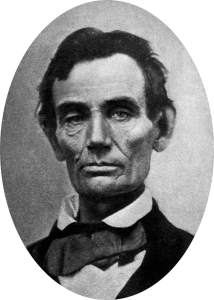
800px-Abraham_Lincoln_1858
Lincoln in 1858.

In which we see that even old people have heroes.

Emily.
—Mr. K.
The other day you referred to Abraham Lincoln as “my boyfriend.”
—I did.
Can I infer from this that you have some curiosity about our relationship?
—Hey, whatever you’re into, Mr. K. You do have a wedding ring, I see.
I do.
—But what you do on your own time is your business.
Agreed. Of course your observation about my wedding ring testifies to your powers of observation—and can be taken as an ongoing indication of your curiosity about the status of my relations with Mr. Lincoln.
—Are you married to him?
—OK, this is officially weird.
Well, making you uncomfortable is not the goal here, Sadie. What I’m really trying to do is leverage Emily’s interest for larger pedagogical purposes. That’s why I’m appointing her chief interviewer. Emily you’re going to be the Director of Information Management on Abraham Lincoln for Mr. King’s US History Class. Your fellow students are your staff members. Fire away.
—Uh. OK. This is officially weird. But whatever. First question: are you named after him?
Yes. But your job is to ask about my boyfriend, as you refer to him, not me. Though you may learn about me in the process.
—You’re named after him? That’s so cool!
You might say my father was also Abraham Lincoln’s boyfriend, Kylie.
—Let’s stop with this analogy. But was your dad a teacher too, Mr. K.?
No, Sadie. Just a passionate lover of history. But let’s keep our focus on Mr. Lincoln.
—Right. So tell us about Abraham Lincoln. He wasn’t actually born in a log cabin, was he?
Pretty much. The exact circumstances of Lincoln’s birth are unclear, but his basic circumstances are well-established: he was born poor in Kentucky. His beloved mother died when he was nine years old. His beloved sister died when he was a teenager. He didn’t get along with his father. His family moved from Kentucky to Indiana, and later to Illinois.
—What kind of kid what he?
A little strange: He liked to read. Which is surprising, since he received about a year, total, formal education. His father, among other people in his extended family, thought he was lazy. But Lincoln was lucky: his dad remarried after his mother died, and—contrary to the fairy tales—his stepmother proved to be a godsend. She loved him and supported him, prodding her husband not to be hard on his son. Lincoln only read a few books—the Bible, Shakespeare—which he knew very well.
—So what was his first job?
Well, he held odd jobs. As an adolescent, he did odd jobs for his father -- and for other people, his dad pocketing the pay -- but he left home as soon as he could, moving to the small town of New Salem, Illinois. It was there he reputedly fell in love with a woman who was engaged someone else.
–Oooh. Scandal. I love it.
But then she died, and Lincoln became severely depressed—so depressed he stayed in bed for weeks. He had such episodes a lot. Anyway, over the course of his adolescence and young adulthood he worked in a store. He worked at the post office. He made a couple trips down the Mississippi River to New Orleans to deliver goods. That’s when he was introduced to slavery (and was attacked by slaves trying to steal the stuff). Those experiences had a deep impact on him: he emerged from them with a lifelong hatred of slavery, even if, for most of his life, he considered abolitionism impractical.
—So when did he get into politics?
When he was 22 years old, Adam, he ran for the state legislature. He lost. But he got 90% of the votes in his hometown. That was the thing about Lincoln: to know him was to like him. Once, when he was new to town, a friend bragged he could beat the head of the local gang in wrestling. There was a match, and there are two versions of the story. In one, Lincoln won; in the other, he lost. But in both cases, he became lifelong friends with the members of the gang. After he ran for office the second time, he won. He served four terms. Over the course of that time he also taught himself to be a lawyer, passed the bar, and began a legal career. He married a rich woman who also dated Stephen Douglas.
–Oooh. Scandal. I love it.
Hardly, Sadie. But Mary Todd and Lincoln did have a tempestuous relationship, and there are reports of shouting matches that could be heard outside their house. She was difficult, and smart. Mary was from Kentucky, and Henry Clay had been a guest in her home and her father's business partner. Lincoln idolized Henry Clay—he loved the idea of internal improvements, the American System, the whole kit and caboodle. Which was a little hard, because he lived in Jackson country. But Lincoln did pretty well for himself. And by the mid-1840s, he was ready to run for Congress. Here was the problem: there was one district that was reliably Whig, and three guys who wanted the job. So Lincoln proposed they take turns, each supporting the other. His turn came last, and he was indeed elected. But as we discussed, he arrived in Congress for the start of the Mexican War, which he opposed. Not smart. Lincoln didn’t intend to run for re-election, but his stance cost the Whigs the seat. President Fillmore offered him the governorship of the Oregon territory, but Mary nixed that: Siberia. So Lincoln went back to Springfield and got rich. He and Mary had four sons, one of whom died there.
And that’s how things might have ended, if the Kansas-Nebraska Act hadn’t come about.
—Wait. Before you get to that.
Yes, Yin?
—I don’t really understand exactly why Lincoln was so popular. Emily calls him your boyfriend, and you say that people liked him. But I don’t really understand. Can you explain?
Well, that was the point of that wrestling story. And there’s the famous story, you’ve probably heard it, of “Honest Abe” walking miles to refund money to someone he accidentally overcharged by working at the store.
—I still don’t feel I get his personality. We’re told people from history were great and admirable, but I never feel like I understand why.
—It’s true.
I understand. Let me try this. At one point in the 1850s, when Lincoln was a successful, but provincial, lawyer, he was hired by a firm back in New York to represent a manufacturing company for a case that was being tried in Springfield. At the last minute, the case was transferred to Cincinnati. Lincoln was told that, and went there, but he didn’t understand the case would now be handled by a very prominent Cincinnati attorney named Edwin Stanton. Stanton thought Lincoln was a loser, a hick; Stanton’s colleague described Lincoln as “a tall rawly boned, ungainly back woodsman, with coarse, ill-fitting clothing.” Stanton’s crew pushed Lincoln aside during the case, never invited to meet or eat with the other attorneys. When Lincoln was paid for showing up, he returned the check until he was urged to cash it. When he got home, Lincoln described himself as “roughly handled” by Stanton, though he recognized, as many people at the time did, that Stanton was a very talented man, even if he was also a jerk.
A few years later, when Lincoln was president, he fired the corrupt and inept Secretary of War Simon Cameron (Lincoln’s boosters at the Republican Convention of 1860 foisted Cameron on him as the price of the Pennsylvania delegation’s support when he was running for president in 1860). And the man Lincoln chose as his successor? None other than Edwin Stanton, the former Democrat whom he entrusted—wisely—with substantial latitude to run the Civil War. And a few years after that, when Lincoln had been shot and was bleeding to death, it was Stanton who literally stood by him, managing the crisis while he wept. “Now he belongs to the ages,” Stanton said when Lincoln died.
—That’s a really moving story.
I’m glad to you think so, Yin. Does it get at what you’re asking?
—Yes.
There are a lot of stories like it: Lincoln making, and staying, friends with people who disagreed with him. He refused to demonize his opponents. His great rival for the presidency, William Seward, ended up as one of his closest friends. So did one of his adversaries in Congress, abolitionist Charles Sumner—Sumner had been savagely beaten on the floor of Congress after giving a provocative speech against slavery in 1856—who believed Lincoln moved too slowly in abolishing slavery. So did Frederick Douglass, who would also ultimately be an admirer. Lincoln was that kind of guy. He also had a great sense of humor. “God loves ugly people,” he once said in a context of self-deprecation. “That’s why he made so many of them.” (Walt Whitman once wrote that Lincoln was so ugly that he was beautiful.)
But here’s the thing: Lincoln was also a man of great patriotism and moral conviction, and he thought the two went together. He loved his country because he knew it had been very good to him—only in the United States, he plausibly believed, could someone like him be as successful as he’d been—and he hated slavery, not only because it was wrong, but also because it endangered the very idea of what we would call the American Dream. This may be why Lincoln seemed utterly galvanized by Stephen Douglas’s Kansas-Nebraska Act, which created the potential for slavery—something he always believed would die—to spread in the name of democracy. Lincoln’s denunciations attracted a lot of attention, and after the Whig Party fell apart and he became a Republican, there was talk of him running for Senate in 1855. But he stepped aside for the sake the party, which was seeking antislavery Democratic support by running another candidate instead. This was another act that won him admirers (and which would eventually pay off).
—So what happened next?
Lincoln remained in the public light in Illinois and around the Midwest. And when Stephen Douglas was up for re-election, Republicans coalesced around him. Everybody knew he was a long shot, which is why there was some talk of actually nominating Douglas as a Republican in the hope they could gain some concessions from him. Everybody but Lincoln, that is.
—Really?
Well, I’m exaggerating a bit. But Lincoln and Douglas went back a long way. Douglas was born in Vermont, and came to Springfield as a young man, just as Lincoln did. They were both excellent lawyers and politicians. Douglas had left Lincoln in the dust—Congressman, Senator, future president. But he knew Lincoln was good.
Lincoln also knew he was a long shot, and he played to Douglas’s vanity: he challenged him to a series of debates around Illinois. Douglas should have said no, and knew he should have said no: front-runners don’t give rivals chances to face them as equals on a stage. But Douglas couldn’t resist, and what followed was one of the truly legendary battles in American political history: the Lincoln-Douglas debates. If we had more time, we’d go into more detail. Suffice it to say that contrary to what is sometimes suggested, they weren’t exactly high-minded affairs. Lots of repetition and innuendo. Lincoln depicted Douglas as a cynic whose indifference toward slavery was dangerous, and Douglas depicted Lincoln as a raging abolitionist. Question: How are senators chosen in 1858?
—The same way they are now?
Nope. What does the Constitution say? How was it done until the Seventeenth Amendment in 1916?
—Oh c’mon, Mr. K. You don’t actually expect us to know that.
Hey, you can’t blame a guy for trying. They’re chosen by state legislatures. And how are state legislatures chosen? In part by the census. In 1858, Illinois is working off the 1850 census. And in 1850—but not by 1860—the population of Illinois is mostly in the southern part of the state. That part of the state has more weight, and so Douglas wins. Lincoln says he feels like the boy in Kentucky who stubs his toe while rushing to visit his girlfriend: it hurts too much to laugh, but he’s too old to cry.
—So how does he become president, then?
Well, Jonah, that’s a long story—a longer story than I can tell in a course like this. Suffice it to say that even though Lincoln loses, the Senate race attracts national attention. Lincoln is by no means a household name, but the people who are household names—Douglas for the Democrats, Seward for the Republicans—are too controversial to be easily elected. When the Democrats hold their convention in Charleston in 1860, the proslavery wing walks out in protest at the prospect of Douglas getting the nomination; they nominate their own candidate. The Douglas crowd reconvenes in Baltimore and nominates him there. The Republicans happen to have their convention in Lincoln’s backyard, Chicago. He and his supporters skillfully position him as everybody’s safe second choice, and that works like a charm. So now there’s Douglas, and the proslavery candidate, whose name is John Breckinridge, and Lincoln, and a fourth candidate, John Bell of Tennessee, who runs as a “constitutional unionist,” which basically means anything to avoid a war. Under such circumstances, Lincoln is a cinch to win.
Lincoln’s position is clear but firm: he won’t attack slavery where it exists, but won’t allow it to expand. All through the fall, there are indications that the proslavery crowd finds this unacceptable, that they’ll leave the Union if he gets elected. Not a lot of people believe them, though. Lincoln doesn’t either. He gets 39% of the vote: more than anyone else but hardly a majority. A few weeks later, the South Carolina legislature votes to leave the Union.
—Oh my, Mr. K.! What will your boyfriend do?

'm confident he'll do the right thing, Emily.

Next: Essaying

Wednesday, November 23, 2016

King's Survey: Damned Spot

In which we see it's one thing to know a war is wrong, and another to know what to do about it.
 Mexican_map_en_1838OK, kids, what are we going to do about this war?
—Whatever you tell us, Mr. K.
No, Jonah. That’s too much responsibility. I don’t want to carry all of it. We need to come up with a plan.
—Well, what are our options?
That’s the problem. We’re kind of in a box. I mean, we all know this war was bogus from beginning to end.
—We do?
—Of course we do, Jonah!
—How’s that?
—I don’t know. What I do know is that Mr. K. is about to set it up.
That’s right, Ethan. Let’s review the facts here. We’ve had tensions in the neutral zone between the (more northern) Nueces River and (more southern) Rio Grande in Texas. President Polk claims shots were fired—note the passive construction there, scourge of English teachers and refuge for scoundrels everyone—and asked for a declaration of war. Naturally, the Manifest Destiny crowd and their Slave Power allies rushed to judgment and war was declared about a year and a half ago. In the time since, the U.S. army has won a string of victories over the Mexicans and now occupy Mexico City. So what do we do?
—Well, you said the war was bogus, right?
Right.
—So let’s protest it.
Not an option.
—Why not?
—Because, dummy, you can’t protest a war that’s already over. And one that you’ve just won. Decisively.
—You can if that war was wrong, Adam.
—No you can’t. Like Mr. K. said, it’s not an option.
Well, it is an option for people like that idiot Henry David Thoreau. He proudly announced he wasn’t going to pay his taxes because he didn’t want to fund the Mexican War. When the world did not react with shock and indignation, he convinced his friend, the constable of Concord, Massachusetts, to throw him in jail. But that got botched too, because, much to Thoreau’s irritation, an unknown benefactor paid his bail. Thoreau. What a jerk. Loved trees, hated people.
—Why don’t you tell us what you really think, Mr. K?
—God, Em, did you read Walden in your English class? We did. It’s terrible. Worse than watching grass grow. Which, basically, is what he did.
Sorry kids. I got distracted. Really it’s an avoidance device. Adam is right: we’ve got a real problem. Unlike Thoreau, we’re politicians. So we’re supposed to have answers.
—I still don’t understand why you can’t speak out against a war that was wrong, even if you’ve won it. How do things ever get better if people don’t speak up?
That’s a really good question, Yin. I just wish I had a clue about how to answer it. Particularly now, given that President Polk has just asked Congress for millions of dollars to help bring the negotiations with the Mexican government to a close.
—Well, isn’t that a place to start? To vote against giving him the money?
—You just don’t get it, do you, Jonah? How are you going to withhold money from someone who’s just succeeded?
—Yeah, well, Adam, I don’t see you coming up with any great ideas. You’re just saying no no no. How is that helping?
I think you’re asking the right question, Jonah: How do you challenge someone who’s just succeeded? Sadie, you’ve got your hand up.
—You show the person who succeeded cheated. He broke the rules.
—But is that what happened here?
Hmmm. Promising. Actually, we don’t know what happened. But we can ask. Maybe Paolo is really onto something after all.
—Paolo?
Yes, Paolo. Anybody here gave the speech he gave on the floor of the House last week?
Nobody? Not surprising. He’s a freshman member. Nobody really pays attention. Paolo, you want to tell us what you said?
—Ummm, I don’t remember. Maybe you can remind us, Mr. K.
Sure thing, Paolo. Paolo introduced a resolution demanding to know just where the so-called spot was that shots were fired (his motion became known as the Spot Resolution). He asked President Polk to specify exactly what happened as a condition of giving him the money. Paolo figures that if Polk is forced to actually start talking, he’ll either start lying or revealing a truth he’d rather hide. Meanwhile, the Whigs, who have been scattered, can finally recover from their disarray. What do you think? Is it a good idea?
—Sounds good to me.
All right, then, fellow Whigs. Do we have a plan? Raise your hands.
Great. We’re unified.
—OK, now tell us, Mr. K. Is that what happened? Did it work?
No, not really. What happened is that the Whig Party lurched toward collapse. Southern Whigs could not really afford to come out against the war, but were outnumbered by Northern Whigs. They managed to paper over their differences for a while, principally by rallying around the presidential candidacy of General Zachary Taylor, a hero who was critical of the Polk administration. Taylor himself typified the divided soul of the Whig Party: he was a Tennessee slaveholder who also wanted to limit slavery. But he never really got the chance to work his way out of that box because he died shortly after taking office. Once he did, the Whigs fell apart entirely.
—So did that mean the Democrats ran the country?
In a way, yes. But if the Democrats didn’t actually die the way the Whigs did (gradually, I should point out, over a period of a few years), the they nevertheless came out of the war seriously divided. That’s because of a guy named David Wilmot, a member of the House from Pennsylvania. Wilmot was no abolitionist, but he hated Southern slaveholders, who he regarded as political bullies. So he made a modest proposal—it was called a “proviso,” the Wilmot Proviso—as the war broke out in 1846
—What did it say?
It said Congress should agree that whatever may come of the Mexican War (which, again, was just getting underway), the government should agree that slavery would not be allowed to go there.
—But wasn’t that the whole point of the war?
Pretty much. Not for everybody. But certainly for most of its serious supporters.
—So then why did he ask for it?
—Because he was as smartass.
Pretty much. The Wilmot Proviso had zero chance of becoming law. It was passed by the House dozens of times, largely because non-slaveholding Northern states were in favor of it, and the population of the Northern states was growing and reflected there. But it was rejected repeatedly by the Senate, where population changes didn't matter, and where powerful slaveholding Senators like John Calhoun (coming the end of his long career) had dominated for decades. What the Wilmot Proviso showed is that the Democrats were now divided along sectional lines, something that everybody had dreaded. Democrats divided, Whigs dead. Thoreau’s friend Ralph Waldo Emerson had it right when he predicted, “Mexico will poison us.” The country was headed for serious trouble.
—Yeah, but what I want to know is what happened to Paolo?
Who?
—Paolo.
Paolo? Oh, you mean that freshman congressman? I told you nobody listens to guys like that. But that wasn’t entirely accurate. The voters back home did. They hated his “spotty” speech. He was voted out in the next election. (He wasn’t actually planning on running again, but he blew what had been a safe Whig seat.) Schmuck. He went back home to Illinois. Made a few waves again about a decade later. You may have heard of him.
—What was his real name?
Abraham Lincoln.
Next: A runaway problem

Saturday, November 16, 2013

Freely Unequal (Part I)

The following is the first of a series of posts on the relationship between freedom and equality in U.S. history.

“If slavery is not wrong, nothing is wrong.             --Abraham Lincoln, April 4, 1864

We all have our heroes. Mine is Abraham Lincoln. I spend a fair amount of time asking myself, especially when I’m dealing with a knotty problem in my job, WWLD: What Would Lincoln Do? As a Christian, I also sometimes ask myself WWJD – What Would Jesus Do? – but I tend to find the Lincoln question more arresting. Jesus was divine; Lincoln was mortal. By that I mean not only that he died a tragically premature death (Jesus did that, too), but that he was a fallible human being. I’m not sure, for example, that Lincoln was all that great a husband – he was away from home for long stretches of time, and I believe the stories I’ve heard about shouting matches with his wife at the Lincoln home in Springfield Illinois, where he spent most of his adult life. Nor do I think he was all that great a father. He seems to have had a chilly relationship with his oldest son, Robert, which I suspect was not entirely Robert’s fault (though I must say I never found much to like about Robert Lincoln, who always struck me as chilliness personified). Conversely, Lincoln seems to have been indulgent, to the point of irresponsible, with his sons Tad and Willie when he was in the White House. (Willie, who got sick and died in the White House, was apparently the one who was most like his dad, and it breaks my heart every time I read Lincoln say, “I know he is better off in heaven, but then we loved him so.”) Lincoln’s relationship with his own father wasn’t that great, either. He refused to refused to go see Thomas Lincoln when he was dying, telling his cousin that he suspected the encounter would be more painful for his father than his absence would be.

And that’s just the private Lincoln. Lincoln was racist. (He said so himself: “I as much as any other man am in favor of having the superior position assigned to the white race,” he explained in the Lincoln-Douglas debates of 1858.) Lincoln misjudged the determination of southern states to secede. He pushed his generals into battle sooner than he should have at the start of the Civil War. You get the idea: the guy screwed up a few things along the way.

But, my God, Lincoln was a deeply admirable man. The clarity of his thinking – the way he was able to slice through to the heart of an issue and frame it not in a persuasive, but deeply moving way. His instinctive sense of generosity toward opponents, a refusal to believe other people were any worse than he was, even when he disagreed with them profoundly. And his sense of humor. Lincoln makes me laugh all the time – “God must love ugly people; he made so many of them”; “Better to remain silent and be thought a fool than to speak out and remove all doubt”; describing Union General Joe Hooker as having his headquarters where his hindquarters should be – the one liners and jokes are sprinkled across various accounts of his life and never fail to amuse me.

But the real reason Lincoln is so important to me is that he has decisively shaped my moral imagination. To put it more simply, he has durably defined the line between right and wrong. And you know what? He hasn’t just done this for me. He’s pretty much set our national standard for morality for the last 150 years.

This is a bold, and somewhat touchy, claim. We Americans, especially of the liberal stripe, get nervous when some of us start making broad statements about good and evil (or even just start tossing around words like “evil”); we tend to call that “imposing our morality” on others. The matter is complicated further by the fact that there’s virtually nothing that’s entirely universal as a matter of morality. Murder, incest, rape: You not only can find people doing these things at any given time, but you can find people justifying them at any given time. Hell, you can even find people justifying them in the United States at different times. Of course a lot turns on context and definitions (does one soldier killing another constitute murder, for example? Is cousin marrying cousin incest? Can a husband assert conjugal rights?), but that’s kind of my point – we tend to shy away from absolutes.

But in at least one case, Lincoln didn’t. It happened late in his life, in an 1864 letter to a supporter who had been upset that Lincoln was recruiting African American soldiers in Kentucky, a slave state that had barely remained in the Union, and one where putting black men in uniforms and giving them guns was controversial, to put it mildly. Lincoln apparently explained his position so effectively that this person, a newspaper editor, that he asked Lincoln to write it down. Here, as Lincoln remembered it, were his first words: “I am naturally anti-slavery. If slavery is not wrong, nothing is wrong. I can not remember when I did not so think, and feel.”

If slavery is not wrong, nothing is wrong: for Lincoln, slaveholding is the very essence of evil. For him, this view is “natural,” and it’s one he’s always held. Simple and direct.

Now, at this point I’m going to say two things you probably know but which I think I need to say. The first is that prior to the Civil War, a great many Americans were not anti-slavery. They did not think of it as wrong, and never had. The other is that that Lincoln certainly did not invent the notion that slavery was wrong. That notion had been around as long as slavery itself had been around in the Americas. Nor, until the last three years of his life, was Lincoln regarded as any great champion of ending slavery among the people who cared most about the issue. Indeed, a great many of these people felt Lincoln was too timid in his antislavery beliefs, that he should have done more than he did to bring it to an end.

Lincoln’s great distinction, then, was not his conviction, which represented a minority view but certainly not unique. Instead, it took two forms. The first, of course, is that he’s the guy who actually ended slavery – or, more precisely, he issued the order as the head of the U.S. army that set slavery on the road to destruction in the form of the Emancipation Proclamation, which took effect on January 1, 1863. The other, more subtle but for our purposes more important thing he did was explain the end of slavery in a way that became the prevailing common sense ever since. He did it in a series of speeches in a series of ways, whose essence was that the only real way to save the country he and others loved was to end a practice that was destroying it and to give what he called “the last best hope of earth” a second chance.

Next: Varieties of slavery

Tuesday, February 12, 2013

A. Lincoln, 2/12/09

An annual tribute to my hero. --J.C.

He's right there when I enter the classroom first thing in the morning, his gentle smile directly in my line of sight. That's just the way I wanted it. The photograph is in the public domain, and so I could have gotten it for free, but I was glad to pay an online poster company for an image that's about 3 feet tall and 2 feet wide. It came shortly before his hundred 199th birthday. Now I celebrate every day.

It's a pretty famous picture. One of about a half-dozen we have engraved in our collective memory, trotted out by retailers for Presidents’ Day sales. It was taken by Alexander Gardner, former assistant of the famed Matthew Brady, who got tired of Brady getting credit for his pictures and struck out on his own. Gardner had been out in the field taking pictures at the front, but came back to Washington and had secured an appointment with the president. Though there's some dispute about the dating, the consensus is that was taken on April 10, 1865, about four days before he died. This was just after the fall of Richmond, one of the few truly happy days of his presidency. Earlier that week, he'd gone to the Confederate capital itself and swiveled in Jefferson Davis’s desk chair (he had a rebel five dollar bill in his pocket that night at Ford’s Theater). He had the good grace to be embarrassed when a group of former slaves threw themselves at his feet on the street, thanking him for their freedom. It was God, not I, who freed you, he said. Only one day earlier, Lee had surrendered to Grant; for all practical purposes, the war was over.

One of the things I love so much about the picture is that smile on his face, slight but unmistakable. That's very rare. People tend not to smile in 19th-century photographs because exposure times were relatively prolonged, and such expressions seem fake if you have to sustain them for more than a moment. Of course, there was also the matter that he didn't have a whole lot to smile about in those terrible days. The fact that he was doing so here, just after his gargantuan task was accomplished and just before he became another casualty in the struggle, seems almost unbearably moving.

Indeed, the smile, real as it is, does not hide the deep sense of sorrow etched into his face. He fingers his glasses with a kind of absent-minded gentleness. His bow tie is slightly off-center; to the last he never lost his rumpled quality. He managed to retain a full head of jet black hair and beard, only slightly touched with gray. Yet there's something almost steely about them. Though his face seems about as soft as the bark on a tree, I find myself wishing I could run my hand across it. Walt Whitman had it right -- he's so ugly that he's beautiful.

But it's the eyes that haunt me. His right eye is a socket; he looks like he's half dead already. His left eye is cast downward slightly. It does not seem focused on anything in the room, but seems instead to be gazing within, saturated with a sadness that nothing will ever take away. They say he had a great sense of humor and loved cracking jokes to the very end, and I believe it. Surely there was no man on the face of the earth who could have savored a good laugh more. A look into those eyes could leave no doubt.

But the strongest impression conveyed by the photograph is one of compassion. Kindness as a form of wisdom. That's my aspiration. On Monday morning, this room will be filled with hungry, well fed adolescents. Some will be laughing, some will be content. But surely it will do someone some good to have him there. He'll be gazing out for the discussion of Little Big Horn, the Pullman Strike, the New Deal, the request for an extension on the research essay, and lunch. Long after I'm gone, he will remain.


Happy 204th, Mr. Lincoln.

Monday, April 4, 2011

The Heirs of Nancy Hanks


Tom Hanks, Relative Lincolnian

The following post is first of an ongoing series on Tom Hanks specifically and Hollywood actors as historians generally.


There are lots of ways to talk about Abraham Lincoln, and historians are always finding new ones. The early 21st century witnessed book-length efforts to portray him as a gay man, clinically depressed, and a proto-Darwinian in his thinking (Lincoln and Charles Darwin were born on February 12, 1809, spawning bicentennial commentary).[1] But here’s a simple way of thinking about Lincoln that I’d like to deploy in the pages that follow: quintessential institutionalist. No man had more confidence in the power of formally constituted organizations as a means to make life better.
The most obvious, but by no means only, manifestation of this institutionalism was his confidence in the positive power of the federal government. Lincoln devotees of the liberal stripe are fond of quoting his famous maxim that “the legitimate object of government is do for a community of people, whatever they need to have done, but can not do, at all, or can not, so well do, for themselves—in their separate, and individual capacities.” One can argue about what really constitutes legitimate, and press hard on need. Lincoln himself went on to note in this fragment, unpublished in his lifetime, that “the best framed and best administered governments are necessarily expensive; while by errors in frame and administration most of them are more onerous than they need to be, and some of them are very oppressive.” But he was able to offer some core examples that remain as cogent as ever: “making and maintaining roads, bridges and the like; providing for the helpless young and afflicted; and disposing of deceased men’s property.”[2] If these are not legitimate needs, then nothing is.
Quoting such a passage is a great lever for turning Lincoln into Franklin Delano Roosevelt, and ever since poet Carl Sandburg’s multivolume biography of the 1920s and 30s, many have done so.[3] But Lincoln can be stretched in plenty of other directions, too. For example, he was a fervent apostle of industrial capitalism, who, as a wealthy lawyer, frequently represented large corporations with a clear conscience. He was an Illinois man, a devoted Republican Party man, and a man whose same faith in government to provide for “the helpless young and afflicted” also led him to command the largest military the world had ever seen, which he used to prosecute a war of unprecedented scale and destructiveness.
Interestingly, about the only institutions Lincoln seemed to lack real zeal for were religious ones. While many historians have noted a deep spiritual vein in his thinking, and believe it increased in intensity over the course of his life, Lincoln was an indifferent churchgoer at best.[4] Born a Baptist, he rented a pew at a Presbyterian Church, largely at his wife’s insistence. But Lincoln took rumors of his infidelity during his first Congressional campaign seriously enough to publish a rebuttal that he himself could not support a candidate who he knew to be “an open enemy of, and scoffer at, religion.”[5] (How’s that for a non-denial denial?) True to his word, Lincoln frequently invoked traditional Christian language for the rest of his life while actively sidestepping doctrinal issues or professing denominational loyalty. He wasn’t opposed to organized religion. He just wasn’t as enthusiastic about it as he was most other institutions in American life.
Perhaps this makes Lincoln sound like a pretty conventional, even bland, guy. But it’s worth pointing out that there were plenty of people of his time—and ever since—with decidedly different values. Lincoln came of age in a decidedly Jacksonian political culture in which government was widely seen, in Illinois and much of the rest of the country, as a problem, not a solution. Corporations were tools of oppression.  Political parties were (newly) acceptable, but the dominant party was that of latter-day Jeffersonians, the Democratic Party, and Lincoln was a Whig, only reluctantly becoming a Republican long after it was clear to many of his peers that the Whigs were no longer a viable political organization. Lincoln’s youth also corresponded with a major theological upheaval known as “The Second Great Awakening,” in which emerging evangelical churches and doctrines pushed aside established ones and edged their way into social and even political debates. Insofar as Lincoln’s religious thought reflected any religious orthodoxy, it was the Calvinism of his New England branch in his ancestry.[6] So it’s safe to say he that in the major public issues of his time, he was always a bit out of the mainstream.
And yet he managed to win just about every popularity contest he ever entered. That included four terms in the state legislature, a term U.S. House of Representatives, and election to the captaincy in the state militia during his military service, an honor he described as “a success which gave me more pleasure than any I have had since.”[7] The one major election he lost, his U.S. Senate race with Stephen A. Douglas in 1858, proved closer than any informed observer could have safely predicted at the outset. The point bears emphasizing: Lincoln was not simply respected and admired: he was deeply liked by a great many who knew him personally and a great many who did not. The stories attesting to this are legion, as are the jokes, many grounded in self-effacing humor, which have been attributed to him. (“I suppose God loves ugly people,” he reputedly said. “That’s why he makes so many of them.”)
Of course, many people hated Lincoln, too, one enough to kill him. Lincoln took significantly less than half of the popular vote in the divisive presidential election of 1860. Even now, when he comes as close as being beloved by all of the people all of the time, he can still provoke bitter polemics over his racism or his big-government policies.[8] But no one has embodied the pursuit of individual happiness through the common good more vividly than Lincoln, so much so that he is perhaps the inevitable standard of measurement for anyone remotely like him.
Like his distant relative, Tom Hanks. That’s Hanks as in Nancy Hanks, the maiden name of Lincoln’s mother. She was one of eight Nancy Hankses born during the 1780s; Lincoln himself, who believed he inherited his ambition, alertness and powers of analysis from his mother, believed she was illegitimate (he understood her to be the child of Lucy Hanks and “a well-bred Virginia farmer or planter”). A distant cousin of Lincoln, the main trunk of the Tom Hanks’s family tree emerges with his great-grandfather, Daniel Boone Hanks, who left his native Kentucky (where Nancy Hanks married Thomas Lincoln, and where Abraham Lincoln was born) and migrated to California in 1873.[9]
Hanks has made allusions to his famous ancestor. As generations of children know, he is the voice of Woody the cowboy in the Toy Story saga. In Toy Story II (1999), Woody meets his love interest in the Jessie the Cowgirl (voice of Joan Cusack) who exclaims “Sweet Mother of Abraham Lincoln!” upon meeting him.  In a 1990 episode of Saturday Night Live, Hanks, who’s hosting, pretends to limp onstage with a bad knee, recounting his recent triumphs when suddenly confronted by the Great Emancipator—which does not appear to be a good sign:

Abraham Lincoln (offstage): They can't hear you, Tom.

Tom Hanks' Inner Self (looking around ):  What? What? Who said that? [runs into the hall and finds Abraham Lincoln ] Mr. President, it's you ! Tell me… what's happening? Why can't I make them understand?

Abraham Lincoln: Because they exist on a different plane from us, Tom.

Tom Hanks' Inner Self: You mean … all that pain ... what happened backstage … that I bumped my knee? I'm… dead?

Abraham Lincoln: No, Tom. You're an incredible pussy.

Tom Hanks' Inner Self: I'm frightened, Mr. President ... I don't like this place. I want to go back!

Abraham Lincoln: Then you must cling to life, Tom. You must want to live.

Tom Hanks' Inner Self: Oh, but I do! I do, Mr. President. I want to live![10]


He spins back to life, ready to resume hosting the show.

As such silly jokes suggest, would be foolish to make too much of this connection. Or the two mens’ affinity for Shakespeare. Or difficult childhoods in blended families that led both to leave them decisively behind. Or even their submerged religiosity and tendency to go along with their wives’ traditions. Nevertheless, there is a clear and useful affinity to be noted between Hanks and Lincoln: they both symbolized, for millions of Americans of their time, the viability and decency of national institutions when they were being called into active question. Neither man is typically described in these terms. But to a great extent, their institutionalism lies at the core of their appeal.
As with Lincoln, one can begin to appreciate what makes Hanks both popular and distinctive by comparing him with his peers. Clint Eastwood’s entire career has been premised on skepticism toward big institutions, whether they’re movie studios or governments. (Yes, he has enjoyed stable good relations with Warner Brothers, but that’s because he maintains his autonomy with his own production company. And when he ran for office, it was for a single term as mayor.) From Dirty Harry to Gran Torino, his characters are constantly fighting authority figures even as they’re chasing down bad guys. Denzel Washington’s vision of history is conceived in terms of families, literal and figurative. In his vision of republican fatherhood, good parents and mentors make dutiful public servants. Washington has more confidence in government than Eastwood does, but his locus, literally and figuratively, is closer to home. Daniel Day-Lewis plays rugged individualists, even more than Eastwood, who typically tries to fashion alternative families among casts of misfits. But Day-Lewis characters can’t be contained, and attempts at solidarity—personal, political, or both—almost always fail.
Hanks is different. Fathers, children and lovers have always figured in his work, particularly his early work, but they’ve never really been central and are as likely to be a hindrance as a help. Families are often part of the story. But teams, broadly construed, are close to his heart, particularly after he began to develop to the Hollywood leverage to make this clear. No less than Day-Lewis or Eastwood, Hanks has an ego, and his characters typically occupy some kind of leadership position. But they operate within a system of some sort, and are committed not only to working within it, but making it better. There’s an emphatic spirit of republicanism at large in Hanks’s America: his characters represent, serve, and act on that basis.
It’s a powerful vision, and it’s made him a powerful man. By the early 21st century, Hanks was the single most successful actor in U.S. history, with box office grosses that will have crossed $4 billion by the time you read these words.[11] A surprising number of lines from his movies—“There’s no crying in baseball!”; “Houston, we have a problem,”; “Life is like a box of chocolates”; “Stupid is as stupid does”—became pop culture slogans. He has also become an entertainment impresario with his own production company (Playtone, named after a fictional record label he created for the 1996 film That Thing You Do!), and an active producer whose programming ranged across movies, television and the Internet, where he developed a pioneering online video series, Electric City. He repeatedly worked with the premier Hollywood mogul of our time, his friend Steven Spielberg, and did so as an equal. Hanks makes mocking references to his “crack team of show-business experts,” but the irony of the phrase can’t quite hide the reality of his circumstances.[12]
Amid his wide-ranging interests, history is central. Hanks was the executive producer (along with Spielberg, with whom he collaborated in the 1998 film Saving Private Ryan) of the 2001 World War II miniseries Band of Brothers, and a producer of its successor, The Pacific (2010). His lifelong interest in the space program—and appearance in the 1995 film Apollo 13—led to the 1998 cable series From the Earth to the Moon, which he helped write, produce, direct, and made cameo appearances as an actor. As of this writing, he is developing yet another series on the Kennedy assassination. These are among the reasons the esteemed journalist and historian Douglas Brinkley wrote a 2010 essay on Hanks as historian[13]—a subject that merits book-length treatment. Here, though, our focus will be on Hanks the actor, where his vision first crystallized. It’s a vision that’s surprisingly clear—and just plain surprising in having materialized at all.
Next: From modest beginnings to modest stardom

[1]C.A.Tripp, The Intimate World of Abraham Lincoln (New York: The Free Press, 2005); Joshua Wolf Shenk, Lincoln’s Melancholy: How Depression Challenged a President and Fueled His Greatness (New York: Houghton Mifflin, 2005); Adam Gopnik, Angels and Ages: A Short Book about Darwin, Lincoln, and Modern Life; James Lander, Lincoln and Darwin: Shared Visions about Race, Science and Religion (Carbondale: Southern Illinois University Press, 2010).
[2]Abraham Lincoln, “Fragments on Government,” in Lincoln: Speeches, Letters, Miscellaneous Writings, ed. By Don Feherenbacher (New York: Library of America, 1989), 301-302.
[3] Carl Sandburg, Abraham Lincoln: The Prairie Years, 2 vols. (New York: Harcourt, Brace and Company, 1926) and Abraham Lincoln: The War Years, 4 vols (New York: Harcourt Brace and Company, 1939). For an analysis of Sandburg’s Lincoln biography as a document of New Deal liberalism, see Jim Cullen, The Civil War in Popular Culture: A Reusable Past (Washington, D.C.: Smithsonian Institution Press, 1995), 29-64.
[4] Writers who have paid sustained attention to Lincoln’s religiosity include Garry Wills, William Miller, and Richard Carwardine. For a good brief description of his nominal Presbyterianism, see Ronald C. White, Lincoln’s Greatest Speech: The Second Inaugural (New York: Simon & Schuster, 2002), 128-ff.
[5]Abraham Lincoln, “Handbill Replying to Charges of Infidelity,” in Speeches and Writings, 140.
[6] Lincoln’s strain of Calvinism is discussed in the above-mentioned sources. For a brief distillation, see Jim Cullen, The American Dream: A Short History of an Idea that Shaped a Nation (New York: Oxford University Press, 2003), 97-202.
[7]Lincoln quoted in David Herbert Donald, Lincoln (New York: Simon and Schuster, 1995), 44.
[8] See, for example Lerone Bennett, Jr., Forced into Glory: Abraham Lincoln’s White Dream (Chicago: Johnson Publishing Company, 2000); Thomas DiLorenzo, The Real Lincoln: A New Look at Abraham Lincoln, His Agenda, and an Unnecessary War (New York: Forum, 2002).
[9]Donald, 19-20; David Gardner, The Tom Hanks Enigma: The Biography of the World’s Most Intriguing Movie Star (London: Blake, 2007), 4-7.
[11] See the respected website Box Office Mojo for the latest statistics: http://boxofficemojo.com/people/chart/?id=tomhanks.htm (accessed March 22, 2011). Gardner cites Hanks as the leading box office star of all time (xiii). Hanks has also been a longtime fixture of the Harris Poll cited in previous chapters, ranking #1 in 2002, 2004, and 2005. See http://www.harrisinteractive.com/Insights/HarrisVault.aspx (accessed February 5, 2011)
[12] Kurt Anderson, “The Tom Hanks Phenomenon: How Did He Pull It Off?” The New Yorker, December 17, 1998. Accessed via KurtAnderson.com (accessed March 24, 2011)
[13] Douglas Brinkley, “How Tom Hanks Became America’s Historian in Chief,” Time, March 6, 2010. Accessed via Gale’s “Popular Magazines” databases (March 22, 2011).

Friday, February 26, 2010

Evolving emancipators


Adam Gopnik makes an unlikely, but profound, comparison in Angels and Ages: A Short Book about Darwin, Lincoln, and Modern Life


The following review was posted last week on the Books
page of the History News Network website.


"He is as greedy of cases and precedents as any constitutional lawyer."
--T.H. Huxley on Charles Darwin's The Origin of Species, 1859

The fact that Abraham Lincoln and Charles Darwin were both born on the same day -- February 12, 1809 -- has long been regarded as a historical curio. In this regard, it's a bit like the famous set of coincidences regarding Lincoln and John F. Kennedy (one was born elected president in 1860, the other 1960; both names had seven letters, both shot on a Friday, et. al.), though never as annoying, because no one has strained to make as much of it. But in Angels and Ages, just issued in paperback by Vintage (and thus giving me an excuse to circle back to it) New Yorker critic Adam Gopnik draws meaningful parallels between Lincoln and Darwin with insight and verve. This is a remarkable little volume.

In a series of
alternating essays that look at them individually, framed by a pair that handle them together, Gopnik argues that Darwin and Lincoln did not so much invent as embody the modern liberal conscience, a feat they accomplished largely on the basis of their skills as writers of the best prose of their time. Their method involved a comparable empirical style rooted in careful observation, tight reasoning, and a determination to express themselves with the greatest possible degree of clarity for the broadest possible audience. Their faith involved a confidence in the power of persuasion as an agent of historical change. That this was a faith stemmed from both mens' chastened recognition that they lived in a post-Enlightenment era in which power, interest, and superstition -- not to mention more welcome influences like love -- made it far from evident that reason could prevail in public life or co-exist with a livable private one. That both men grappled with such problems, Gopnik believes, is about as important as their respective solutions. As Gopnik says of Darwin but could just as easily say of Lincoln, in a sentence typical of his burnished prose, "His habits of mind -- fairness, popular address, and the annealing of courage with tact -- are worth revering even if scientists abandon or revise half his tenets."

Similar personal circumstances were crucial to the mens' achievements. Darwin was born
to wealth at the heart of a global empire, and Lincoln achieved it at the periphery of an emerging one. But both were devoted family men -- and both went through the excruciating experience of losing a child in devoted marriages. In both cases, Gopnik believes, these events were transformational, because in both cases the two figures were confronted with the the experience of personal grief in a context of impersonal death. For Lincoln, of course, it was the Civil War, over which he presided the killing of hundreds of thousands of people. For Darwin, it was the entire realm of biology, in which death -- implacably certain even as evolution was implacably random -- was the defining fact of life.

Their respective lives and careers sent the two men in different psychic directions. Lincoln, ever the skeptic, arrived at an idiosyncratic Calvinism in which he saw himself as a blind and chastened instrument of God's will. Darwin, who famously withheld the results of his research for decades, in large measure out of consideration of his wife's religious feelings, surrendered his faith in a teleological God and with it a logic of suffering. And yet, as Gopnik notes, "both gave liberalism a tragic consciousness without robbing it of a hopeful view." That hopeful view
-- the notion that a kind of progress is nevertheless possible in improving the existential experience of those live on earth at a given time -- ultimately became a working definition of what liberalism now is. And with it a notion that any definition is a working one, keeping alive the possibility, as science always does, of a different way of looking at the world. Gopnik distills this worldview into an assertion that "we can turn to faith for meaning, but not for morality." As he notes, both men were, from our standpoint, racists. But in marked distinction to a great many of their contemporaries, they were notably mild-mannered, compassionate ones, always willing to reconsider their views in light of changing circumstances. Here it is worth noting that Darwin over and over again specifically rejected the tenets of Social Darwinism, and that it was a speech in which Lincoln publicly entertained the notion of giving black men the vote -- i.e. moving beyond freedom toward the even more radical notion of equality -- that made John Wilkes Booth decide to kill him.

Reading this book was a somewhat startling experience, and not simply because it proved to be unexpectedly coherent. Living in the shadows of the American Century (and the Western millennium), I did not expect to hear such a full-throated celebration of the world that Darwin and Lincoln represented. As Gopnik notes, "Slow, carefully argued evidentiary-minded speech sure doesn't seem like a winning ticket in modern life." And yet, if the values that Darwin and Lincoln embodied are not self-evident, or even permanent, Gopnik makes a convincing case here for their resilience and their beauty. It's enough to make you believe in the (bitter)sweet power of reason.