Showing posts with label Stephen Douglas. Show all posts

Monday, December 12, 2016

King's Survey: Mr. K.'s Boyfriend


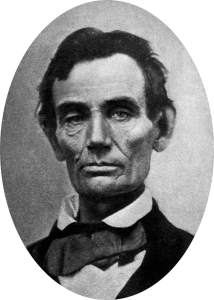
800px-Abraham_Lincoln_1858
Lincoln in 1858.

In which we see that even old people have heroes.

Emily.
—Mr. K.
The other day you referred to Abraham Lincoln as “my boyfriend.”
—I did.
Can I infer from this that you have some curiosity about our relationship?
—Hey, whatever you’re into, Mr. K. You do have a wedding ring, I see.
I do.
—But what you do on your own time is your business.
Agreed. Of course your observation about my wedding ring testifies to your powers of observation—and can be taken as an ongoing indication of your curiosity about the status of my relations with Mr. Lincoln.
—Are you married to him?
—OK, this is officially weird.
Well, making you uncomfortable is not the goal here, Sadie. What I’m really trying to do is leverage Emily’s interest for larger pedagogical purposes. That’s why I’m appointing her chief interviewer. Emily you’re going to be the Director of Information Management on Abraham Lincoln for Mr. King’s US History Class. Your fellow students are your staff members. Fire away.
—Uh. OK. This is officially weird. But whatever. First question: are you named after him?
Yes. But your job is to ask about my boyfriend, as you refer to him, not me. Though you may learn about me in the process.
—You’re named after him? That’s so cool!
You might say my father was also Abraham Lincoln’s boyfriend, Kylie.
—Let’s stop with this analogy. But was your dad a teacher too, Mr. K.?
No, Sadie. Just a passionate lover of history. But let’s keep our focus on Mr. Lincoln.
—Right. So tell us about Abraham Lincoln. He wasn’t actually born in a log cabin, was he?
Pretty much. The exact circumstances of Lincoln’s birth are unclear, but his basic circumstances are well-established: he was born poor in Kentucky. His beloved mother died when he was nine years old. His beloved sister died when he was a teenager. He didn’t get along with his father. His family moved from Kentucky to Indiana, and later to Illinois.
—What kind of kid what he?
A little strange: He liked to read. Which is surprising, since he received about a year, total, formal education. His father, among other people in his extended family, thought he was lazy. But Lincoln was lucky: his dad remarried after his mother died, and—contrary to the fairy tales—his stepmother proved to be a godsend. She loved him and supported him, prodding her husband not to be hard on his son. Lincoln only read a few books—the Bible, Shakespeare—which he knew very well.
—So what was his first job?
Well, he held odd jobs. As an adolescent, he did odd jobs for his father -- and for other people, his dad pocketing the pay -- but he left home as soon as he could, moving to the small town of New Salem, Illinois. It was there he reputedly fell in love with a woman who was engaged someone else.
–Oooh. Scandal. I love it.
But then she died, and Lincoln became severely depressed—so depressed he stayed in bed for weeks. He had such episodes a lot. Anyway, over the course of his adolescence and young adulthood he worked in a store. He worked at the post office. He made a couple trips down the Mississippi River to New Orleans to deliver goods. That’s when he was introduced to slavery (and was attacked by slaves trying to steal the stuff). Those experiences had a deep impact on him: he emerged from them with a lifelong hatred of slavery, even if, for most of his life, he considered abolitionism impractical.
—So when did he get into politics?
When he was 22 years old, Adam, he ran for the state legislature. He lost. But he got 90% of the votes in his hometown. That was the thing about Lincoln: to know him was to like him. Once, when he was new to town, a friend bragged he could beat the head of the local gang in wrestling. There was a match, and there are two versions of the story. In one, Lincoln won; in the other, he lost. But in both cases, he became lifelong friends with the members of the gang. After he ran for office the second time, he won. He served four terms. Over the course of that time he also taught himself to be a lawyer, passed the bar, and began a legal career. He married a rich woman who also dated Stephen Douglas.
–Oooh. Scandal. I love it.
Hardly, Sadie. But Mary Todd and Lincoln did have a tempestuous relationship, and there are reports of shouting matches that could be heard outside their house. She was difficult, and smart. Mary was from Kentucky, and Henry Clay had been a guest in her home and her father's business partner. Lincoln idolized Henry Clay—he loved the idea of internal improvements, the American System, the whole kit and caboodle. Which was a little hard, because he lived in Jackson country. But Lincoln did pretty well for himself. And by the mid-1840s, he was ready to run for Congress. Here was the problem: there was one district that was reliably Whig, and three guys who wanted the job. So Lincoln proposed they take turns, each supporting the other. His turn came last, and he was indeed elected. But as we discussed, he arrived in Congress for the start of the Mexican War, which he opposed. Not smart. Lincoln didn’t intend to run for re-election, but his stance cost the Whigs the seat. President Fillmore offered him the governorship of the Oregon territory, but Mary nixed that: Siberia. So Lincoln went back to Springfield and got rich. He and Mary had four sons, one of whom died there.
And that’s how things might have ended, if the Kansas-Nebraska Act hadn’t come about.
—Wait. Before you get to that.
Yes, Yin?
—I don’t really understand exactly why Lincoln was so popular. Emily calls him your boyfriend, and you say that people liked him. But I don’t really understand. Can you explain?
Well, that was the point of that wrestling story. And there’s the famous story, you’ve probably heard it, of “Honest Abe” walking miles to refund money to someone he accidentally overcharged by working at the store.
—I still don’t feel I get his personality. We’re told people from history were great and admirable, but I never feel like I understand why.
—It’s true.
I understand. Let me try this. At one point in the 1850s, when Lincoln was a successful, but provincial, lawyer, he was hired by a firm back in New York to represent a manufacturing company for a case that was being tried in Springfield. At the last minute, the case was transferred to Cincinnati. Lincoln was told that, and went there, but he didn’t understand the case would now be handled by a very prominent Cincinnati attorney named Edwin Stanton. Stanton thought Lincoln was a loser, a hick; Stanton’s colleague described Lincoln as “a tall rawly boned, ungainly back woodsman, with coarse, ill-fitting clothing.” Stanton’s crew pushed Lincoln aside during the case, never invited to meet or eat with the other attorneys. When Lincoln was paid for showing up, he returned the check until he was urged to cash it. When he got home, Lincoln described himself as “roughly handled” by Stanton, though he recognized, as many people at the time did, that Stanton was a very talented man, even if he was also a jerk.
A few years later, when Lincoln was president, he fired the corrupt and inept Secretary of War Simon Cameron (Lincoln’s boosters at the Republican Convention of 1860 foisted Cameron on him as the price of the Pennsylvania delegation’s support when he was running for president in 1860). And the man Lincoln chose as his successor? None other than Edwin Stanton, the former Democrat whom he entrusted—wisely—with substantial latitude to run the Civil War. And a few years after that, when Lincoln had been shot and was bleeding to death, it was Stanton who literally stood by him, managing the crisis while he wept. “Now he belongs to the ages,” Stanton said when Lincoln died.
—That’s a really moving story.
I’m glad to you think so, Yin. Does it get at what you’re asking?
—Yes.
There are a lot of stories like it: Lincoln making, and staying, friends with people who disagreed with him. He refused to demonize his opponents. His great rival for the presidency, William Seward, ended up as one of his closest friends. So did one of his adversaries in Congress, abolitionist Charles Sumner—Sumner had been savagely beaten on the floor of Congress after giving a provocative speech against slavery in 1856—who believed Lincoln moved too slowly in abolishing slavery. So did Frederick Douglass, who would also ultimately be an admirer. Lincoln was that kind of guy. He also had a great sense of humor. “God loves ugly people,” he once said in a context of self-deprecation. “That’s why he made so many of them.” (Walt Whitman once wrote that Lincoln was so ugly that he was beautiful.)
But here’s the thing: Lincoln was also a man of great patriotism and moral conviction, and he thought the two went together. He loved his country because he knew it had been very good to him—only in the United States, he plausibly believed, could someone like him be as successful as he’d been—and he hated slavery, not only because it was wrong, but also because it endangered the very idea of what we would call the American Dream. This may be why Lincoln seemed utterly galvanized by Stephen Douglas’s Kansas-Nebraska Act, which created the potential for slavery—something he always believed would die—to spread in the name of democracy. Lincoln’s denunciations attracted a lot of attention, and after the Whig Party fell apart and he became a Republican, there was talk of him running for Senate in 1855. But he stepped aside for the sake the party, which was seeking antislavery Democratic support by running another candidate instead. This was another act that won him admirers (and which would eventually pay off).
—So what happened next?
Lincoln remained in the public light in Illinois and around the Midwest. And when Stephen Douglas was up for re-election, Republicans coalesced around him. Everybody knew he was a long shot, which is why there was some talk of actually nominating Douglas as a Republican in the hope they could gain some concessions from him. Everybody but Lincoln, that is.
—Really?
Well, I’m exaggerating a bit. But Lincoln and Douglas went back a long way. Douglas was born in Vermont, and came to Springfield as a young man, just as Lincoln did. They were both excellent lawyers and politicians. Douglas had left Lincoln in the dust—Congressman, Senator, future president. But he knew Lincoln was good.
Lincoln also knew he was a long shot, and he played to Douglas’s vanity: he challenged him to a series of debates around Illinois. Douglas should have said no, and knew he should have said no: front-runners don’t give rivals chances to face them as equals on a stage. But Douglas couldn’t resist, and what followed was one of the truly legendary battles in American political history: the Lincoln-Douglas debates. If we had more time, we’d go into more detail. Suffice it to say that contrary to what is sometimes suggested, they weren’t exactly high-minded affairs. Lots of repetition and innuendo. Lincoln depicted Douglas as a cynic whose indifference toward slavery was dangerous, and Douglas depicted Lincoln as a raging abolitionist. Question: How are senators chosen in 1858?
—The same way they are now?
Nope. What does the Constitution say? How was it done until the Seventeenth Amendment in 1916?
—Oh c’mon, Mr. K. You don’t actually expect us to know that.
Hey, you can’t blame a guy for trying. They’re chosen by state legislatures. And how are state legislatures chosen? In part by the census. In 1858, Illinois is working off the 1850 census. And in 1850—but not by 1860—the population of Illinois is mostly in the southern part of the state. That part of the state has more weight, and so Douglas wins. Lincoln says he feels like the boy in Kentucky who stubs his toe while rushing to visit his girlfriend: it hurts too much to laugh, but he’s too old to cry.
—So how does he become president, then?
Well, Jonah, that’s a long story—a longer story than I can tell in a course like this. Suffice it to say that even though Lincoln loses, the Senate race attracts national attention. Lincoln is by no means a household name, but the people who are household names—Douglas for the Democrats, Seward for the Republicans—are too controversial to be easily elected. When the Democrats hold their convention in Charleston in 1860, the proslavery wing walks out in protest at the prospect of Douglas getting the nomination; they nominate their own candidate. The Douglas crowd reconvenes in Baltimore and nominates him there. The Republicans happen to have their convention in Lincoln’s backyard, Chicago. He and his supporters skillfully position him as everybody’s safe second choice, and that works like a charm. So now there’s Douglas, and the proslavery candidate, whose name is John Breckinridge, and Lincoln, and a fourth candidate, John Bell of Tennessee, who runs as a “constitutional unionist,” which basically means anything to avoid a war. Under such circumstances, Lincoln is a cinch to win.
Lincoln’s position is clear but firm: he won’t attack slavery where it exists, but won’t allow it to expand. All through the fall, there are indications that the proslavery crowd finds this unacceptable, that they’ll leave the Union if he gets elected. Not a lot of people believe them, though. Lincoln doesn’t either. He gets 39% of the vote: more than anyone else but hardly a majority. A few weeks later, the South Carolina legislature votes to leave the Union.
—Oh my, Mr. K.! What will your boyfriend do?

'm confident he'll do the right thing, Emily.

Next: Essaying

Monday, December 5, 2016

King's Survey: The PopSov Bubble

In which we see the limits of democracy in a democracy without limits

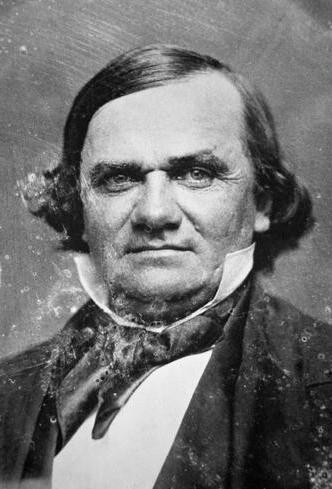
Stephen_A_Douglas_private_collection
Senator Stephen A. Douglas (Illinois)

Once upon a time, kids, there was a grand compromise to avoid a civil war. The man who tried to make it happen failed. And then another man swooped in and made it happen. And then the very man who made it happen destroyed that compromise. That’s the story I want to tell you today.
—OK. So who destroyed it?
—Henry Clay.
—No, not Clay. He was the guy who failed. It was the other guy.
—Which guy?
—Douglas something.
—No: I have it here in my notes: Stephen A. Douglas.
—Oh yeah. Him.
—Who was he, again?
—It says here he was “the little giant.”
I need to partially take back what I said. When I say the man made it happen
—Which man? Is it Stephen Douglas?
Yes. You kids figured it out. Douglas did make it happen. Clay couldn’t get the Compromise of 1850 through as the Omnibus bill, and then Douglas broke it into pieces and got it passed that way. Crisis averted. But as I already explained to you, it’s not like that Compromise of 1850 made everything just fine.
—Right. That fugitive slave law and all that.
The fugitive slave law and all that. Some people are angry about the obligation to return escaped slaves, and other people angry that they’re potentially liable if they don’t say something if they see something. And of course there was all the hoopla around Uncle Tom’s Cabin, which Harriet Beecher Stowe wrote in response to the fugitive slave provision in the Compromise of 1850. Still, the whole thing might have held if it wasn’t for Senator Stephen A. Douglas’s real estate speculation in Michigan.
—All right, Mr. K. I’ll take the bait: what’s the deal with the Michigan real estate?
Funny you should ask, Em (bless your heart). So you all know about the railroadsInternet of the 19th century, and all that.
—Yeah, we did all that.
So the big question now is where to build a transcontinental railroad. Everybody wants oneDemocrat, Whig, Free Soiler, abolitionist, woman suffragist. And why not? A wonder technology that will literally stitch the nation together. Everybody understands that the government is going to have to get involved; it’s too big a project and requires too much money up front for the private sector to handle it single-handedly, even if it’s expected the private companies will do it.
—Why doesn’t the government just do it?
Well, Adam, I hear two questions there. One is, “why doesn’t the government simply commit to the project?” And the other is “Why doesn’t the government itself build the railroad?”
—Well, yeah, when you put it that way, I guess it is two questions.
I’ll address the second one first. The government itself doesn’t have the resources, the labor force, technology, or business acumen to actually launch a major capital project like that. That’s a matter of logistics. But it’s also a matter of philosophy: every since the settlement of the Ango-American colonies, English speaking peoples have favored the private over the public sector more than other people in Europe or the rest of the world. So it was that when Samuel Morse developed the new technology of the telegraph, and offered it to the U.S. government in the 1840s, Congress turned him down. Instead, it was private companies that built the telegraph business. Which, as we’re speaking, are in the process of laying a cable across the Atlantic Ocean. Soon there will be virtually instant communication across seas and continents. We live, truly, in an amazing world, don’t you agree, Chris?
—Yeah, I guess.
You guess! This is the 19th century, Chris! Has there ever been a time of greater moral and scientific progress?
—Yeah, sure. Whatever.
I can hear the awe in your voice. Anyway, to the second half of Adam’s question, or, I should say, the first half: “Why doesn’t the government simply commit to building the railroad?” And the answer is that while everybody wants a railroad, the railroad actually has to go somewhereit actually has to occupy a stretch of territory. But which stretch? You’ll be shocked, shocked to hear that Southerners want that railroad to run something like Georgia to California, while Northerners would like it to take a route that runs from Massachusetts to California. (California? Does that mean San Francisco or somewhere else? Certainly not Los Angeles. That's a desert.) Anywhere the railroad does run gets an economic bonanza. You can see how this whole thing turns into a political nightmare.
—Maybe they should have a lottery or something.
Maybe they should, Sadie. But Senator Douglas owns some real estate in Michigan. And he’d really, really like it if that railroad happened to run through that land he currently ownswhich of course he would be delighted to sell to the government at an appropriate price, something which, as a lawmaker he is, shall we say, uniquely qualified to do.
—Is that legal?
Sure. The problems posed by these development are only being invented now, so the solutions don't exist. Anyway, Douglas may want this. But he knows he can’t necessarily get this unless he plays ball with his friends in Congress. As we know, playing ball is something he’s very good at. And so he goes to his Southern friends, the friends he’s going to need to make this deal happen, and he says, “Boys, what will it take for me to get the votes I need?” And do you know what they say?
—“Funny you should ask.”
Excellent, Em.
—It's a line I've heard a few times before in this room.
That is, figuratively speaking, exactly what they say. And then they go on to note there was an interesting concept in the Compromise of 1850 involving the future states of the New Mexico and Utah territories. That concept is “popular sovereignty”: the idea that the people actually living in a territory, not the politicians back in Washington DC, should make decisions about the future of that territory. In particular, they should decide about slavery. In the case of New Mexico and Utah, this is all pretty theoretical, since it was obvious that it would be decades before those territories ever had enough people to become states. Still, the Slave Power liked the idea, because they believed slavery had to expand in order to survive, and they wanted to keep their options open, even if they were long term.
But what about the short term? This is where Senator Douglas’s request becomes interesting. New Mexico and Utah’s admission to the Union is far away, but that of the territories of Kansas and Nebraska are not. What if they were to be admitted on a basis of popular sovereignty? What do you say, Senator Douglas? Give us popular sovereignty there and you’ve got yourself a railroad where you want it.
Before I tell you how he replied, let me ask: what do you say?
—I don’t like it.
But why not, Kylie?
—Because I don’t like slavery.
Do you like democracy?
—Yeah, but….
But what?
—It doesn’t seem right.
—Democracy for who is the question.
Democracy for the voters, Adam.
—But who gets to vote?
Well, that depends a little on the location, but basically, the answer is white men.
—Well, that’s not really democracy, then.
Why not?
—Because a democracy means everybody gets a vote.
No, Adam. In fact, that’s not correct. No democracy has let everybody vote. In ancient Athens, usually cited as the prototype of democracy, only citizens could vote, and they were a tiny portion of the overall population. (Slavery was common in ancient Greece, by the way, as indeed it was in a great many societies, ancient and modern.) Women almost never voted in democratic societies. Children still don’t. So the fact that the franchise, as it is known, was limited doesn’t really work as an argument. So if you’re going to come up with an argument against popular sovereignty, you’re going to have to approach it from a different direction.
—What did Douglas say?
Douglas wanted that railroad. Douglas was also a Democrat, and a democrat. “I don’t care whether slavery is voted up or voted down,” he often said. What he did care about was that the people—which for him meant white people—got to choose. So he accepted the deal and shepherded it through Congress with those great legislative skills of his. The Kansas-Nebraska Act became the law of the land in 1854. Douglas is looking more and more like a future president of the United States, after James Buchanan, Democrat who gets elected in 1856.
—So did the Kanas-Nebraska thing work?
It was a disaster. Truly catastrophic. Now try to figure out why.
—They couldn’t agree.
—Duh. The question is why they couldn’t work it out.
—Slaveholders brought their slaves in whether the law allowed it or not.
That’s not quite right, Yin, but you are on to something. You’re not right because there was no law regarding slavery in the territory. That’s the problem. Slaves are flooding into Kansas before there’s a vote on statehood. The people who are bringing them are known as “bushwackers.” They’re coming from Southern states, especially Missouri. But there are also antislavery peoplestrong antislavery peoplecoming into into Kansas, too. They’re known as Jayhawkers.
—That’s the name of the University of Kansas basketball team.
Well, how about that, Jonah. The bushwackers and and jayhawkers really go at it. There’s widespread violence. In one famous case a man named John Brown—you’ll be hearing about him again—and his sons ambush a group of slaveholders when they emerge from a bar. They hack the slaveholders to death with broadswords.
—Wow.
Amid all this violence—the situation there in 1856-57 is known as “Bleeding Kansas”—a vote is organized on statehood and a constitution. But the antislavery forces think the election is rigged, and they boycott it. The vote and document that results are known as the Lecompton Constitution. There are widespread reports of violence and intimidation. A lot of people don’t think it should be accepted as legitimate.
—So what happens?
Well, the Buchanan administration is stacked with proslavery advocates; the Secretary of War, for instance, is a man named Jefferson Davis. They push the president to accept the Lecompton Constitution, and he does. But the decision on Kansas statehood becomes a political football in Congress, and its application stagnates. Now, here’s a question: what you do you think Senator Douglas does?
—Why do you ask?
Here’s the thing: If Douglas accepts Lecompton, he compromises his reputation as an honest broker, especially since he’s a senator from a non-slave state. But if he rejects Lecompton, he angers the people with whom he made is deal.
—Sounds like a no-win situation.
It is, Em. Turns out the Little Giant might have been too clever by half.
—So what does he do?
—What would you do?
—I’d probably reject the deal. I mean, I’m like Kylie in that I think slavery is wrong. But just on the politics, it’s a bad idea to push what you’re saying was a bad deal.
Well, that’s what Douglas said, too, Em.
—I guess that makes me a giant too, then.
Well, maybe; you're certainly taller than he is. But both of you just got a whole lot less electable as president. Still, there’s hopeafter you get re-elected to the Senate.
—Will that be hard?
Hard to say. Depends how easy it will be to minimize opposition to his candidacy. But there is a guy who wants to run who worries Douglas a little bit.
—What’s his name?
Abraham Lincoln.
—Oh, him again.
Next: Dred’s prospects

Wednesday, November 30, 2016

King's Survey: Compromising Situation, 1850

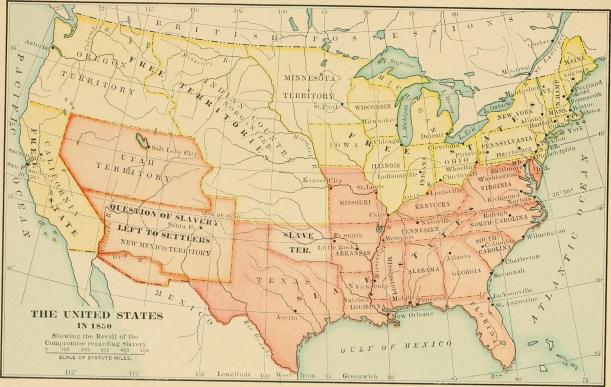
Compromise1850map

In which we view a nation teetering on the edge, and pulling back (for the moment)  

OK, kids. So I think we need to take a little stock of where we are in the United States of America in the Year of Our Lord 1850. Texas is securely in the Union as a slave state. The Mexican War is over. Gold has been discovered in the newly acquired territory of California. It appears that the manifest destiny of the nation is indeed to stretch from sea to shining sea, and amid a booming economy, there are efforts afoot to stitch it together with an transcontinental railroad. You might say things really couldn’t be better.
And yet the national mood is miserable. Tell me why.
—Because of slavery.
Yes, Jonah. But what about it?
—Well, people can’t agree on it.
Agree on what?
—Where it will go.
Yes: where it will go. You make a very important point. Where slavery is—and isn’t—is regarded as settled. The argument is over the future of slavery. Proslavery advocates are becoming more and more convinced that the peculiar institution, as it’s known, must expand, which is why they’re hatching schemes like taking over Cuba or founding a colony in Nicaragua. Antislavery activists are becoming more and more convinced that it must not. Both agree, largely implicitly, that if slavery stops growing it will die. There are also some curious tensions, contradictions, hypocrisies. As we discussed, proslavery advocates have long been suspicious of national government power for any reason except the protection of slavery, because they fear that power could be used to regulate or destroy it. Antislavery advocates have generally favored a stronger federal government, except when it comes to things like enforcing the return of fugitive slaves. The effect of all of this has been gridlock: it’s getting harder and harder to get anything done.
—Maybe we need a war.
Now Ethan, that’s really offensive. War talk is sensational and inappropriate. I demand that you apologize right now, young man.
—Are you serious?
—Really, Ethan. Don’t you know by now when Mr. K. is in drama mode?
I have no idea what Emily is talking about, Ethan, but I do apologize. I guess I just got carried away. It’s just that there’s been so much irresponsible talk lately. All the abolitionists on one side, fire-eaters on the other. People tend to forget that both sides are really minority voices. Most of us don’t care about slavery one way or another. We just want peace!
—Fire-eaters?
—Probably means proslavery people.
—Sounds like Harry Potter.
—Cool term.
—Cool fire-eaters. Brilliant, Jonah.
So what are we going to do, kids? How can we break the gridlock?
—I have no clue. But I have a hunch you’re about to tell us.
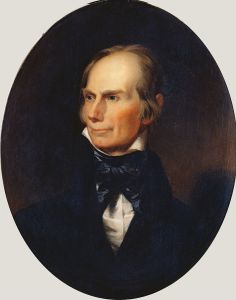
HenryClay
Henry Clay
Well, yes, I am. But first I want to bring back our old friend Henry Clay.

—Jeez, Mr. K. You’re obsessed with that guy.
Yeah, well, Em, a lot of us are. But in 1850, Henry Clay is an old man. He’s been dominant force in American politics for over forty years. He’s an antislavery slaveholder from agrarian Kentucky who seeks to promote the industrial revolution
—That doesn’t make any sense.
What? You're confused by the notion of an agrarian industrialist?
—Nevermind that. Antislavery slaveholder?
Well, he’s not an abolitionist, for God’s sake, Em. Yes, he owns slaves. But he’s looking forward to the day when slavery is gone.
—What a hypocrite. How can you be for something and against something at the same time?
Kylie, are you an environmentalist?
—Me? Sure.
Then why are you drinking whatever that is from a plastic bottle? You say you’re in favor of saving the environment at the very moment you’re destroying the environment!
—Oh, c’mon, Mr. K. That’s unfair to Kylie. You’re being ridiculous.
Am I, Em? Or am I simply pointing out that people are complicated?
—No. You’re just being ridiculous.
So says a former supporter of Andrew Jackson. I know where you’re coming from Em.
—You are impossible.
Why thank you, Emily. Anyway, Henry Clay is old, and he’s dying, but he’s still a patriot. And he’s been thinking very hard about what might save the country from disintegrating. He’s put together an interlocking series of proposals known as the omnibus bill.
—What does omnibus mean?
—Isn’t it like a bus?
In a way, yes. “Omnibus” basically means multiple. Like kids on a school bus. The idea here is Clay’s bill consists of a set of proposed laws. If you vote in favor of it, you get the whole thing. It will have stuff you like, but also stuff you don’t.
— Like a streaming service. You pay for all the shows, but only watch some.
—Or a combination plate at a food court. You get a good price on the whole thing, even if you don’t eat everything.
Right. Clay figures that’s the only way to get the job done. In a spirit of a compromise. Here are the highlights of the bill:
  1. California comes into the Union as a free state.
  2. The slave trade ends in Washington DC (a lot of people really hated the fact that slaves were bought and sold in the nation’s capital).
  3. There’s a new stronger fugitive slave law. I’ll talk about this in more detail later.
  4. Rather than decide now what will happen to the Utah and New Mexico territories (a whole bunch of future states there, but not for a long time—Arizona, for instance, doesn’t enter the Union until 1912a new principle, known as “popular sovereignty” will be used to determine whether such states will be slave or free. The voters will choose rather than Congress deciding.
  So, what do you think?
—The first two ideas seem to favor the North. The third one the South. The last one breaks even. So the overall law seems pro-Northern.
A reasonable assessment, Ethan. But point number three is a big one. Again, I don’t want to get into it right now. But suffice it to say that in Clay’s mind, at least, the overall package was truly balanced. What do you think, Sadie?
—Sounds reasonable. Does it work?
No.
—Oh. Why not?
Well, that’s complicated, by which I mean you ask ten people you’ll get ten different answers. I will tell you that old man John Calhoun, who had been at it as long as Henry Clay and was in fact on death’s door, told his fellow Southerners to reject the bill, and he had a lot of influence in the Senate. Senator Daniel Webster of Massachusetts—remember him? We talked about the big speech he gave, “Liberty and Union, now and forever” a while back—came out in favor of the bill, and got a lot of grief over it. Clay was known as “the Great Compromiser”—remember, he’s the guy who got the Compromise of 1820, a.k.a. the Missouri Compromise through Congress—but he just couldn’t summon the old magic.
—So what happened next?
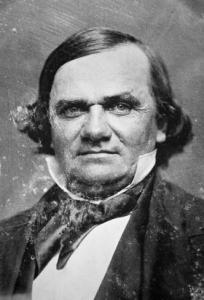
Stephen_A_Douglas_private_collection
Stephen A. Douglas
What happened next is counter-intuitive. Remember that the whole basis of Clay’s approach was compromise: you take a little, you give a little. He assumed the bill had to work as a package. But in the aftermath of the vote, another senator came forward, a younger man named Stephen A. Douglas of Illinois. (You haven’t heard the last of him.) Douglas was a Jacksonian Democrat. But like Clay, he considered himself a patriot. What he did was break up the Omnibus Bill into separate pieces. An he got them passed one by one.


—How did he do that?
A very good question, Yin. The short answer is horse trading. So take the California piece for example. He’d go do you, a Southern senator, and say: Hey, I know you hate this bill. But if you pass it, I’ll make sure you get that bridge you want for your state. Or the railroad going through your town. That kind of thing. It was very complicated, and exhausting, but it worked. And before the year was over, President Millard Fillmore—the non-entity who followed the forgettable Zachary Taylor, who died a few weeks into office—signed the Compromise of 1850 into law.
—So what happened then?
Peace in our time, of course. Crisis averted.
—Well, we know that didn’t happen. So what went wrong? Who blew it?
Stephen A. Douglas did. But a few things had to happen before he could. We’ll get to them.
—Such drama!
All in a day’s work, kids.
The compromised compromise

Saturday, March 23, 2013

Little Giant, Big Giant

In Lincoln's Tragic Pragmatism: Lincoln, Douglas and Moral Conflict, a historic debate becomes a living analogy

I think of myself as an amateur Lincolnologist who tries to keep up on the latest literature in the field. But I really didn't want to read this book.  For months, it sat in a pile in my living room, its appealingly simple bright orange cover beckoning me. (It's a beautifully produced book generally, as one would expect of Harvard University Press.) But its sheer bulk -- 800 pages, a hundred in the form of a densely annotated editorial apparatus -- led me to steer around it. Only when that pile got small did I lift it for a single-session trial run: if the Preface and Introduction hooked me, I would see it through. It did, and I did. You should, too.

As a number of reviewers have noted, among them Steven Smith in the New York Times, Lincoln's Tragic Pragmatism can be usefully viewed as a reply to Harry Jaffa's classic 1959 book Crisis of the House Divided in its exhaustive treatment of the Lincoln-Douglas debates of 1858. Like Jaffa, Burt (by training a literature scholar; he teaches in the English department at Brandeis) views the debates through a philosophic lens. Indeed, for all the exhaustive contextual detail that laces his analysis, Burt, like Jaffa, rejects a strictly historicist reading of the debates, insisting on their ongoing relevance as a case study in ethics. But he departs from Jaffa in two important respects. The first are his touchstones; where Jaffa was likely to invoke Plato or Aristotle, Burt invokes (and to some degree defends) John Rawls. The second, related -- or, as Burt is wont to say, "imbricated" -- departure from Jaffa is a partial rehabilitation of Stephen Douglas, whom Jaffa (among many others, in 1858 and ever since) viewed as a crude political opportunist. Burt views Douglas as a worthy opponent, even if he feels that the balance of history, and morality, is on Lincoln's side.

The core question the book poses can be stated relatively simply: How can a liberal (which is to say politically pluralistic) society justly engage a non-negotiable moral position (in this case, that slavery is evil)? In one sense, Burt's answer is that a liberal society can't, not because of any defect in liberalism exactly, but rather because no society comprised of human beings ever can be entirely just. The temptation for individuals to think and act otherwise is almost irresistible, whether because of a collective addiction to intoxicating self-righteousness or out of fear that a sense of doubt would enervate the will to act. Lincoln's greatness, of course, stemmed from a very unusual capacity to prosecute an extremely bloody civil war while at the same managing to maintain a sense of his own moral and epistemological fallibility, captured most durably in his Second Inaugural. This is the essence of the tragic pragmatism invoked in the title of the book.

What Burt maintains, however, is that Lincoln's eventual synthesis of conviction and modesty would have been impossible without the forceful prodding he received at the hands of Douglas seven years earlier. He believes that the Abraham Lincoln who launched his U.S. Senate campaign against Douglas in 1858 with his famous "House Divided" speech in 1858 was more philosophically rigid, and thus politically vulnerable, than commonly allowed. Conversely, Douglas, while no moral philosopher, was on firmer footing than one might think. Burt is among the many observers who have viewed Lincoln's attacks that Douglas was in cahoots with Slave Power apologists like Franklin Pierce and James Buchanan as ridiculous. He is more unusual in finding merit in Douglas's "Freeport Doctrine" that states required by law to protect slavery need not be vigorous in enforcing it, drawing a distinction between allowing and facilitating certain kinds of economic activity that has clear parallels in contemporary life (consider gun ownership, for example, which we have no obligation to make easy).

Douglas famously asserted -- and his enemies on either side of the slavery issue endlessly repeated -- a claim that he didn't care whether slavery was voted up or down. What Douglas did say he cared about is that the citizens of a state or territory be allowed to choose for themselves, a notion that lay at the heart of the popular sovereignty premise codified in the Kansas-Nebraska Act, which triggered Bloody Kansas, the Civil, War -- and, ironically, the destruction of Douglas's own presidential aspirations.

But the Kansas-Nebraska Act was more than just a failed political gambit. It posed a genuine philosophical dilemma. As Burt explains, "the issue between Lincoln and Douglas was not the difference between moral and amoral politics, but the difference between one set of prudential compromises about moral issues and another set." Neither man liked, but both men were willing to tolerate, slavery -- Lincoln was less tolerant than Douglas, because he was unwilling to allow it to enter the territories and Douglas was (though Southern suspicions of Douglas's professed indifference about slavery were justified). The real question was how far the two men were willing to go to end it. Douglas was not as willing to go as far as Lincoln because he feared that fanaticism -- not so much Lincoln's, but that of abolitionists with which was not quite implausibly associated, would wreck what Douglas considered the last best hope of The People (which of course did not mean black people, but then in no polity does "the people" include everybody).

Given the reality of what this meant in 1858, it's easy to view Douglas's position as slickly cynical at best. But in an important respect, it lands right in the middle of a straight line that runs from James Madison's Federalist #10 to Franklin Delano Roosevelt's New Deal. It's the same vision of interest-group politics in which a liberal tells an antiabortion activist that if he doesn't like abortion, he shouldn't have one, a vision in which the only legitimate values are those you don't dare try to impose on somebody else. Burt, alluding to Max Weber (and, perhaps, Ron Takaki), describes it as "a world bound in the iron cage of purely instrumental rationality, in which means are calculated but ends are 'value judgments' about which reason has nothing to say. It is, in short, the modern world."

From this perspective, Lincoln becomes smug, even scary: he knows he's right, he says you know he's right, and even if he's willing to play by the (Constitutional) rules, he will stop at nothing short of that to take away what you hold most dear. Really, how far can you trust someone like that? A majority of voters in 1858 -- and a majority of voters in the presidential election of 1860 -- said: not far enough.  Douglas was right: Lincoln really was a sectional candidate. At best.

And yet Burt insists that Lincoln was right to insist on antislavery -- not abolition, but antislavery. That's because not all values are negotiable, even if no values should be absolutist. They should not be absolutist, because, as Burt pithily puts it, "in politics we are always Hawthorne's children, not Emerson's." Burt's literary background serves him well in other ways as well, notably his deployment of the Keatsian notion of negative capability, which Burt describes as an understanding that "we know our values by knowing that we can never exhaust them with our understanding, and that we never stand in a privileged position as regards them, that they remain in a position to put us, in some unanticipated way, in the wrong."

The miracle of Lincoln is that his final skepticism was skepticism about despair. One might think that it was Douglas who embodied a Rawlsian vision of fairness being defined in terms of willing to accept as fair the consequences of an unknown outcome, but Burt invokes Rawls's later work in which priorities are not understood solely in terms of economic or political self-interest. No political order can survive without a sense of sacred values, and part of what it means for values to be sacred -- to be living -- is a willingness follow where they lead, accepting the unforeseen consequences of a commitment rather than simply seeing them as expedient (Lincoln is in this sense Rawlsian, though he seems at least as much Kantian). Lincoln's God is not particularly attentive, kind, or forgiving. And yet he's still a repository of hope.

The burden of belief is not what it allows you to do to other people, but what you're willing to do to yourself in the name of your values. This leads Burt to assert that Lincoln really did not foresee emancipation and racial equality in 1858; one reason why he was able to do deal so effectively with the border states in the Civil War is that "his mind was another Maryland," which is to say he was a man of racial prejudices just as his fellow citizens were. But he was ultimately able to contemplate the "implictness" of his antislavery commitments, and to act on them when their force of their moral logic became clear --not Union versus freedom, or even Union through freedom, but Union as freedom -- and time was right. And, thanks to Douglas, to explain them unforgettably at Gettysburg and in the Second Inaugural.

Again, this is a big, sprawling book. And it's not entirely persuasive. (For one dissent, see Allen Guelzo's recent review in the Wall Street Journal.) I elected to skip over some of the minutiae, like that surrounding variant bills and amendments of the Kansas-Nebraska Act; for a non-historian, Burt goes pretty deep into the weeds. I'd have to read it again to figure out how to trim it, but a to me a book this size is almost always guilty unless proven innocent.

Ironically, there are also some surprising omissions. I found myself wondering, for example, how non-violence figures into all of this. Martin Luther King, Jr. shows up twice in passing. This is no anachronistic query for clarification, not only because of the range of modern voices that pepper Burt's discourse, but also because the roots of King's philosophy can of course be found in antebellum abolitionists like Henry David Thoreau and WilGarrison -- but without the self-righteousness that has always limited their appeal. I raise the question less as a complaint than a desire to understand if and how a moral giant like King, who also managed to combine unshakeable moral conviction with a sense of sin, compares with Lincoln.

Even more surprising in a book with the word "pragmatism" in it is the absence of William James. That's especially true because Burt's use of "implicitness" has a distinctly Jamesian ring: truth inhering in action. Surely there should have been room somewhere for Lincoln of American philosophy.

All this said, I'm making space on my overstuffed shelves for Lincoln's Tragic Pragmatism. This is a book I expect to be picking up and thumbing through for years to come. That's not only because I may someday really want to know what was actually in the Toombs bill of 1857 or the various provisions of the Crittenden Compromise. It's also because I may need some help figuring out What Would Lincoln Do. His judgment may not have been divine. But I'm only human.