Showing posts with label Andrew Jackson. Show all posts

Monday, November 7, 2016

King's Survey: Seeing Red

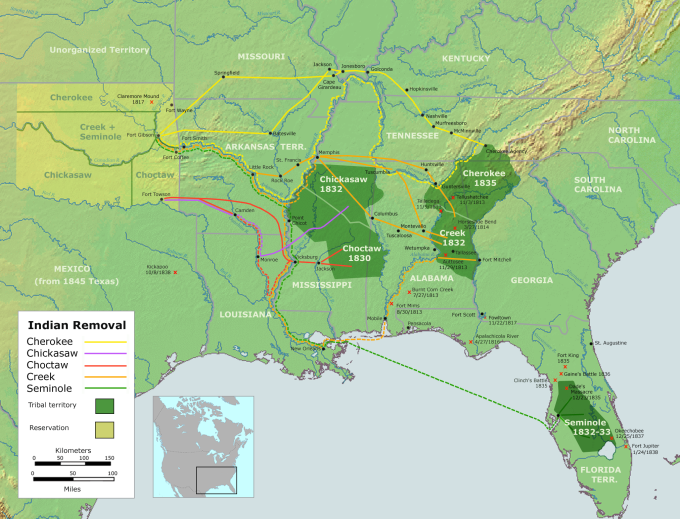
Trails_of_Tears_en

In which we witness one of the most the most disgraceful chapters of U.S. History. 


So kids, yesterday we talked about the impressive, but unsuccessful, efforts of New England women to stop one of the great evils of their time: the Jackson administration’s illegal effort to push Native Americans from their legally held territory. But the story didn’t end there. That’s because the Cherokees were resourceful people, and they had friends in their lands as well as in Washington. So they could, and did, wage their own struggle.
—I’m not sure what you mean the “illegal effort.” Was there a specific thing that happened?
I’m referring to the Indian Removal Act of 1830, Ethan. We talked about it yesterday, but I don’t think I ever named it as such. The law, narrowly passed in the Senate, allowed the state governments to push Native American tribes off their ancestral lands into territory the federal government designated for their settlement west of the Mississippi. One of the terms of the new law is that white missionaries were not allowed to operate down there without a license (obviously, racist whites were trying to prevent what they considered troublemakers from entering contested territory). One such missionary, Samuel Worcester, was arrested, tried, and convicted for this. He and his allies appealed the decision by suing the state of Georgia, a case that worked its way all the way to the Supreme Court.
Question, and I realize I’m pushing my luck here: Who was the chief justice of the Supreme Court when this case was heard in 1832?
—You really are pushing your luck, Mr. K.
Well, here’s a hint, Em: It was the same guy John Adams had appointed back in 1801. The guy who drove Thomas Jefferson crazy.
—Oh, the same guy Adams had appointed in 1801! Why didn’t you say so!
—John Marshall.
Hey! Nice job, Chris! How’d you get that one?
—Don’t sound so surprised, Mr. K. Chris is a fragile flower. Don’t want to make it seem it was that unlikely.
You’re right Em. On the other hand, Chris is high-fiving Ethan. 
—Yeah, well, Ethan is a fragile flower, too. And an idiot. Just kidding. See, Mr. K.? Ethan is blowing me a kiss.
I’m sure he’s every bit as sincere as you are. Anyway, John Marshall is the chief justice of the Supreme Court. And he’s a super-Federalist extraordinaire.
—I thought the Federalists were over by this point. Didn’t they get wiped out during the War of 1812?
And another brilliant play, this one by Sadie! Yes, they pretty much were gone by that point. But Marshall kept the Federalist flame, the spirit of Alexander Hamilton, alive all through this period, repeatedly reaffirming the power of the federal government over that of the states. And now, in 1832, he’s presented with a case where the state of Georgia is saying it doesn’t have to follow federal law when it comes to Indians. So what does Marshall say?
—Duh. He says no, you can’t do that.
Well yes, Ethan. But who does he say it to?
—Georgia?
Yes. But not only Georgia. Whose job is it to make Georgia do the right thing?
—Jackson?
Yes. But why?
—Because he’s the president?
Right. But why is that relevant?
—Because it’s his job.
Yes, but how is it part of his job?
—Because it’s in the Constitution?
Where?
—Jesus, Mr. K! I dunno.
Yes you do, Ethan. The Constitution has a bunch of sections, known as articles. The first is about the legislative branch. The second is about
—The executive branch! Jackson is the executive. It’s his job to uphold the law.
You see? You did know. And what does Jackson say? Why don’t you take this one, Adam.
—He says, “Don’t fuck with me, John Marshall!”
I see we’re still on that.
—Forever, Mr. K.
You’re more or less correct. Jackson is reputed to have replied, “Marshall has made his ruling. Now let him enforce it.” Think about that for a minute.
—He’s saying he won’t stop the takeover of the Cherokees’ land.
Right, Sadie. But to review: Congress makes the law. The Supreme Court interprets the law. And the president is the one who’s supposed to enforce the law. Using the armed forces, which he commands, if necessary. So when the Supreme Court makes a ruling
—Jackson is supposed to be the guy who makes it happen.
Right. And here he is telling Marshall that if he wants to kick the Georgians out of Cherokee land, he should do it.
—Weird.
More than weird, Sadie.
—Sounds kinda illegal.
More than “sounds.” It’s a direct violation of the Constitution.
—So what happens?
Well, as you know, Jackson gets impeached. He goes to trial, and is convicted. He goes to jail. And in 1832 John Calhoun becomes president of the United States. So it is that the Constitution gets vindicated.
—Didn’t you say—
—He’s kidding, Kylie.
—How do you know?
—Calhoun never became president. Mr. K. said so last week.
—Also, Jackson was never impeached. That was another guy.
—Andrew Johnson.
—No. Clinton.
—Who was he?
—We haven’t gotten to him yet.
Fine. I lied about Jackson getting impeached. The important thing is that the Constitution was vindicated.
—You’re lying about that, too.
Oops. Silly me. I take that back. The Constitution was not vindicated.
—What’s a few facts among friends, right Mr. K.?
—So what happened with the Indians?
Here’s where the story gets really grim. The Indian Removal Act of 1830 allowed the mass expulsion of the Native American tribes. The Jackson administration gained a fig leaf in the form of the Treaty of New Echota in 1836, in which cooperative Native American leaders agreed to leave in exchange for cash and other considerations. (This was a typical way whites dealt with Indians: by finding Indians willing to play ball who the U.S. would consider legitimate representatives of Indian tribes.) Over the course of the decade, tens of thousands of Cherokees, Choctaws, Chickasaws, and other tribes are forcibly expelled from part of Georgia, Alabama, and Mississippi.
—Where did they go?
West of the Mississippi River to the unorganized territory on the outer perimeter of the Louisiana Purchase. They ended up in what is now Oklahoma. (Oklahoma, by the way, was created in 1890 when that land was taken away from the Indianswhen settlers rushed in to see who could get their soonesthence the nickname of Oklahomans as “Sooners.”) This mass migration came to be known as the Trail of Tears. It was one of the great humanitarian disasters of American history. Over 10,000 Native Americans died from disease, weather and other conditions.
—I don’t understand how Jackson could have gotten away with that.
Very clearly, Yin, Jackson is a villain here. Certainly there were a lot of people vehemently opposed to his policies toward the Indiansnot just the women we were talking the other day, but also political insiders like John Quincy Adams (who by this point had returned to Washington as a member of the House of Representatives) and Henry Clay. But the important thing to keep in mind is that Jackson had the supportor maybe it’s more accurate to say that he was supporting—his core constituency. Lots and lots of white people wanted those Indians out. And they were willing to do what it took to make that happen. Just as there were lots and lots of people who were willing to buy, sell, and own slaves. And lots and lots of peoplemany, many more peoplewho didn’t care and therefore didn’t object when such things happened.
—That’s disgusting.
I’m not going to argue with you, Sadie. Except to ask this: Have times changed?
—What do you mean?
I mean, are there equally disgusting things happening now?
—He’s saying maybe something just as bad is happening right now.
—In the United States? I don’t think so, Adam.
—Yeah, but you don’t know, do you. People being ripped off, or living as slaves. You hear stories like that on the news sometimes about illegal immigrants.
—I can believe that. But this seems pretty bad. And I think saying something like ‘Well it’s always bad’ is just a way of minimizing and ignoring problems.
—All I’m saying is that we shouldn’t assume we’re so much better than people in the past.
—So there’s no such thing as progress?
—I don’t know if there is. Sometimes I think so. And sometimes not.
What about you, Paolo? Do you believe in progress?
—Me? I’m not sure. I don’t think so. I mean, I think it’s possible in some ways. People’s lives get better. But not everybody’s.
Fair enough. Kids, we’ve spent a lot of time looking at the career of Andrew Jackson. He was a guy who was very controversial in his time, and somebody who’s been controversial ever since. I wonder if any of you would like to offer an overall assessment.
—That’s tough.
I know, Kylie That’s why I asked. Brianna, what do you think?
—I think he was pretty bad. Jackson was a racist. He did a lot of damage.
That’s true. Does him standing up to the nullifiers in South Carolina matter to you? That he was a champion of the little guy?
—Not really. The “little guys” he cared about weren’t that little.
So you’re glad he’s being taken off the front of the $20 bill?
—Absolutely.
—I gotta confess that I kinda like Jackson. I mean, I know that he did some things that were wrong. But he was kind of a badass in ways that were cool. He was a real leader.
Ethan, is the fact of leadership more important than where he led people?
—Kinda. Yeah.
—I don’t think so at all. It’s what you’re for, not how you’re for it that matters most.
Does that mean, Em, that if you’ve got the right cause you can be a jerk in the service of that cause?
—Maybe not always. Let’s put it this way: I’d be more likely to forgive someone who went overboard if his heart was in the right place.
Hmmm. Interesting. And I guess that means you’re less likely to be impressed by someone who does the right thing but has a cold heart?
—Yeah.
Like Jackson?
—He didn’t do the right thing.
The guy who adopted the orphan Indian boy?
—Oh, now you’re playing hardball, Mr. K. Look, nobody’s perfect. And nobody’s a saint. And Andrew Jackson is pretty damn far from a saint.
You know, I had this idea that you kinda liked Jackson, Em.
—You’re right. I kinda did. But he lost me today.
So be it, Em. But before we call it a day, I want to go back to a question that Adam said a while back with regard to the Ladies’ Circular, that petition to try and save the Cherokees. He said, “So all that women’s stuff was for nothing.” You still think so, Adam?
—How could I not?
Well, let me try this. The Trail of Tears was terrible. And those women failed to stop it. They triedthey really did, even if there were limits to their vision and their effortand they failed. But no one had ever done anything quite the way they had before since the United States had been created. That effort to mobilize mass opinion, and develop arguments, and influence leaders, despite the fact they had no real standing. But those women had learned something from their effort. And they applied its lessons. Infused by the moral ardor of the Second Great Awakening (we’re doing that next), they continued to agitate for a better worldfor progress, which they believed in, even though Paolo is surely right that there is reason to doubt that such a thing exists. It was in this movement that we talked about today that the drive to end slavery first began to crystallize, an effort that did ultimately succeed (though it took so horribly long). And it was in this movement that women began to think that there could be progress for themselves, as well. They supplied us with the logic land language that we continue to apply long after Andrew Jackson left office.
—I dunno, Mr. K. That’s a lot of spin you’re doing there.
I take your point. And if the women’s logic and language lingered, so too did that of Andrew Jackson. And it’s his face that’s still on the $20 bill.
—Don’t fuck with me, America.
—I am America.
—But is he?
—I hope not.
Keep hoping, Yin.
Next: A revival meeting

Friday, November 4, 2016

King's Survey: Mrs. Eaton's Knocker

In which we see a woman's status shape the outcome of a dangerous national controversy
Andrew_jackson_head
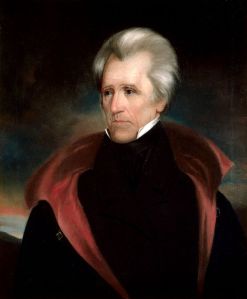
Andrew Jackson

Andrew Jackson was the quintessential man’s man.
—Don’t fuck with me.
Exactly.
—Do you regret teaching us this slogan, Mr. K?
Well, I wince a little when I hear all of you say it. But I think it works. You get what Jackson was about.
As I was saying, the masculine character of the Jackson administration is very much a matter of gender (as is, conversely, the virtual absence of women from the story to this point). You remember that Jackson had a wife, Rachel, over whom he dueled and to whom he was very devoted. You also remember that the Jacksons hailed from Tennessee, which was a frontier state, and indeed Jackson’s reputation as a frontiersman was part of his rugged appeal. But the flip side of that appeal is that people from the frontier can sometimes be regarded as unsophisticated, even backward. Rachel Jackson was sensitive on this matter as the couple prepared to move to the relatively (and I do mean relatively) cosmopolitan city of Washington DC after the election of 1828. And then, just after the election something shocking happened: she died suddenly of a heart attack. Jackson was convinced that his wife died of mortification about nasty gossiping behind her back, and was embittered about it for the rest of his life. And this is something crucial to keep in mind as we turn to the Tariff of Abominations, that law passed by the Jacksonians in the 1820s to hurt the Adams administration by placing very high tariffs on imported goods.
—OK. But what does Jackson’s wife have to do with the Tariff of Abominations?
I’ll tell you, Yin. The link is Mr. and Mrs. John Calhoun. As I said earlier, Representative Calhoun had run for president in 1824, and had spent his career as a nationalist War Hawk. In 1828, he accepted an offer to become Jackson’s vice president. But here’s the thing: by the early 1830s, Calhoun was moving more and more into the orbit of the South Carolina plantation aristocracy. That made him the chief spokesman against that tariff at a time when its critics were becoming ever more insistent.
—Yes, but how does Calhoun’s wife figure into this?
Peggy_O'Neale_Eaton
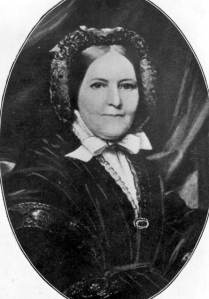
Peggy Eaton

Floride Calhoun was an elegant and influential Southern woman very different than Rachel Jackson. She also appears to have been something of a moralist and something of a snob. When Jackson came to Washington, President Jackson named a man named John Eaton as his Secretary of War. Eaton’s wife, Peggy, was a saloonkeeper’s daughter. There were also rumors that she had cheated on her first husband, who had reputedly committed suicide over the affair. As a result, Calhoun and her friends froze Peggy Eaton out, refusing to visit her home or invite her to theirs. When Jackson learned of this, he became enraged: as far as he was concerned this was exactly the kind of thing that had killed Rachel. His anger over this dovetailed with Calhoun’s growing criticism of the tariff, which Jackson didn’t like either, but which he felt Calhoun was too strident about, particularly after the tariff’s critics began talking about leaving the Union if their demands weren’t met. The term they used was “Nullification.”
—Like the Virginia and Kentucky Resolutions.
Very good, Sadie. There was also another incident where angry politicians, this time Northern ones, had also threatened secession. Anybody remember that?
—The Constitutional Convention?
Well, yes, Kylie, there was talk of Georgia and South Carolina pulling out, though these were Southern states. I was thinking of the Hartford Convention.
—The War of 1812.
Right. Just before the Battle of New Orleans, which had put Jackson on the map.
800px-Mvanburen
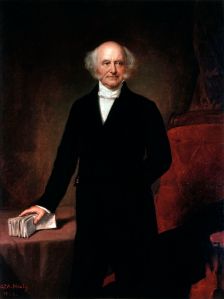
Martin Van Buren

Now, there’s one other person I need to bring in here, who I mentioned in passing earlier: Martin Van Buren. Van Buren, who came from upstate New York and was sometimes called “the Red Fox of Kinderhook,” is actually an important figure in American political history, because he’s really the first person you might call a “fixer”: someone who really organized campaigns and thought in terms of image and strategy, a role he played very effectively in managing Jackson’s political operations before and after he went to the White House. His primary nickname, “the Little Magician,” suggests his talents. There’s one other fact that important to mention here: Van Buren was single, and so he had no partner to get snagged in “the Petticoat Affair,” as the whole Eaton-Calhoun scandal was known. Recognizing which way the winds were blowing, Van Buren went out of his way to be nice to Peggy Eaton, visiting her frequently. Later, after he won the presidency himself, there was a joke that the political history of the United States got rewritten when Martin Van Buren touched Mrs. Eaton’s knocker.
—I don’t get it.
“Knocker” is a pun, Yin. It refers to a latch on a door that you use to signal that you’re at someone’s door, and a
—Boob.
Thank you, Chris.
—That’s so lame.
—I think it’s pretty funny.
Either way, Van Buren was playing his cards right. And Calhoun was increasingly estranged from the president. Actually, you might say Calhoun tried to pull a fast one at a dinner party honoring Thomas Jefferson in the spring of 1832. The party was attended by a big Nullification crowd, and Jackson was asked to give a toast in the expectation that he would lend his support to the cause. After all, Jackson was a Southerner, a slaveholder, and a states’ rights supporter himself. How could he not publicly side with Calhoun, however he might have felt about him? But instead, Jackson said, “Our Federal Unionit must be preserved.” It was an awkward moment.
—Don’t fuck with me, John Calhoun.
Yes: that’s exactly what Jackson was saying, Ethan, and that’s how everyone in the room heard it. An angry and humiliated Calhoun got up and gave a toast of his own. He said, “The Unionnext to our liberty most dear.” Thank about that for a minute.
—“Next to our liberty, most dear.”
Yes, Kylie. He’s damning the Union with faint praise.
— Don’t fuck with me, Andrew Jackson.
OldJohnCalhoun
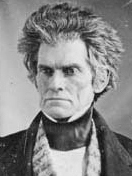
John Calhoun

Right, Em. That’s also what he was saying. Calhoun was a pretty tough guy himself. Look at this portrait.
—Whoa. Scary.
Yup. But Jackson won this duel. Calhoun resigned as vice president after that to take a seat in the Senate, from which he would become one of the most powerful people in American politics. But his place was taken by our friend Martin Van Buren, who became Jackson’s hand-picked successor, and was elected president, an ambition that Calhoun was never able to realize. As we discussed, the presidency didn’t turn out so well for Van Buren, because he inherited the Panic of 1837. But the Little Magician would also be a real force in American politics despite that.
—So what happened with the tariff?
In 1832, Congress, with Jackson’s support, passed a new tariff that moderated the worst effects of the Tariff of Abominations. But this was not enough for South Carolina. It issued its famous “Ordinance of Nullification,” in November of 1832, which said that the state could ignore provisions of the 1828 as well as 1832 tariffs that it regarded as unconstitutional.
—He we go again. So what did Jackson do?
He sent the U.S. navy down to the South Carolina coast in December of 1832, threatening to invade. And then his supporters pushed through the a law known as the Force Billyou can guess it’s meaning by its name, as well as Calhoun’s opposition to it. The law authorized Jackson to send ground troops into the state if it refused to comply with federal law.
—Don’t fuck with me, South Carolina!
That’s pretty much the size of it.
—What did South Carolina do?
What do you think, Sadie?
—They backed down.
Yes. They repealed the Ordinance of Nullification. In the months that followed, there was another revision to the tariff, which allowed South Carolina to claim that the state had won concessions. But most people at the time and ever since viewed this as Jackson’s force of will prevailing.
—I don’t really get why Jackson felt so strongly about a strong national government. In every other way, he was states’ rights.
—It was a pissing context, Yin. He couldn’t back down to Calhoun.
—Really, Adam? Was he that petty?
—Sure. The women were that petty. They even called it the Petticoat Affair. Why couldn’t the men be as petty as the women?
—This was too important. I don’t really like Jackson. But I don’t think he was stupid.
Some people did think he was stupid. When Harvard gave President Jackson an honorary degree in 1833, John Quincy Adams was among the alums who boycotted the ceremony. Jackson joked he couldn’t respect a man who only knew one way to spell a word. Go head, Kylie.
—Maybe there’s no big mystery here. He was states’ rights in most ways, but he loved his country because it was states’ rights. There had to be some rules that everybody agreed on.
—But he was being inconsistent.
—Yeah, Yin, but that’s just the way people are sometimes.
 —I guess.
Emily, I want to go back to you. The other day, you voted for John Quincy Adams in the presidential election of 1824. Today, when we discussed economic policy, you came out as a Jacksonian.
—Came out, Mr. K?
Well, I wondered if you’re a closet Jackson supporter.
—I’m not a closet anything, Mr. K.
No, I guess not. I guess what I’m wondering is where you stand with Jackson now. Let me ask this: Will you be voting for Van Buren in 1836?
—Probably. He doesn’t seem to have the baggage Jackson does.
So are you saying that you like Jackson’s ideas, but not the man himself?
—I guess that’s what I am saying.
Oh good.
—Oh no. No “oh goods,” please.
Why not?
—Because “oh good” means you’re about to tell me something that’s going to make my brain hurt.
—No pain, no gain, Em.
—Oh shut up, Sadie. When’s the last time you went to the gym?
—I saw her there one Tuesday last April, Em. She’s been saying she has to go to the nurse every time she gets within five feet of the girls’ locker room.
—I do not, Brianna. I also bring doctor’s notes.
Well, we do have one more Jackson angle to consider. It involves women, and Indians. We’ll do that one tomorrow.
—I was just kidding about the doctor’s notes, Mr. K. Em and Brianna are lying. I really do go to gym. I hate it, but I go.
You’re a paragon of virtue, Sadie.
—Yup. That’s me. Off to math. Where we do parabolas, not paragons.
Next: the power of angry women

Wednesday, November 2, 2016

King's Survey: Breaking the Bank

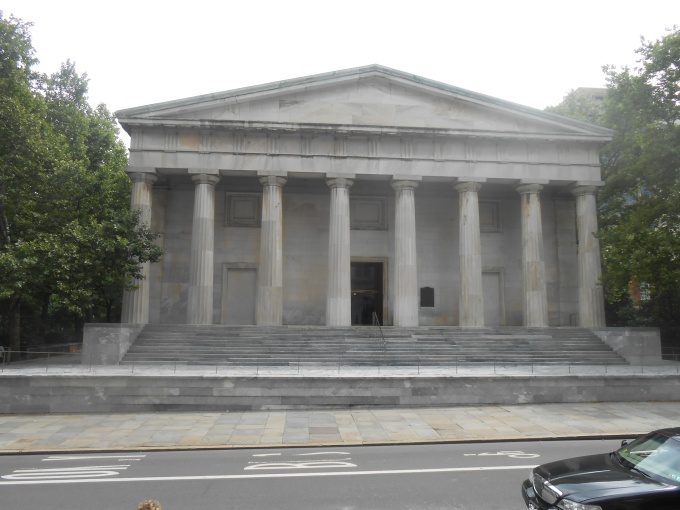
Second_Bank_of_the_United_States_-_north_side
Second Bank of the United States, Philadelphia

In which we see a contest of wills, and a wager on the future of the American economy

Kids, we need to talk about Andrew Jackson again.
—What did he do this time?
Well, Jonah, he’s been up to his old tricks.
—What is it what that guy?
What do you mean?
—I mean, what is it about that guy? I don’t get him.
Essentially, Jackson was a Jeffersonian small government man.
—But you said Jefferson hated him.
Well, like I said the other day, it was more like Jefferson feared him: feared the way ignored the rule of law, and feared the popularity he seemed to have because of it. But there was an underlying continuity there. And it’s important to understand that it’s not simply the small-government thing: that was a means to an end. The end was championing the cause of the little guy (and I guess I do mean guy in this context). When Henry Clay looks at Brianna, the proprietor of the of the Yankee Shoe Company we talked about in our last class, he sees a story of upward mobility that’s honorable and worth encouraging. When Jackson looks at Brianna of the Yankee Shoe Company, he sees an oppressor in the making: someone who’s looking for an unfair advantage that will put her even farther ahead than she already is.
—When you put it that way, I guess he has a point.
Right. You suggested so that day. So you’re a Jacksonian, then, Em?
—I’m not sure.
Fair enough. In any case, once John Quincy Adams was defeated for re-election as president in 1828, it was clear who President Jackson’s main adversary would be: Clay. Jackson hated Clay. That went back to Jackson's invasion of Florida circa 1818, when Jackson invaded to stop Native American raids and Adams protected him over the objections of Clay, who he thought was playing with fire. (Kind of a curious reversal of roles thereAdams was usually the one who played it straight.) Now that Jackson is president, he’s on the lookout for opportunities to give Clay a kick in the ass. And he gets one right away in 1829, the first year of his presidency, with a project called the Maysville Road.
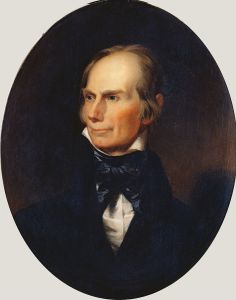
HenryClay
Henry Clay
The Maysville Road was an idea close to Clay’s heart, a perfect illustration of the way how what Clay called “internal improvements” would advance his American System. The road was to run from one end of Kentuckynot so coincidentally, Clay’s home stateto the other. Look at the map: Kentucky is centrally located, particularly in the United States of 1829, with borders on eight different states. Clay argued that the road would facilitate traffic and trade for the nation as a whole. Nothing doing, Jackson responded: there’s no way I’m going to approve spending federal money on a road in a single state. He vetoed the bill authorizing the Maysville Road, and it died.

—Don’t fuck with me, Henry Clay.
I’m shocked that you remember that slogan from a few classes ago, Ethan.
—It’s what you wanted, isn’t it?
Yeah, I guess. It works. In any case, Henry Clay was hardly through, um, shall we say fighting, with Andrew Jackson. By the early 1830s, the two had emerged as the leaders in what was now a bona fide two-party system that succeeded the old Federalist/Democratic-Republican opposition. As I mentioned, Jackson inherited the Jefferson-Madison mantle, whose supporters were now known as Democrats. (Their opponents considered them a bunch of jackasses, an image that the Democrats adopted as a badge of honor, and indeed is the party icon to this very day is that of a jackass.) Clay became the leader of the Whig Party. Their name came from the Revolutionary erain both Britain and America, the Whigs positioned themselves as opponents of corrupt and arbitrary power. Jackson may have considered himself the champion of the people, but they saw him “King Andrew,” who acted arbitrarily and in defiance of the good of the people as a whole. For the next few decades, the Second Party System, as it was known, shaped American politics.
And few people played politics better than Henry Clay. With the election of 1832 on the horizon, Clay came up with what he regarded as a perfect plan to defeat Jackson’s re-election and vault to the presidency himself. Anybody remember the National Bank?
—That was Alexander Hamilton’s thing, wasn’t it? To promote industry and trade?
Excellent, Adam. Hamilton got the bank through Congress, which chartered it for 20 years. It was in existence from 1791 to 1811. In 1816, recognizing that it had benefits, the Madison administration created the Second Bank of the United States, which helped the rising national economy during the so-called Era of Good Feelings. The Second Bank was chartered to run for another 20 years, until 1836. Like its predecessor, it was controversial. Critics felt it didn’t really help anyone but the fat cats. Jackson in particular loathed the bank. The problem was that by this point is that it was well established, had friends in high places, and that getting rid of it would be difficultand, given the uncertainty doing so would create, even dangerous.
This allowed Clay to set a trap. As he made plans to launch his presidential campaign in 1832, he announced, four years early, that he was a strong proponent of the Second Bank, and that if elected he would certainly support re-chartering it. No surprise there. Here’s the problem for Jackson: he wanted end the bank, and his supporters were counting on him to do it. But saying so could set off panic and wreck the economy. So what’s it gonna be, King Andrew? Weak or reckless? Go ahead: choose.
What do you think Jackson did?
—Don’t fucking fuck with me and your fucking bank, Henry fucking Clay.
Could you translate that into policy, Ethan?
—He means Jackson came out against the bank.
Right. He called Clay’s bluff, famously saying, “The bank is trying to kill me. But I will kill it.”
—But you said that would be dangerous. So what happened?
The Jackson administration in effect constructed an alternative banking system. It began siphoning the government’s money out of the Second Bank of the United States (which was in Pennsylvania, as New York had not yet displaced Philadelphia as the largest city and financial capital of the nation) and putting it in a series of smaller “pet banks” in other states around the country. The pet banks, now gorged with cash, began lending it out feverishly, since banks need to lend money to make money. Jackson cruised to re-election in 1832, and the economy grew in the years that followed. But the pet banks couldn’t really handle all that money. They made lots of loans they shouldn’t have, and the Jackson administration, getting worried about growing profligacy, issued an executive order that any money owed to the United States government had to be paid in gold and silver, not bank notes.
—What do you mean by bank notes?
In those days, there were no dollar bills of any denomination in the way we understand the concept. That didn’t happen until the Civil War. Instead, each bank issued its own bills. Let’s say I put $8 in gold in Paolo’s bank. I’d get a receipt in the form of a piece of paper. The idea would be that after a certain point I’d be able to cash in that paper and get $10: the eight bucks plus another two in interest. So the piece of paper I’d be given would be a $10 note. Now let’s say I did a business deal with Kylie, and I owed her $9. I might say to her, “Here, Kylie, take my $10 note. I owe you $9, but I’ll pay you $10 for your trouble for schlepping to my Paolo bank (she usually puts her money in Chris’s bank) and the fact you have to wait a little to get your money. But Kylie can’t waitor maybe she’s just get nervous about Paolo bank’s financial stability. So she goes to the bank and gets $8.50, because fifty cents is all my original $8 investment has made so far. (Or maybe even less than $8; it will depend on the situation at the time.) To put it another way, my $10 note has depreciated in value. This is just one example of the kind of transactions that would take place. You can see how it could all get pretty complicated pretty fast. That’s why a nervous Jackson administration said: No paper, just precious metal. The problem is when the government does this, everyone else starts doing it, too. And so, in 1837, the U.S. economy crashed, hard, in an event known as the Panic of 1837.
—So Jackson must have become seriously unpopular at that point.
Well, let’s do the calendar math, Kylie. Jackson was elected in 1828, and took office in 1829. In 1832 he was re-elected, and his second term began in 1833. In 1836, he announced he wasn’t running againtwo terms was generally accepted as the limit, and Jackson wanted to retire. So the new president, Martin Van Buren (I’m going to be talking more about him in a minute) was elected in 1836
—And he took office in 1837. Just in time for the depression.
Right.
—So Jackson got away with wrecking the economy.
You could say that, Adam. You could also say that Jackson had legitimate concerns about the size and scope of the Second Bank of the United States, which had the potential to become a corrupt and oppressive force in the American economy. After Jackson destroyed the national bank, the nation went about 75 years before it was resurrected in the form of the Federal Reserve by President Woodrow Wilson in 1913. Significantly, though, the Fed is not a single entity. Here: I’ve got a bunch of $1 bills in my pocket. See this little circle on the left side of Washington’s face? There’s a stamp with a letter and a location. This bill came from the Federal Reserve in St. Louis. I’ve got another here one from Richmond. And a third from Chicago. The Fed in New York is by far the biggest and most important, but Jackson’s insistence on decentralization never entirely disappeared. And here I’ll note that Wilson was a Democrat, and as such was an inheritor of the Jefferson-Jackson tradition. He was also a ProgressiveI’ll explain more what that means next semesterwhich complicates the picture. But it matters that Wilson was a Democratic Progressive, in contrast to his Republican Progressive opponents like Theodore Roosevelt, who was more of a Hamiltonian. But we’ll get to that later. For now you can see that the basic fault line that emerged in the early years of the republic between Hamilton and Jefferson continued long after the left the scene.
—You’re saying that Jackson was a states’ rights kind of guy.
I am saying that, Adam, and it's good that you realize it. And having said that, I’m now going to take it back.
—No, please. Don’t do that. This is complicated enough to understand as it is.
Sorry, Kylie. History is complicated.
—Fine. Just as long as this isn’t on the test.
This is the test: I’m seeing how much complexity you can handle. You're passing.
—I'm not. But whatever.
—You can’t stop Mr. K. when he’s on a roll.
Kids, I think we understand that when it came to the economy, among other issues, Jackson was indeed, to use the term Adam just did, a states’ rights devotee. But that wasn’t always true. Remember that Tariff of Abominations I talked about yesterday? Somebody remind us.
—It was that tariff nobody wanted. But it was also designed to hurt JQA.
Right, Jonah. But now JQA was gone, and that tariff was still around. Southerners in particular hated it. Why?
—Because they weren’t interested in factories. They had cotton farms. And they want the cheap shoes.
Right again. Here’s another side of it: Southerners sold their cotton abroad, especially to England. They were afraid that if the United States put tariffs on foreign goods, foreign countries would slap tariffs on theirs. And that would hurt their business. The South wanted a Walmart economy: cheap goods produced with cheap labor. And for them, cheap labor meant slave labor.
Now it’s at this point in the story that we get into some gender politics.
—Well, it’s about time, Mr. K.
Hey, they’re never far from the center of the story, Emily.
—Well, it would be nice to have them in the center more often.
Will do.
Next: Abominable behavior

Friday, October 28, 2016

King's Survey: House Work, 1824

In which we see a crazy presidential election inaugurate a new chapter of American history.
Andrew_jackson_head
Andrew Jackson

So here we are, kids, at the presidential election of 1824, and it’s shaping up to be like no other in American history. Up until this point, there have been a total of five presidentsWashington, Adams, Jefferson, Madison, and Monroeand all of them, except Adams, had served two terms. All except Adams had been Virginians, too. In each case there was a sense that it was the given person’s turn, and while some elections had been contentious, the Founding Fathers had resisted casting their choice simply as a matter of politics and ideology: for them “party” was a four-letter word. By this logic, John Quincy Adams, or JQA, son of the second president, was next in line. He certainly thought so, and he certainly thought he should not have to fight for a job he very plausibly believed he was best qualified to fill.
But the world was changing by 1824. Though the Federalists were spent as a political force in national politics, there were tensions in the old Jeffersonian Democratic-Republican coalition between generations (the younger crowd was generally more comfortable with a more assertive federal government). There were also new faces on the scene, like Henry Clay of Kentucky, and John Calhoun of South Carolina, the so-called War Hawks who had egged President Madison to declare the War of 1812. There was also William Crawford of Georgia, who would ultimately have to drop out of the race because he fell ill. None of these men were willing to simply defer to JQA.
And then there was Andrew Jackson. He wasn’t exactly a new face in 1824he’d been a national celebrity for about a decade by that pointbut he certainly was an outsider. This was true in a number of respects. For one thing, he was not a professional politician. For another, he was a man of the West, hailing from a state admitted to the Union after the Revolution. Jackson’s policy positions weren’t very clear, but that worked in his favor; his champions read what they wanted into him, and in any case saw him as a new and fresh voice.
So, what do you say, kids? Do we go with Jackson? Or Adams? Or maybe one of the other candidates?
—Tell us a little more about the other guys.
John_C._Calhoun
John Calhoun

Well, Adam, I won’t bother with Crawford, since he withdrew. Calhoun is an interesting guy. At this point in his career, he’s a strong nationalist. But Calhoun is from South Carolina, which is a slave state, and, increasingly, a cotton state. The evolving cotton economy has strong ties to the national government (New York banks, for example, lend a lot to plantation owners trying to buy land, slaves, and equipment), but there’s also anxiety about the feds interfering with what they call their “peculiar institution.”
—What’s that?
Slavery. South Carolina, and the South generally, is literally and figuratively becoming ever more invested in it. And that’s affecting its stance on any number of other things. There’s a fear, for example, that giving the federal government the power to do anything in the economy might eventually legitimate its ability to regulate slavery. Calhoun will soon be drawn ever more tightly into the orbit of this slaveocracy, as it was known. But for now, he’s got his eye on the presidential prize. A famous observer at the time, Harriet Martineau, describes Calhoun as “the cast-iron man, who looks as if he had never been born and could never be extinguished.” But a little spoiler, here, kids: this isn’t Calhoun’s time. He will end up vice president, though, and that will prove very interesting.
—Sounds more like a teaser than a spoiler.
HenryClay
Henry Clay

So be it. The guy I really want to talk about now, though, is Henry Clay. Clay, was born in Virginia but moved to Kentucky as a young man because he thought he’d have more opportunities on the frontier (it was Clay who coined the term “self-made man” to describe the widespread reality of upward mobility in the United States, of which he considered himself a prime specimen). Clay was the quintessential happy warrior. Nothing seemed to please him more than a worthy adversary and a good bottle of whiskey. His nicknames“the gamester”; “Prince Hal”; “Great Harry of the West”suggest his playfulness and informality. After serving in the Kentucky legislature, Clay was elected to finish the term of a Senator who left to take another job in 1806. No one seemed to notice, or at any rate mind, that Clay was only 29 years old, a few months shy of the Constitutionally mandated 30. What may be more amazing is that when Clay was elected to the House of Representatives in 1810, he instantly elected Speaker of the House. He was one popular guy.
There was more to Clay than that, though. He was Alexander Hamilton with social skills: a pragmatic visionary. Like Hamilton, he had a vision for his country that he called “the American System,” the details of which I’ll get into later. Suffice it for now to say that Hamilton was like Clay in his belief that manufacturing was the key to the nation’s economic future, as was a strong national government to stitch the nation together with things like roads and canals. The difference was that Hamilton was an avowed elitist; Clay couldn’t afford to be. Not in a country that was rapidly becoming one where any white man could cast a vote. That doesn’t sound like much to you, I know. That glass is half emptymaybe more like 2/3 or ¾ empty. But it was a big deal at the time.
Clay was a slaveholder. He also opposed slavery.
—How could that be?
People can be complicated, Sadie.
—About that? How could you be on both sides of that?
Ask Thomas Jefferson (who’s still around in 1824, by the way). Are you opposed to poverty?
—Of course.
Are you willing leave your home and give up your goods in the name of economic equality? Or to equalize funding for all school districts, which would mean this school is less good than it is now?
—That’s different.
Is it?
—Yes.
Let’s agree to disagree for the moment. Clay was a charter member of the American Colonization Society, which sought to buy freedom for slaves and send them send slaves back to Africa. An impractical idea that passed for philanthropy at the time. Jefferson was a member of that club, too.
—So they were racist.
Yes, Emily. And your epidermis is showing.
—What?
—He means your skin, Em.
Right, Adam. To call Henry Clay a racist is to state the ragingly obvious: virtually every white person in the 19th century was racist by our standards. Even abolitionists far more committed than Clay ever was to ending slavery sound painfully condescending. It was a different time with different standards for appropriate attitudes and conduct.
—Maybe so, Mr. K. But at least there were people out there against slavery trying to do the right thing.
Yes, there were, Sadie. And Clay was no saint. He was an ambitious guy trying to do and say what he needed to get elected, trying to find a majoritarian sweet spot in the middle of a road where the middle keeps moving. Which is to say that he was a politician. But people can be politicians in different ways, as we’ll see. Clay was a slaveholder. As was Calhoun, and Crawford, and Jackson. Adams wasn’t: the Adams family was relatively good on the slavery issue. So maybe he has your vote, then? There were certainly peoplenot a lot, but somewho favored him for that reason. A lot of them were women. But of course women couldn’t vote.
—Yeah, Adams gets my vote.
Fair enough. Any other takers?  Raise your hands. Adam, I see we have you. And Em. And Brianna, Ethan, and Jonquil. Brianna and Chris. Looks like JQA wins this election.
—I don’t really get Jackson’s appeal.
Really, Yin? Why is that?
—Well, I get that he’s a soldier who’s won lots of battles. And that he’s new. But what was so great about him?
Let me tell you a little story that might help. Jackson had a wife, Rachel, whom he adored. She had been married. But her first husband left her and disappeared without a trace (not all that uncommon at the time). After a decent interval, she and Jackson married. But then her first husband, to whom she was still legally married, returned. Not a big deal: they worked it all out. But for a time, Jackson was technically a bigamist. There was a guy named Charles Dickinson who made fun of Jackson about this. So he challenged him to a duel.
—Naturally.
Right. You know the drill. Dickinson gets the first shot. He aims, fires, hits Jackson in the chest. And Jackson just stands there.
—Wait. Really? How can that be?
Now it’s Jackson’s turn. He coolly takes aim, fires, and kills Dickinson. Only then, after Dickinson is dead, does Jackson fall to the ground, injured: He wasn’t going to give that son of a bitch the satisfaction of knowing he was hurt. Jackson would carry that bullet around for the rest of his life.
—Don’t fuck with me, Dickinson.
You got it. Old Hickory: tough as nails. Such stories about Jackson were legendary. That help, Yin?
—I guess. Not really my thing. But I guess it would appeal to a lot of men at the time.
Exactly. Clay may have been likeable (maybe a little too likeable; there was sometimes a perception that Clay was on the slick side). But Jackson was thrillingly his own man, an embodiment of the rugged individualism that was emerging as a widespread ideal of the time. Anyway, the presidential election of 1824 was unusual from start to finish. After the votes came in, two things were clear: Jackson had the most popular votes, but he didn’t have enough votes in the Electoral College. Does anybody remember what happens in that case?
Anyone? Had it ever happened before?
—Oh yeah. With Jefferson.
Good, Jonah. Can you remember how that went?
—There was the whole Hamilton thing.
Right. But what does the Constitution say?
—There’s a vote in Congress.
Yes. In the House of Representatives. Each state delegation decides on a candidate. As you might imagine, the jockeying was intense. But when the dust settled, two things had happened: Adams won the Electoral College. And Clay was announced as the new Secretary of State.
—So they made a deal.
Oh no no no, Ethan. Not as far as the Jackson camp was concerned. This was no mere deal. It was a corrupt bargain. A massive fraud perpetrated on the American people.
—That seems a little much.
Yes, Sadie, it does. And it did then, to a lot of people. Certainly there was no law against a deal between Adams and Clay, and there had been many like it before and since. But the fact that Jackson had been deprived of the presidency despite winning a majority of the votes rankled a lot of people. Of course, it was precisely to stop people like himpeople who might be massively popular, but also deeply troubling to the elites who run the countrythat the Electoral College had been created for the first place. It was a circuit breaker, a device to prevent a dangerous power surge. It worked precisely as it was supposed to, much to the relief of Jefferson and Old Man Adams, who was approaching ninety years old. It was during JQA’s presidency, on July 4, 1826 that both Adams and Jefferson died.
—The same day!
Yes. Adams’s dying words were, “Jefferson survives.” (He’d died a few hours earlier.)
—So what happened after John Quincy Adams became president?
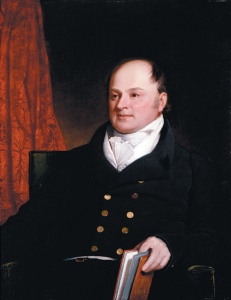
John_Quincy_Adams
John Quincy Adams
JQA had a simply miserable presidency. Let’s face it: he might have your vote, but the guy was an Adams, after all. JQA had many gifts, but a common touch wasn’t one of them, and in this new day and age, that was a real problem. Adams wanted things like a national university, and major infrastructure projects like a system of lighthouses that were simply out of touch with the tenor of his times (though in certain respects you might say he was ahead of his time). But in another sense, none of this mattered. Jackson supporters dogged him all through the mid-1820s, culminating in a complicated maneuver that resulted in a tariff they hatedit was known as the Tariff of Abominationsas part of a scheme to weaken Adams. Henry Clay tried to help out by dredging up the Rachel Jackson bigamy story, and some stories about Jackson ordering he execution of American soldiers for disciplinary infractions. (A Jackson supporter came up with a story that JQA procured women for the Tsar of Russia, which really stretches credulity.) But it was no use. When the presidential election of 1828 came along, JQA was toast. He was crushed by Jackson.

—Don’t fuck with me, John fucking Quincy fucking Adams!
Ahem. It was a new day in American politics. The inauguration of Jackson in 1829 was followed by a party of the kind the nation had never seenby which I mean a frat party. Revelers wrecked the White House furniture. A gigantic wheel of cheese
   —Cheese?
Yup. A huge wheel of cheese was rolled up on the White House lawn. Jackson himself slipped out during the festivities. But the party raged on. And party, by the way, was no longer a four-letter word. Jackson fired all the old-timers in senior positions and brought in his own people, his so-called Kitchen Cabinet. From this point on, it became an accepted fact of American politics: a new administration meant jobs for a president’s supporters.
The question now was what Jackson was going to do now that he was in power. And on that count there were a lot of curious people. I hope you’re one of them. Because I’ve still got a few things to tell you.
Next: Shoe story