Showing posts with label Henry Clay. Show all posts

Wednesday, November 30, 2016

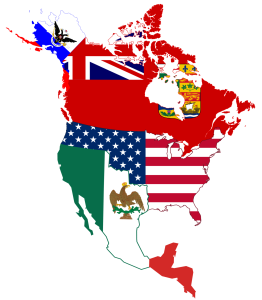
King's Survey: Compromising Situation, 1850

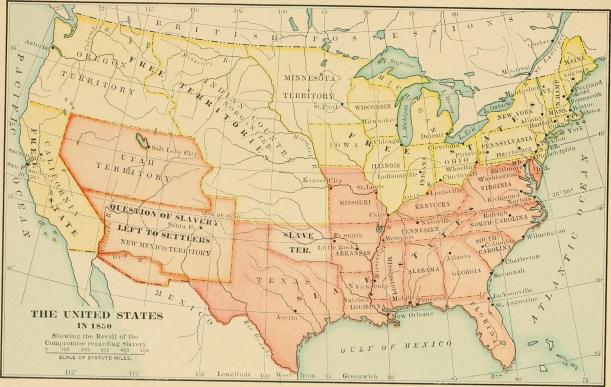
Compromise1850map

In which we view a nation teetering on the edge, and pulling back (for the moment)  

OK, kids. So I think we need to take a little stock of where we are in the United States of America in the Year of Our Lord 1850. Texas is securely in the Union as a slave state. The Mexican War is over. Gold has been discovered in the newly acquired territory of California. It appears that the manifest destiny of the nation is indeed to stretch from sea to shining sea, and amid a booming economy, there are efforts afoot to stitch it together with an transcontinental railroad. You might say things really couldn’t be better.
And yet the national mood is miserable. Tell me why.
—Because of slavery.
Yes, Jonah. But what about it?
—Well, people can’t agree on it.
Agree on what?
—Where it will go.
Yes: where it will go. You make a very important point. Where slavery is—and isn’t—is regarded as settled. The argument is over the future of slavery. Proslavery advocates are becoming more and more convinced that the peculiar institution, as it’s known, must expand, which is why they’re hatching schemes like taking over Cuba or founding a colony in Nicaragua. Antislavery activists are becoming more and more convinced that it must not. Both agree, largely implicitly, that if slavery stops growing it will die. There are also some curious tensions, contradictions, hypocrisies. As we discussed, proslavery advocates have long been suspicious of national government power for any reason except the protection of slavery, because they fear that power could be used to regulate or destroy it. Antislavery advocates have generally favored a stronger federal government, except when it comes to things like enforcing the return of fugitive slaves. The effect of all of this has been gridlock: it’s getting harder and harder to get anything done.
—Maybe we need a war.
Now Ethan, that’s really offensive. War talk is sensational and inappropriate. I demand that you apologize right now, young man.
—Are you serious?
—Really, Ethan. Don’t you know by now when Mr. K. is in drama mode?
I have no idea what Emily is talking about, Ethan, but I do apologize. I guess I just got carried away. It’s just that there’s been so much irresponsible talk lately. All the abolitionists on one side, fire-eaters on the other. People tend to forget that both sides are really minority voices. Most of us don’t care about slavery one way or another. We just want peace!
—Fire-eaters?
—Probably means proslavery people.
—Sounds like Harry Potter.
—Cool term.
—Cool fire-eaters. Brilliant, Jonah.
So what are we going to do, kids? How can we break the gridlock?
—I have no clue. But I have a hunch you’re about to tell us.
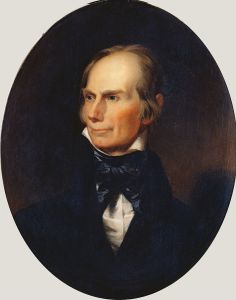
HenryClay
Henry Clay
Well, yes, I am. But first I want to bring back our old friend Henry Clay.

—Jeez, Mr. K. You’re obsessed with that guy.
Yeah, well, Em, a lot of us are. But in 1850, Henry Clay is an old man. He’s been dominant force in American politics for over forty years. He’s an antislavery slaveholder from agrarian Kentucky who seeks to promote the industrial revolution
—That doesn’t make any sense.
What? You're confused by the notion of an agrarian industrialist?
—Nevermind that. Antislavery slaveholder?
Well, he’s not an abolitionist, for God’s sake, Em. Yes, he owns slaves. But he’s looking forward to the day when slavery is gone.
—What a hypocrite. How can you be for something and against something at the same time?
Kylie, are you an environmentalist?
—Me? Sure.
Then why are you drinking whatever that is from a plastic bottle? You say you’re in favor of saving the environment at the very moment you’re destroying the environment!
—Oh, c’mon, Mr. K. That’s unfair to Kylie. You’re being ridiculous.
Am I, Em? Or am I simply pointing out that people are complicated?
—No. You’re just being ridiculous.
So says a former supporter of Andrew Jackson. I know where you’re coming from Em.
—You are impossible.
Why thank you, Emily. Anyway, Henry Clay is old, and he’s dying, but he’s still a patriot. And he’s been thinking very hard about what might save the country from disintegrating. He’s put together an interlocking series of proposals known as the omnibus bill.
—What does omnibus mean?
—Isn’t it like a bus?
In a way, yes. “Omnibus” basically means multiple. Like kids on a school bus. The idea here is Clay’s bill consists of a set of proposed laws. If you vote in favor of it, you get the whole thing. It will have stuff you like, but also stuff you don’t.
— Like a streaming service. You pay for all the shows, but only watch some.
—Or a combination plate at a food court. You get a good price on the whole thing, even if you don’t eat everything.
Right. Clay figures that’s the only way to get the job done. In a spirit of a compromise. Here are the highlights of the bill:
  1. California comes into the Union as a free state.
  2. The slave trade ends in Washington DC (a lot of people really hated the fact that slaves were bought and sold in the nation’s capital).
  3. There’s a new stronger fugitive slave law. I’ll talk about this in more detail later.
  4. Rather than decide now what will happen to the Utah and New Mexico territories (a whole bunch of future states there, but not for a long time—Arizona, for instance, doesn’t enter the Union until 1912a new principle, known as “popular sovereignty” will be used to determine whether such states will be slave or free. The voters will choose rather than Congress deciding.
  So, what do you think?
—The first two ideas seem to favor the North. The third one the South. The last one breaks even. So the overall law seems pro-Northern.
A reasonable assessment, Ethan. But point number three is a big one. Again, I don’t want to get into it right now. But suffice it to say that in Clay’s mind, at least, the overall package was truly balanced. What do you think, Sadie?
—Sounds reasonable. Does it work?
No.
—Oh. Why not?
Well, that’s complicated, by which I mean you ask ten people you’ll get ten different answers. I will tell you that old man John Calhoun, who had been at it as long as Henry Clay and was in fact on death’s door, told his fellow Southerners to reject the bill, and he had a lot of influence in the Senate. Senator Daniel Webster of Massachusetts—remember him? We talked about the big speech he gave, “Liberty and Union, now and forever” a while back—came out in favor of the bill, and got a lot of grief over it. Clay was known as “the Great Compromiser”—remember, he’s the guy who got the Compromise of 1820, a.k.a. the Missouri Compromise through Congress—but he just couldn’t summon the old magic.
—So what happened next?
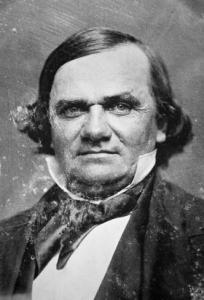
Stephen_A_Douglas_private_collection
Stephen A. Douglas
What happened next is counter-intuitive. Remember that the whole basis of Clay’s approach was compromise: you take a little, you give a little. He assumed the bill had to work as a package. But in the aftermath of the vote, another senator came forward, a younger man named Stephen A. Douglas of Illinois. (You haven’t heard the last of him.) Douglas was a Jacksonian Democrat. But like Clay, he considered himself a patriot. What he did was break up the Omnibus Bill into separate pieces. An he got them passed one by one.


—How did he do that?
A very good question, Yin. The short answer is horse trading. So take the California piece for example. He’d go do you, a Southern senator, and say: Hey, I know you hate this bill. But if you pass it, I’ll make sure you get that bridge you want for your state. Or the railroad going through your town. That kind of thing. It was very complicated, and exhausting, but it worked. And before the year was over, President Millard Fillmore—the non-entity who followed the forgettable Zachary Taylor, who died a few weeks into office—signed the Compromise of 1850 into law.
—So what happened then?
Peace in our time, of course. Crisis averted.
—Well, we know that didn’t happen. So what went wrong? Who blew it?
Stephen A. Douglas did. But a few things had to happen before he could. We’ll get to them.
—Such drama!
All in a day’s work, kids.
The compromised compromise

Monday, November 21, 2016

King's Survey: Mexican Mess

In which see see how politics can be a matter of avoiding stands, and the price that policy exacts.  

TexasQuestionMapDammit, Emily, I need to know where you stand on the Mexican War!
—And good morning to you, Mr. Abraham King.
—I think that’s a highly inappropriate question, Mr. K. Asking the political views of a student like that. Especially with poor, timid Emily.
Oh you do, do you, Sadie? Well for your information, this “student” is running for president of the United States in this Year of Our Lord 1844, and there are millions of American voters who wish she would clarify her position on this decisive issue of our time!
—Honestly, I don’t think I can be any more clear on that issue.
Ha. Sounds like standard Whig sophistry.
—What the hell does that mean?
You know exactly what I’m talking about, Jonah.
—No, really. I have no idea what “standard Whig sophistry” means.
You actually want me to spell it out for you?
—Well, not particularly. But given that class has just started and I don’t really have anything better to do, since you won’t let me whip out my phone, you might as well explain.
With an offer like that, Jonah, I can hardly refuse. As you all know, the current controversy goes back about a dozen years to what we called “the Texas Question.” The word “Texas” once referred to a region of Mexico. Mexico, of course, was a Spanish colony. It won its independence in 1821. At that time, Texas, like northern Mexico generally, was sparsely populated. The government hoped to promote economic development by inviting los Yanquis into the region. There were three conditions: the Americans would have to become Mexican citizens, convert to Roman Catholicism and give up their slaves. The Yankees flooded in, but they didn’t honor any of these terms. And when the Mexican government prodded them about it, they went to war to declare their independence.
—Isn’t that when the Alamo happened?
Yes, Adam, It is. A group of Yankee holdouts at that fort in San Antonio lost their lives to a surrounding Mexican army. But the quest for Texas independence was successful in 1836. In a way, though, that was a consolation prize. The leaders of the new Texas government did not really want to be an independent republic: they wanted to join the United States. The problem was that large segments of the American public, particularly in the Northern states, did not particularly want Texas, which would be a slave state, to join the Union. So while President Jackson supported the effort, it could never get through Congress, and Texas lived in limbo as its own country for the next nine years.
—Sound like kind of a sweet deal to me. Why not be your own country?
Well, Ethan, many of these Texas leaders, like Sam Houston, were Americans, even if most of the people who lived there were not. There were also trade considerations. And the matter of military protection. Texas and Mexico squabbled over their border; the Mexicans said it was at the Rio Nueces, while the Texans said it was the Rio Grande, and as you can the territory between those two rivers is a pretty big piece of real estate. The people who advocated Texas annexation pointed out that if the United States didn’t go ahead and do it, Great Britain might get involved (remember, this is a moment when the U.S. and Britain were squabbling over the borders of the Oregon territory).
—Sounds complicated.
Well, Yin, it was, at to some people. But there were others who saw the matter in amore straightforward light. Like James K. Polk. Polk’s nickname was “Young Hickory.” Anyone know why?
—Because he was wooden?
Nice try. Let’s try it this way: to say that Polk was young Hickory implies that there was an old Hickory. Anyone know who “Old Hickory” was?
—Oh, Mr. K. That like so totally gives it away. Old Hickory! Duh!
Love your sincerity, Em. Well, one more angle. I think I touched on this when we talked about him a while back. Hickory is a very hard wood. It’s tough.
—Andrew Jackson!
Ding ding ding! Ten points for Jonah. Polk was a favorite of old man Jackson, who in fact is near death in 1844. But he’s strongly in favor of Texas annexation, and when the Democratic Party deadlocks over the candidacy of former president Martin Van Buren, who’s trying to make a comeback as an antislavery Democrat, the party turns to Polk, a so-called “dark horse” who comes out of nowhere to take the nomination. The key to Polk’s appeal is his straightforward simplicity. Elect me he says, and I’ll only serve one term. But in that term I’ll work out the Oregon thing, work out the Texas thing, and realize the “Manifest Destiny” of the United States to stretch territorially from sea to shining sea.
—Yeah but what about slavery?
A good question, Adam. Polk is a Tennessee slaveholder. He’s happy for Texas to come into the Union as a slave state, as are all of the slaveholding states. He’s also got the support of the old Jacksonian coalition up North, though its solidity is weakening a bit. Which is exactly why we need to know where Emily, a.k.a. Henry Clay stands in all of this.
—That’s funny. Emily doesn’t look like Henry Clay.
—Sure she does. Sexy Beast. Love that Clay hair.
—What hair?
—It’s wispy. Totally cool.
So what’s it going to be, Em?
—Like I said, I couldn’t be more clear.
Oh, you’re too modest. We need to know: are you going to oppose annexation, and anger southern Whigs (and, very possibly, the majority of the electorate), or go along with it, and anger northern Whigs (who are probably more numerous and loyal) and abolitionists (who are annoying weirdoes, but increasingly influential)?
—Geez, Mr. K., you sure know how to pressure a girl, or a guy, or whatever I am. Can’t I come down somewhere in the middle?
You can, and you do.
—Phew. Disaster avoided. Thank you.
Not exactly. You fudge the issue: you say you can go along with annexation of Texas as a slave state, as long as the Northern electorate goes along with it, which is a little like saying you favor abortion as long as no one gets killed. Polk may be reckless, but at least you know where he stands. It’s sort of the worst of all worlds for Clay because he pleases nobody. That includes the abolitionists, who find the Whigs too timid. They have their own party, the Liberty Party. They get 2% of the vote. That 2% is enough to deny you the presidency, Henry Clay.
But let me shift my gaze from Senator Clay for a moment You happy now, abolitionists? You with your goddamned moral purity have landed a slaveholder who’s determined to expand slaveholding into across the continent in to the White House. Congratulations! This is what your radical activism has achieved. With friends like these, who needs enemies! Am I right, Mr. Clay?
—A little harsh. Mr.-K.-in-the-1840s. But kinda fair.
—No it isn’t, Em. Slavery is wrong. They said so. You’re telling me that the abolitionists, and not the slaveholders, are the real problem here? That’s what’s unfair.
—It’s not a question of what’s right or wrong in terms of the election, Sadie. It’s a question of what’s likely to work. The abolitionists may have been right, but they were dumb.
Kylie, what do you think?
—Well, I know slavery did end. So the abolitionists were on the right track.
Adam, you’re shaking your head.
—You can’t know the abolitionists were right in 1844. Who knows? Maybe if Clay won slavery could have ended without the Civil War.
How likely to do you think that would be, Adam?
—How should I know? But who’s to say I’m wrong?
Fair enough. In any case, Senator Clay, this election is strike three for you. You tried for the presidency in 1824, 1832, and now in 1844—and you’re out for good. But I still love you.
—Oh, well, that makes all the difference, Mr. K. And at least I don’t need to make any more difficult decisions.
Oh yes you do. There’s a war coming. And I want to know where you—and you, and you and you and you stand.
—Can’t we just sit back and have you tell us what to think?
Nope. History doesn’t work that way.
—Yes it does. Every time you read a book.
—Wait: Jonah, you’ve read a book?
—Well, not me, necessarily. I mean in theory. When you read a book you let someone else do the talking.
Maybe, but you shouldn’t let someone else do the thinking. You should be actively considering what the author is saying, and how, and how you feel about it.
—Yeah, but you don’t have to.
—Which is why we have history classes.
—Well, it’s why we have history classes like this. With Mr. K. stalking us demanding to know what we think.
—He doesn’t ask everybody what they think.
—Well, not every day. But there’s always that danger. Right Chris? Chris? Are you there, Chris?
—Uh ... Yeah, right.
Thanks, Chris, for that reality check.
Next: Spotty politics

Friday, November 4, 2016

King's Survey: Mrs. Eaton's Knocker

In which we see a woman's status shape the outcome of a dangerous national controversy
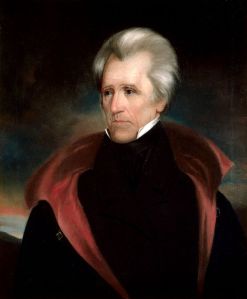
Andrew_jackson_head
Andrew Jackson

Andrew Jackson was the quintessential man’s man.
—Don’t fuck with me.
Exactly.
—Do you regret teaching us this slogan, Mr. K?
Well, I wince a little when I hear all of you say it. But I think it works. You get what Jackson was about.
As I was saying, the masculine character of the Jackson administration is very much a matter of gender (as is, conversely, the virtual absence of women from the story to this point). You remember that Jackson had a wife, Rachel, over whom he dueled and to whom he was very devoted. You also remember that the Jacksons hailed from Tennessee, which was a frontier state, and indeed Jackson’s reputation as a frontiersman was part of his rugged appeal. But the flip side of that appeal is that people from the frontier can sometimes be regarded as unsophisticated, even backward. Rachel Jackson was sensitive on this matter as the couple prepared to move to the relatively (and I do mean relatively) cosmopolitan city of Washington DC after the election of 1828. And then, just after the election something shocking happened: she died suddenly of a heart attack. Jackson was convinced that his wife died of mortification about nasty gossiping behind her back, and was embittered about it for the rest of his life. And this is something crucial to keep in mind as we turn to the Tariff of Abominations, that law passed by the Jacksonians in the 1820s to hurt the Adams administration by placing very high tariffs on imported goods.
—OK. But what does Jackson’s wife have to do with the Tariff of Abominations?
I’ll tell you, Yin. The link is Mr. and Mrs. John Calhoun. As I said earlier, Representative Calhoun had run for president in 1824, and had spent his career as a nationalist War Hawk. In 1828, he accepted an offer to become Jackson’s vice president. But here’s the thing: by the early 1830s, Calhoun was moving more and more into the orbit of the South Carolina plantation aristocracy. That made him the chief spokesman against that tariff at a time when its critics were becoming ever more insistent.
—Yes, but how does Calhoun’s wife figure into this?
Peggy_O'Neale_Eaton
Peggy Eaton

Floride Calhoun was an elegant and influential Southern woman very different than Rachel Jackson. She also appears to have been something of a moralist and something of a snob. When Jackson came to Washington, President Jackson named a man named John Eaton as his Secretary of War. Eaton’s wife, Peggy, was a saloonkeeper’s daughter. There were also rumors that she had cheated on her first husband, who had reputedly committed suicide over the affair. As a result, Calhoun and her friends froze Peggy Eaton out, refusing to visit her home or invite her to theirs. When Jackson learned of this, he became enraged: as far as he was concerned this was exactly the kind of thing that had killed Rachel. His anger over this dovetailed with Calhoun’s growing criticism of the tariff, which Jackson didn’t like either, but which he felt Calhoun was too strident about, particularly after the tariff’s critics began talking about leaving the Union if their demands weren’t met. The term they used was “Nullification.”
—Like the Virginia and Kentucky Resolutions.
Very good, Sadie. There was also another incident where angry politicians, this time Northern ones, had also threatened secession. Anybody remember that?
—The Constitutional Convention?
Well, yes, Kylie, there was talk of Georgia and South Carolina pulling out, though these were Southern states. I was thinking of the Hartford Convention.
—The War of 1812.
Right. Just before the Battle of New Orleans, which had put Jackson on the map.
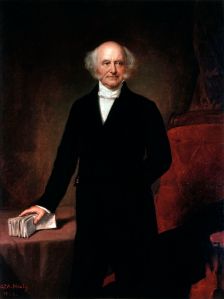
800px-Mvanburen
Martin Van Buren

Now, there’s one other person I need to bring in here, who I mentioned in passing earlier: Martin Van Buren. Van Buren, who came from upstate New York and was sometimes called “the Red Fox of Kinderhook,” is actually an important figure in American political history, because he’s really the first person you might call a “fixer”: someone who really organized campaigns and thought in terms of image and strategy, a role he played very effectively in managing Jackson’s political operations before and after he went to the White House. His primary nickname, “the Little Magician,” suggests his talents. There’s one other fact that important to mention here: Van Buren was single, and so he had no partner to get snagged in “the Petticoat Affair,” as the whole Eaton-Calhoun scandal was known. Recognizing which way the winds were blowing, Van Buren went out of his way to be nice to Peggy Eaton, visiting her frequently. Later, after he won the presidency himself, there was a joke that the political history of the United States got rewritten when Martin Van Buren touched Mrs. Eaton’s knocker.
—I don’t get it.
“Knocker” is a pun, Yin. It refers to a latch on a door that you use to signal that you’re at someone’s door, and a
—Boob.
Thank you, Chris.
—That’s so lame.
—I think it’s pretty funny.
Either way, Van Buren was playing his cards right. And Calhoun was increasingly estranged from the president. Actually, you might say Calhoun tried to pull a fast one at a dinner party honoring Thomas Jefferson in the spring of 1832. The party was attended by a big Nullification crowd, and Jackson was asked to give a toast in the expectation that he would lend his support to the cause. After all, Jackson was a Southerner, a slaveholder, and a states’ rights supporter himself. How could he not publicly side with Calhoun, however he might have felt about him? But instead, Jackson said, “Our Federal Unionit must be preserved.” It was an awkward moment.
—Don’t fuck with me, John Calhoun.
Yes: that’s exactly what Jackson was saying, Ethan, and that’s how everyone in the room heard it. An angry and humiliated Calhoun got up and gave a toast of his own. He said, “The Unionnext to our liberty most dear.” Thank about that for a minute.
—“Next to our liberty, most dear.”
Yes, Kylie. He’s damning the Union with faint praise.
— Don’t fuck with me, Andrew Jackson.
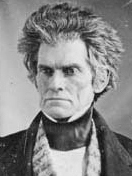
OldJohnCalhoun
John Calhoun

Right, Em. That’s also what he was saying. Calhoun was a pretty tough guy himself. Look at this portrait.
—Whoa. Scary.
Yup. But Jackson won this duel. Calhoun resigned as vice president after that to take a seat in the Senate, from which he would become one of the most powerful people in American politics. But his place was taken by our friend Martin Van Buren, who became Jackson’s hand-picked successor, and was elected president, an ambition that Calhoun was never able to realize. As we discussed, the presidency didn’t turn out so well for Van Buren, because he inherited the Panic of 1837. But the Little Magician would also be a real force in American politics despite that.
—So what happened with the tariff?
In 1832, Congress, with Jackson’s support, passed a new tariff that moderated the worst effects of the Tariff of Abominations. But this was not enough for South Carolina. It issued its famous “Ordinance of Nullification,” in November of 1832, which said that the state could ignore provisions of the 1828 as well as 1832 tariffs that it regarded as unconstitutional.
—He we go again. So what did Jackson do?
He sent the U.S. navy down to the South Carolina coast in December of 1832, threatening to invade. And then his supporters pushed through the a law known as the Force Billyou can guess it’s meaning by its name, as well as Calhoun’s opposition to it. The law authorized Jackson to send ground troops into the state if it refused to comply with federal law.
—Don’t fuck with me, South Carolina!
That’s pretty much the size of it.
—What did South Carolina do?
What do you think, Sadie?
—They backed down.
Yes. They repealed the Ordinance of Nullification. In the months that followed, there was another revision to the tariff, which allowed South Carolina to claim that the state had won concessions. But most people at the time and ever since viewed this as Jackson’s force of will prevailing.
—I don’t really get why Jackson felt so strongly about a strong national government. In every other way, he was states’ rights.
—It was a pissing context, Yin. He couldn’t back down to Calhoun.
—Really, Adam? Was he that petty?
—Sure. The women were that petty. They even called it the Petticoat Affair. Why couldn’t the men be as petty as the women?
—This was too important. I don’t really like Jackson. But I don’t think he was stupid.
Some people did think he was stupid. When Harvard gave President Jackson an honorary degree in 1833, John Quincy Adams was among the alums who boycotted the ceremony. Jackson joked he couldn’t respect a man who only knew one way to spell a word. Go head, Kylie.
—Maybe there’s no big mystery here. He was states’ rights in most ways, but he loved his country because it was states’ rights. There had to be some rules that everybody agreed on.
—But he was being inconsistent.
—Yeah, Yin, but that’s just the way people are sometimes.
 —I guess.
Emily, I want to go back to you. The other day, you voted for John Quincy Adams in the presidential election of 1824. Today, when we discussed economic policy, you came out as a Jacksonian.
—Came out, Mr. K?
Well, I wondered if you’re a closet Jackson supporter.
—I’m not a closet anything, Mr. K.
No, I guess not. I guess what I’m wondering is where you stand with Jackson now. Let me ask this: Will you be voting for Van Buren in 1836?
—Probably. He doesn’t seem to have the baggage Jackson does.
So are you saying that you like Jackson’s ideas, but not the man himself?
—I guess that’s what I am saying.
Oh good.
—Oh no. No “oh goods,” please.
Why not?
—Because “oh good” means you’re about to tell me something that’s going to make my brain hurt.
—No pain, no gain, Em.
—Oh shut up, Sadie. When’s the last time you went to the gym?
—I saw her there one Tuesday last April, Em. She’s been saying she has to go to the nurse every time she gets within five feet of the girls’ locker room.
—I do not, Brianna. I also bring doctor’s notes.
Well, we do have one more Jackson angle to consider. It involves women, and Indians. We’ll do that one tomorrow.
—I was just kidding about the doctor’s notes, Mr. K. Em and Brianna are lying. I really do go to gym. I hate it, but I go.
You’re a paragon of virtue, Sadie.
—Yup. That’s me. Off to math. Where we do parabolas, not paragons.
Next: the power of angry women

Wednesday, November 2, 2016

King's Survey: Breaking the Bank

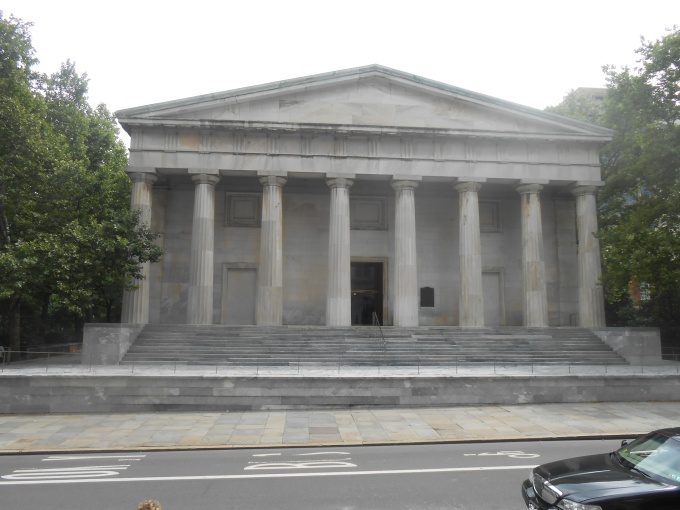
Second_Bank_of_the_United_States_-_north_side
Second Bank of the United States, Philadelphia

In which we see a contest of wills, and a wager on the future of the American economy

Kids, we need to talk about Andrew Jackson again.
—What did he do this time?
Well, Jonah, he’s been up to his old tricks.
—What is it what that guy?
What do you mean?
—I mean, what is it about that guy? I don’t get him.
Essentially, Jackson was a Jeffersonian small government man.
—But you said Jefferson hated him.
Well, like I said the other day, it was more like Jefferson feared him: feared the way ignored the rule of law, and feared the popularity he seemed to have because of it. But there was an underlying continuity there. And it’s important to understand that it’s not simply the small-government thing: that was a means to an end. The end was championing the cause of the little guy (and I guess I do mean guy in this context). When Henry Clay looks at Brianna, the proprietor of the of the Yankee Shoe Company we talked about in our last class, he sees a story of upward mobility that’s honorable and worth encouraging. When Jackson looks at Brianna of the Yankee Shoe Company, he sees an oppressor in the making: someone who’s looking for an unfair advantage that will put her even farther ahead than she already is.
—When you put it that way, I guess he has a point.
Right. You suggested so that day. So you’re a Jacksonian, then, Em?
—I’m not sure.
Fair enough. In any case, once John Quincy Adams was defeated for re-election as president in 1828, it was clear who President Jackson’s main adversary would be: Clay. Jackson hated Clay. That went back to Jackson's invasion of Florida circa 1818, when Jackson invaded to stop Native American raids and Adams protected him over the objections of Clay, who he thought was playing with fire. (Kind of a curious reversal of roles thereAdams was usually the one who played it straight.) Now that Jackson is president, he’s on the lookout for opportunities to give Clay a kick in the ass. And he gets one right away in 1829, the first year of his presidency, with a project called the Maysville Road.
HenryClay
Henry Clay
The Maysville Road was an idea close to Clay’s heart, a perfect illustration of the way how what Clay called “internal improvements” would advance his American System. The road was to run from one end of Kentuckynot so coincidentally, Clay’s home stateto the other. Look at the map: Kentucky is centrally located, particularly in the United States of 1829, with borders on eight different states. Clay argued that the road would facilitate traffic and trade for the nation as a whole. Nothing doing, Jackson responded: there’s no way I’m going to approve spending federal money on a road in a single state. He vetoed the bill authorizing the Maysville Road, and it died.

—Don’t fuck with me, Henry Clay.
I’m shocked that you remember that slogan from a few classes ago, Ethan.
—It’s what you wanted, isn’t it?
Yeah, I guess. It works. In any case, Henry Clay was hardly through, um, shall we say fighting, with Andrew Jackson. By the early 1830s, the two had emerged as the leaders in what was now a bona fide two-party system that succeeded the old Federalist/Democratic-Republican opposition. As I mentioned, Jackson inherited the Jefferson-Madison mantle, whose supporters were now known as Democrats. (Their opponents considered them a bunch of jackasses, an image that the Democrats adopted as a badge of honor, and indeed is the party icon to this very day is that of a jackass.) Clay became the leader of the Whig Party. Their name came from the Revolutionary erain both Britain and America, the Whigs positioned themselves as opponents of corrupt and arbitrary power. Jackson may have considered himself the champion of the people, but they saw him “King Andrew,” who acted arbitrarily and in defiance of the good of the people as a whole. For the next few decades, the Second Party System, as it was known, shaped American politics.
And few people played politics better than Henry Clay. With the election of 1832 on the horizon, Clay came up with what he regarded as a perfect plan to defeat Jackson’s re-election and vault to the presidency himself. Anybody remember the National Bank?
—That was Alexander Hamilton’s thing, wasn’t it? To promote industry and trade?
Excellent, Adam. Hamilton got the bank through Congress, which chartered it for 20 years. It was in existence from 1791 to 1811. In 1816, recognizing that it had benefits, the Madison administration created the Second Bank of the United States, which helped the rising national economy during the so-called Era of Good Feelings. The Second Bank was chartered to run for another 20 years, until 1836. Like its predecessor, it was controversial. Critics felt it didn’t really help anyone but the fat cats. Jackson in particular loathed the bank. The problem was that by this point is that it was well established, had friends in high places, and that getting rid of it would be difficultand, given the uncertainty doing so would create, even dangerous.
This allowed Clay to set a trap. As he made plans to launch his presidential campaign in 1832, he announced, four years early, that he was a strong proponent of the Second Bank, and that if elected he would certainly support re-chartering it. No surprise there. Here’s the problem for Jackson: he wanted end the bank, and his supporters were counting on him to do it. But saying so could set off panic and wreck the economy. So what’s it gonna be, King Andrew? Weak or reckless? Go ahead: choose.
What do you think Jackson did?
—Don’t fucking fuck with me and your fucking bank, Henry fucking Clay.
Could you translate that into policy, Ethan?
—He means Jackson came out against the bank.
Right. He called Clay’s bluff, famously saying, “The bank is trying to kill me. But I will kill it.”
—But you said that would be dangerous. So what happened?
The Jackson administration in effect constructed an alternative banking system. It began siphoning the government’s money out of the Second Bank of the United States (which was in Pennsylvania, as New York had not yet displaced Philadelphia as the largest city and financial capital of the nation) and putting it in a series of smaller “pet banks” in other states around the country. The pet banks, now gorged with cash, began lending it out feverishly, since banks need to lend money to make money. Jackson cruised to re-election in 1832, and the economy grew in the years that followed. But the pet banks couldn’t really handle all that money. They made lots of loans they shouldn’t have, and the Jackson administration, getting worried about growing profligacy, issued an executive order that any money owed to the United States government had to be paid in gold and silver, not bank notes.
—What do you mean by bank notes?
In those days, there were no dollar bills of any denomination in the way we understand the concept. That didn’t happen until the Civil War. Instead, each bank issued its own bills. Let’s say I put $8 in gold in Paolo’s bank. I’d get a receipt in the form of a piece of paper. The idea would be that after a certain point I’d be able to cash in that paper and get $10: the eight bucks plus another two in interest. So the piece of paper I’d be given would be a $10 note. Now let’s say I did a business deal with Kylie, and I owed her $9. I might say to her, “Here, Kylie, take my $10 note. I owe you $9, but I’ll pay you $10 for your trouble for schlepping to my Paolo bank (she usually puts her money in Chris’s bank) and the fact you have to wait a little to get your money. But Kylie can’t waitor maybe she’s just get nervous about Paolo bank’s financial stability. So she goes to the bank and gets $8.50, because fifty cents is all my original $8 investment has made so far. (Or maybe even less than $8; it will depend on the situation at the time.) To put it another way, my $10 note has depreciated in value. This is just one example of the kind of transactions that would take place. You can see how it could all get pretty complicated pretty fast. That’s why a nervous Jackson administration said: No paper, just precious metal. The problem is when the government does this, everyone else starts doing it, too. And so, in 1837, the U.S. economy crashed, hard, in an event known as the Panic of 1837.
—So Jackson must have become seriously unpopular at that point.
Well, let’s do the calendar math, Kylie. Jackson was elected in 1828, and took office in 1829. In 1832 he was re-elected, and his second term began in 1833. In 1836, he announced he wasn’t running againtwo terms was generally accepted as the limit, and Jackson wanted to retire. So the new president, Martin Van Buren (I’m going to be talking more about him in a minute) was elected in 1836
—And he took office in 1837. Just in time for the depression.
Right.
—So Jackson got away with wrecking the economy.
You could say that, Adam. You could also say that Jackson had legitimate concerns about the size and scope of the Second Bank of the United States, which had the potential to become a corrupt and oppressive force in the American economy. After Jackson destroyed the national bank, the nation went about 75 years before it was resurrected in the form of the Federal Reserve by President Woodrow Wilson in 1913. Significantly, though, the Fed is not a single entity. Here: I’ve got a bunch of $1 bills in my pocket. See this little circle on the left side of Washington’s face? There’s a stamp with a letter and a location. This bill came from the Federal Reserve in St. Louis. I’ve got another here one from Richmond. And a third from Chicago. The Fed in New York is by far the biggest and most important, but Jackson’s insistence on decentralization never entirely disappeared. And here I’ll note that Wilson was a Democrat, and as such was an inheritor of the Jefferson-Jackson tradition. He was also a ProgressiveI’ll explain more what that means next semesterwhich complicates the picture. But it matters that Wilson was a Democratic Progressive, in contrast to his Republican Progressive opponents like Theodore Roosevelt, who was more of a Hamiltonian. But we’ll get to that later. For now you can see that the basic fault line that emerged in the early years of the republic between Hamilton and Jefferson continued long after the left the scene.
—You’re saying that Jackson was a states’ rights kind of guy.
I am saying that, Adam, and it's good that you realize it. And having said that, I’m now going to take it back.
—No, please. Don’t do that. This is complicated enough to understand as it is.
Sorry, Kylie. History is complicated.
—Fine. Just as long as this isn’t on the test.
This is the test: I’m seeing how much complexity you can handle. You're passing.
—I'm not. But whatever.
—You can’t stop Mr. K. when he’s on a roll.
Kids, I think we understand that when it came to the economy, among other issues, Jackson was indeed, to use the term Adam just did, a states’ rights devotee. But that wasn’t always true. Remember that Tariff of Abominations I talked about yesterday? Somebody remind us.
—It was that tariff nobody wanted. But it was also designed to hurt JQA.
Right, Jonah. But now JQA was gone, and that tariff was still around. Southerners in particular hated it. Why?
—Because they weren’t interested in factories. They had cotton farms. And they want the cheap shoes.
Right again. Here’s another side of it: Southerners sold their cotton abroad, especially to England. They were afraid that if the United States put tariffs on foreign goods, foreign countries would slap tariffs on theirs. And that would hurt their business. The South wanted a Walmart economy: cheap goods produced with cheap labor. And for them, cheap labor meant slave labor.
Now it’s at this point in the story that we get into some gender politics.
—Well, it’s about time, Mr. K.
Hey, they’re never far from the center of the story, Emily.
—Well, it would be nice to have them in the center more often.
Will do.
Next: Abominable behavior