In which we see the fears and threats, hopes and successes of the union at a moment when its fate hangs in the balance.
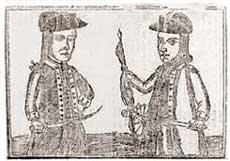
- Daniel Shays & Job Shattuck
—Why do they call it that?
Because it was a very bad stretch in George Washington’s marriage to Martha.
—Why? What was wrong with his marriage?
—It’s a joke, Kylie. A really lame one.
Well, I reckon Em is right, Kylie. But things in the country were rough. Remember, we talked the other day about all the disagreements about the nation’s finances.
—Honestly, I’m kind of amazed the country didn’t fall apart. It’s not just the money. It’s that they were 13 states used to doing things 13 ways. And the different parts of the country were so different. I don’t really understand why they didn’t go to war with each other.
Well, that’s an understandable reaction, Yin. But the situation wasn’t entirely bad. The states did agree on a few things. Some, ironically, were rooted in territorial disputes. According to the Treaty of Paris that ended the war with Britain, the western border of the United States was the Mississippi River (which the Spanish controlled, and at this point weren’t actually letting the Americans use—bummer). But a lot of the western borders of the thirteen states weren’t clearly drawn, because they hadn’t been mapped out yet, and also because there were Indians, like the Shawnees of modern-day Ohio, occupying the land. So states like Pennsylvania and Virginia asserted their territory went all the way to the Mississippi and beyond. Weirdly enough, so did a state like Connecticut: it claimed its territory hopscotched over Pennsylvania and resumed somewhere west of Pittsburgh. So the two states both claimed the same turf.
—That sounds like a real mess. So how did they resolve it?
Goes back to that debt problem. States like Connecticut relinquished their claims on the land in return for the federal government taking on their debts. If the Feds paid back the loans, they wouldn’t insist on Cleveland becoming part of Connecticut, as it were.
—Did Cleveland exist at that point?
I think, Adam, that it was a gleam in a real estate developer’s eye. Anyway, You’ll I was saying some less than nice things about Thomas Jefferson the other day about how he couldn’t free his slaves because he spent too much money on books and wine. Jefferson, by the way, was over in Paris during these years as the U.S. ambassador to France. (He was hanging out occasionally with John Adams, the U.S. ambassador to Britain.) But both these guys were playing a useful role in American politics. Adams wrote the Constitution for the state of Massachusetts, which influenced the eventual U.S. Constitution. And Jefferson wrote the Northwest Ordinances, a series of laws that helped organize what came to be known as the Old Northwest—the states of Ohio, Indiana, Illinois, Michigan, and Wisconsin—by creating a series of grids, allocating most of them for public sale and a few for things like schools and post offices, and generally creating a sense of order and confidence for the people who moved in there. This confidence was different than what you found in Kentucky, for instance, which was carved out of Virginia but where land ownership was complicated and contradictory. That’s why, for example, Abraham Lincoln, who was born in Kentucky 1809, left with his family in 1816: his father wanted to live somewhere he could feel more confident that any land he settled on would be his.
—What happened to the Indians?
They got pushed back into the Great Plains. And they’d get pushed back again when the Louisiana Purchase came along. But we’re not there yet.
—What happened to the slaves?
One of the notable things about the Northwest Ordinances is that they excluded slavery. Jefferson was notoriously ambivalent on that subject. Not that he was really giving away all that much: the land wasn’t widely viewed as being promising for slavery (you couldn't grow tobacco or rice with the Midwestern soil or climate). The African American population was actually declining in the years following the Revolution. That would change once a new cash crop—cotton—came on the scene. But for now, most people believed Indians and slaves were simply going to disappear. A self-fulfilling prophecy. We’ve got a few of those ourselves.
—Like what?
You tell me.
—I’m a little confused.
Oh, good. That’s just want I want to hear, Yin. A little confused. Tell me what’s confusing you.
—Well, you’ve been talking a lot the last few days about all these problems. But this stuff you’re talking about now seems to be helping. The land is getting settled. The debts are getting organized. So it sounds like there’s progress.
There is, Yin. But the underlying problems are much greater and more intractable than the solutions. Just ask Daniel Shays and his buddy Job Shattuck.
—Who’s Daniel Shays?
—He’s a linebacker for the Broncos, right Mr. K?
It was in the reading, Jonah.
—Oh right. He’s the guy who led the revolt.
Ah, so you seem to know more than you think. Keep going.
—He was from Massachusetts. He attacked the government.
Yes. Which government? The federal government?
—No, the state government.
Correct again. Why?
—Because he was in debt.
Yes. Chris, let me ask you a question. What happens to you when you can’t pay your debts?
—Huh? Sorry. What was the question?
What happens when you can’t pay off your debts? When you owe more than you can pay?
—You go to jail?
Not these days. You declare bankruptcy. Do you know what that means?
—No. Sorry.
No need to apologize. Don’t reckon you’ve ever declared bankruptcy. When you declare bankruptcy you say you can’t pay back your debts. And then you don’t have to.
—Why doesn’t everybody, then?
Well, Sadie, it’s no fun. You lose pretty much everything you have except your house. You can’t get a loan or use a credit card very easily. It’s a last resort. My point is that when Daniel Shays and his compatriots were in debt, though, the primary form of bankruptcy law was jail. The authorities sent you there, and then they charged you room and board.
—That’s so dumb.
Well, the idea was to de-incentivize being a deadbeat. But Shays would certainly agree with you. That’s why he took up arms in 1786. Shays was in Worcester, out in central Massachusetts. The Massachusetts government was in Boston. It raised troops to put down the rebellion. Shays ultimately lost a series of battles (he was captured, tried, convicted, sentenced to death, but pardoned). But in a way, he won the war: in the aftermath of the revolt, the state legislature changed its debt laws. Other states—New Hampshire, South Carolina—also faced insurgencies. But Massachusetts was the worst. And it really, really creeped out James Madison.
—I’ve heard that name.
Hopefully you’re read that name. Will certainly help with the test next week.
—I thought that test was on the Constitution.
It is.
—But this stuff will be, too?
Hate to break it to you, Jonah, but this stuff basically is the Constitution. It is, at any rate, a major reason why it happened. Time to get back to Philadelphia. We’ll go there next.
Next: Conventional wisdom


 e Revolution is over. What happens now?