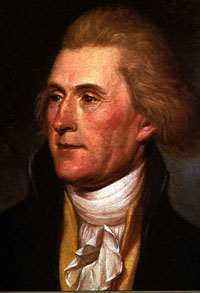
Showing posts with label Thomas Jefferson. Show all posts

Wednesday, October 12, 2016

King's Survey: Jefferson in the Saddle

In which we see a pragmatist act
Thomas Jefferson becomes the third president of the United States in March of 1801. He gives a smashing Inaugural Address. “We are all federalists, we are all republicans,” he tells his fellow Americans. “Not every difference of opinion is a difference of principle.” Jefferson always talked a good game.
—Are you saying the reality was different?
Well, no. The early years of the Jefferson administration were a great success.
—What did he do that was so good?
In a way, nothing. As we’ve been saying in recent days, the fate of the nation wasn’t in the new capital of Washington, DC. It was in London and Paris. These were the years Napoleon Bonaparte was running France, and the first few years of the century were a kind of intermission in France’s slugfest with England. This meant all that trouble on the high seas subsided. In fact things were so good they might have turned out to be a problem: Napoleon seriously considered re-establishing the French empire in the Americas.
—Where?
In Haiti. What do you kids know about Haiti?
—It’s an island near Cuba.
Yes, Kylie. Part of one, anywayHaiti shares the island of Hispaniola, which it shares with the Dominican Republic. Hispaniola is where Christopher Columbus landed in 1492. Anything else? Do you know who lives in Haiti?
—Haitians.
—Duh.
My fault. Not a great question. I mean demographically. Who lives in Haiti?
—Is it black?
—I think it’s poor.
Haiti has historically been very poor. It’s also the site of the first successful slave revolt in the western world. Haiti got its independence from France in 1791 under the leadership of the former slave Toussaint L’Overture. The Adams administration provided aid to L’Overture, which reflected its opposition to slavery, its position Quasi War against France, and its desire to keep the British out. But the new Jefferson administration, fearful of the implications of a slave revolt for the United States, withdrew aid and sought to isolate Haiti.
There are three big ironies that flow from this. One is that that Jefferson, who has been strongly pro-French since the American Revolution, now has to face the prospect of a new French empire in America, something that has to frighten any U.S government. The second is that this slaveholder’s best hope for avoiding such an outcome are former slaves who will fight to prevent it. As it turns out, though, Napoleon’s most powerful adversary turns out not to be Haitians, but insects. Specifically mosquitoes: they sicken a large number of the 20,000 French troops that arrive in early 1802. The French defeat the Haitians in a series of battles, but the Haitians don’t give up, and the growing ranks of the sick invadersone third of French forces succumb to the feverlead Napoleon to conclude that the whole idea isn’t worth the effort.
—So what’s the third irony?
This: that the biggest threat to the nationthe global struggle between Britain and Francebecomes the source of its greatest opportunity. Napoleon decides he wants to go to war with England again. In order to do that he needs some quick cash. The easiest way to do that, he concludes, is to give up on his imperial designs in America. As a result of a secret treaty he’s made with Spain, France actually controls a vast tract of land that extends from New Orleans all the way to modern-day Idaho. It’s a slab of territory bigger than the United States itself. And he wants to sell itfast. For the fire-sale price of $15 million.
Jefferson hesitates: Do I have the authority to do this? I’m Mr. Small Government. Hamilton says: Go for it, moron! More importantly, Madison says: Go for it, Mr. President! Jefferson does. In 1803, the United States makes the Louisiana Purchase. It’s the greatest real estate transaction in the history of the world. Comes out to three cents per acre. Jefferson sends a couple of explorers, Meriwether Lewis and William Clark, to explore the territory. They would have gotten hopelessly lost, if not worse, had they not had the help of Sacagawea, a Native American of the Shoshone tribe, who literally showed the way. So Jefferson scores big.
—You know, Mr. K., I have this idea you don’t like Thomas Jefferson very much.
Oh you do, do you, Em? Where do you get that idea?
—I dunno. We haven’t really talked about him much. We hear a lot more about Hamilton, even Adams. This is the guy who wrote the Declaration of Independence, after all.
You’re right: I’m not really much of a Jefferson fan. I think of him as a phony and a hypocrite. Yes: he wrote the Declaration. But in that document he also included stuff about slavery being the King’s fault, not Americans (that part got cut out), and he never really did anything about ending slavery in his public or private life. He could be gracious, but he also talked about you behind his back. I don’t think he was really fair to Adams after Adams got elected. He played with fire with Aaron Burr, and almost got burned. Now he’s succeeding in office, but that’s more luck than anything else.
—Why don’t you tell us how you really feel?
Well, you did ask. There’s a part of me that feels uneasy about my unease about Jefferson, because my views reflect those of the historians of my generation. Adams and Hamilton have both gotten more positive appraisals in recent decades. But Jefferson’s stock is now about as low as it’s ever been. How do you feel about him?
—I don’t know. I pretty much only know what you tell me. I think the slavery thing is a problem.
Well, you don’t have to make your mind up now. You have a lifetime to think about it. But let me push on: remember, I called this part of the Jefferson era this was the happy middle. We haven’t gotten to the end. Buckle up kids, we’re in for a bumpy ride.
Next: The Duel

Monday, October 10, 2016

King's Survey: Burr in the Saddle

In which we see a schemer foiled by his enemy's enemy


We’re right smack in the middle of the election of 1800, kids, and Thomas Jefferson has a problem.
—I thought you said he was doing really well.
Well, yes, Kylie, I did say that the other day, more or less. I was talking about the political roller coaster for Jefferson was on. First he and his Republican allies were thrown on the defensive by supporting France just before the U.S. went to war with that country. Then his opponents, President Adams and the Federalists, pressed Alien and Sedition Acts, which backfired on the Federalists. So Republicans pressed their advantage with the Virginia and Kentucky Resolutions, in which they said they could ignore laws legislation considered unconstitutional. 
—I still don’t understand why that didn’t really hurt them. Saying they didn’t have to obey any laws they didn’t like.
That’s a good question, Sadie, and I don’t have a straight answer for you. There are two things to keep in mind, though. The first is that President Adams finding his way to peace with the French reduced the overall stress level, even though he himself didn’t benefit much. And the reason, I think, that he didn’t benefit muchthe second thing to keep in mindis that the Federalists had just been in power too long. Their brand of strong government, a government that favored high taxes to support a large military, became increasingly wearisome to a country that was founded in suspicion of big government, hatred of taxes, and fear of armies. Alexander Hamilton had given the country a strong foundation. But with his mentor, George Washington, goneWashington died in December of 1799, widely mourned by his countrymenHamilton was a loose cannon. And since he and Adams didn’t really get along, the road was open for an alternative.
—Like I said, you said Jefferson was in a good position. So what’s the problem?
Well, yes, he was. But you may also remember that I said New York had been the key in 1796: Adams had the North, Jefferson had the South, and the Empire State had swung Federalist. So going into the election of 1800, Jefferson knew he had to secure New York if he wanted to win. And he wasn’t sure he could. He needed an insurance policy. And that insurance policy’s name was Aaron Burr.
—I’ve heard that name.
I’ll bet you have. Do you know anything about him?
—No.
—Wait: didn’t shoot somebody? Was it Hamilton?
As a matter of fact, yes. But that happened later. Before that, Burr shot Jefferson, too.
—Really?
Well, I mean that metaphorically. Burr was a guy with a remarkable pedigree. His grandfather was Jonathan Edwards. Do you remember him?
Anyone?
Ugh. The First Great Awakening?
—The preacher guy?
Right. The preacher guy. Burr came from a really illustrious family. He served in the Revolution, and was a prominent New York City attorney. Worked alongside Hamilton, in fact, during the war and afterward. They were friendly. Sort of. It was never really clear who Burr’s friends were (especially to those “friends”). Or where his political loyalties were. That’s why the Jefferson camp was a little nervous about him. But they believed he could deliver the state to the Republicans, and so they offered him a deal: if he ran with Jefferson, he’d be vice president.
—So what happened?
He accepted the offer.
—So he became vice president?
No. Burr ended up in a tie. With Jefferson. For president.
—How the hell did that happen?
I don’t really know. New York was a big state, with a big haul. Political fixers sometimes arranged for electors in the Electoral College to choose someone other than their top candidate, so that the number two person would move up and lock in the VP slot. Remember: under the terms of the Constitution, the runner-up became vice president, so it made sense to split votes if it would mean you could keep your opponent out. (Remember that Adams and Jefferson, who finished first and second in 1796, were opponentsnot an optimal way to govern.) This was a big flaw with the whole system, and after this was all over, the Congress passed, and the states ratified, the 12th amendment to the Constitution, which created slatespresident and vice presidentto run together as a team. But that’s not helping here.
—So what happened in 1800?
What happened in 1800 is what happens when nobody gets a majority in the Electoral College.
—Amd that is?
Warm my heart, someone. Tell me what the Constitution says.
Anyone?
Ugh. The election goes to the House of Representatives. Each state gets one vote. So the congressmen in a given state confer to choose.
—So what happened with Jefferson and Burr?
It took six days and 35 votes. A lot of the Federalists voted for Burr.
—Why?
To stick it to Jefferson, for one. Because they hoped Burr would really be better, for another.
—Would he have been?
No one knows for sure. But after a certain point, you kinda have to be suspicious of someone who never really tips his hand. Although in one way, Burr did tip his hand: once there was a tie, he put the VP deal he cut with Jefferson aside. He wanted to be president and pushed for it.
—So how did it get resolved?
Ironically, a key figure in all of this was our old friend Alexander Hamilton, who in effect had the power to choose between options he considered truly awful. By this point, he had been out of power for a few years, and had made plenty of enemies. But he still had influence. Hamilton hated Jefferson. And he thought Jefferson was a wooly-headed idiot. But Hamilton was afraid of Burr, afraid of what he might to do the country. Hamilton considered Jefferson an idiot, but at least he had principles. But Burr was a snake. Smart, likeable, even a guy he could work with. But not someone he ever wanted to see run the country. Hamilton urged his fellow Federalists to vote for Jefferson. And in they end, enough of them did to put Jefferson over the top.
—Wow. That’s really quite a story.
And it isn’t over yet, Sadie.
—Woo hoo. What happens next?
Jefferson enters his first term as president.
—So is that a happy ending?
More like a happy middle. We’ll get to it tomorrow.

Next: Jefferson in the saddle

Friday, October 7, 2016

King's Survey: Seditious Resolution

In which we see a quasi war abroad become fully divisive at home


Thomas_Jefferson_rev
Thomas Jefferson
It’s 1798, kids, and a war is underway.

—Did I miss something? Who are we at war with?
—France, dummy.
—Really? Since when?
—Mr. K. told us: 1798.
—I don’t remember talking about this.
—I have it my notes from the last class: the Quasi War.
—But is a quasi war a real war? Doesn’t “quasi” mean fake?
—More like “semi"
—Well is a “semi” war a real war?
—Mr. K. says it is.
—On what basis?
A fair question, Adam. Congress had not formally declared war. But the government is gearing up for one, and no one is more excited about the prospect than our old friend Alexander Hamilton. Because the United States now faces the prospect of armed conflict, it has to build up its military. President Adams wants to concentrate on the navy, but there’s pressure from the Federalists to build up the army. He turns to ex-president Washington, but Washington turns him down: he’s too old and tired to come out of retirement. Washington recommends his old deputy, Hamilton. This is about the last thing Adams wants to hear. His suspicion of Hamilton has been growing steadily (Hamilton has been trash-talking about Adams for years). Adams reluctantly offers Hamilton the job, which he’s only too eager to accept. Hamilton likes the idea of a bigger armyand he likes the idea of using it not only to fight foreign enemies, but to keep order at home, the way he did with the Whiskey Rebellion back in 1794. But now there’s no Washington to hold him in check. Hamilton has his eyes on those pesky Republicans.            
—This doesn’t sound too good.
99px-James_Madison
James Madison

It isn’t, Kylie. The Republican decision to challenge the Adams administration on the XYZ Affair, that whole thing where the French demanded bribes before negotiating with the Americans, really backfires. The mood of the country turns decisively against them, and the Federalists decide this is an opportunity to deal them a mortal blow. They ram a series of bills through Congress known as the Alien and Sedition Acts, and Adams makes the fateful decision to sign them. Three of these laws are directed against immigrants (with the meddling French diplomat Edmond Genet in mind): they extend the number of years you have to be in the United States to become a citizen, allow the government to detail citizens they deemed dangerous, and also to expel them. But it’s the fourth law, the Sedition Act, which proves to be a real flashpoint. It allows the government to jail and impose fines on Americans who write, print or speak “false, scandalous, and malicious” statements against the government or the president (notably, the vice president, i.e. Jefferson, wasn’t included).
—Write, print, or speak?
Yup.
—How can that be?
What’s the problem, Yin?
—Isn’t that against the law?
What law?
—The Constitution?
Where in the Constitution?
—The Bill of Rights.
Where in the Bill of Rights?
—Isn’t it the First Amendment?
Excellent, Yin. Took you a little while, but you got there.
—But I don’t understand how they could do that!
Well they did. Na na na na na na.
—Na na na na na na, Mr. K? Really?
—So what happened?
Well, fourteen Republicans were sent to jail, most of them journalists, one of them Benjamin Franklin’s grandson.
—That’s so outrageous.
I’m really pleased to see you so upset, Yin.
—Mr. K!
I’m impressed by Yin’s outrage, Sadie. I’ve always been impressed by her curiosity. I’m glad to see this other dimension of her intellectual life. In any event, you’ll be glad to know that there were plenty of people, not all of them die-hard Republicans, who were as upset as Yin.
—Like I said, this is not good.
Well, Kylie, by some reckoningsI’ll be interested to hear what you thinkthings are about to get worse. An outraged Jefferson and an outraged Madison decide they need to respond. They agree on a plan to issue protests against the Alien and Sedition Acts. Madison writes a statement that passes the Virginia legislature and comes to be known as the Virginia Resolution. Jefferson, following suit, writes what comes to be known as the Kentucky Resolution.
—What do they say?
In brief, they both say a state doesn’t have to accept a federal law it regards as unconstitutional. What do you think about that, Kylie?
—Well, I guess that makes sense. I mean, if a law is wrong, you shouldn’t have to obey it.
 Ethan, you’re shaking your head.
—That’s nuts.
Why is that?
—Because you can’t just go around saying you’re not go to obey any law you don’t like. That’s how the Civil War happened.
Oh it is, is it?
—Yeah. It’s like the South didn’t like Lincoln getting elected so they said ‘we quit.’
—That’s different, Ethan. Lincoln won fair and square. But what are these guys supposed to do? Do you have to obey a law that’s clearly wrong, like this one is?
—You have to accept it. And then try and change it.
—I agree with Adam.
—But who’s to say you can change it? What if they saying that trying to change it is speaking out against the government? And they send you to jail for that?
—This is a horrible situation. Here you have one set of people who pass a bad law, and then another set of people who pass another bad law?
Were they equally bad laws, Sadie?
—I don’t know. That’s why I say this is a horrible situation. What ends up happening?
Well, I told you that the Republicans got into this situation because they overplayed their hand with the XYZ affair. But now it’s the Federalists who overplay their hand: the Alien and Sedition Acts really boomerang on them. The Republicans really start to make a comeback.
—Yeah, but what about the war?
Good question. As you heard at a few minutes ago, it’s known as the Quasi War.
—OK. But did it ever become an actual war?
Well, there are some shots exchanged on the high seas. But as it turns out, the American government isn’t the only one that’s distracted by internal turmoil. By 1799, there’s another new government in France. And Adams, about as scared as Jefferson by the prospect of Alexander Hamilton in charge of an army, does a really smart thing: he quietly tries again with France. This time the French are more receptive, and they come to an understanding. Which means that Adams can disband the army. Hamilton is pissed; lots of other people are relieved. A bullet has been dodged.
This doesn’t mean, however, that the Republicans are backing off. They’re more determined than ever to defeat the Federalists who have been running the country for ten long years now. They want to get control of the government. And they form a plan to do it.
—So what happens next?
It gets worse. See you tomorrow.
Next: Aaron Burr in the saddle

Friday, September 16, 2016

King's Survey: Pizza Money

In which we see that it's one thing to win one’s independence militarily, and another thing to keep one’s independence financially.
All right, kids: so thSupreme_pizzae Revolution is over. What happens now?
—Isn’t that something you’re supposed to tell us?
Is it?
— You’re the teacher, aren’t you?
Is that my job, Emily? To tell you what happens?
—What do you think your job is? Tell me that, Mr. ask-all-the-questions.
My job is to help you figure out what happened. By which I mean help you figure out. Help you figure out. Help you figure it out.
—What are we supposed to do? Guess?
Yup.
—Oh c’mon. You can be so frustrating, Mr. K.
Well, that’s part of the job, too: to frustrate your desire for easy answers. Right now I’m less interested in giving you information (though I will do that eventually) than asking you to think. It’s 1784 now. The Revolution has ended. So, yes, Emily, I’d like at least one of you to take a guess: what do you imagine is going on in the country? What kinds of issues do you think the American people are dealing with?
—They’re probably wondering what they’re going to eat for breakfast.
Well, yes, Ethan, they probably are. And where to you think that breakfast is going to come from?
—McDonalds?
Well, McDonald’s farm, maybe. Because virtually all breakfasts are coming from farms. That’s what virtually everybody does for a living. But it’s not easy. Why not? What are some of the issues the country is dealing with?
—Money. That’s always an issue, right?
Yes, Kylie. That’s true. But how is it an issue?
—Well, there’s never enough of it, right?
Yes. But why not?
—Debt?
Yes. Debt to who?
—The British?
—Not the British! They just fought the British!
Actually, Kylie is right, Ethan. For one thing, under the terms of the Treaty of Paris, the Americans are supposed to pay back the property of the Tories that they confiscated. For another, the Brits are kinda the only game in town. They’ve got the big banks that have been loaning lots of moneyand charging lots of interest. And they’re the ones who are exporting any number of items (like tea, remember?) that Americans love to buy. But you’re also right, Ethan, in that the Americans owe other people, too. Like the Dutch. Who came through with a big loan during the Revolution that the U.S. government now has to pay back. So money is indeed an issue. What else is?
—Wait. Before you get to that. You’re telling me that Old McDonald on his farm is worried about how he’s going to pay back his loan to Great Britain while he’s eating his breakfast?
Doesn’t sound so plausible when you put it that way, Ethan, I admit. Actually, if you’re a rich planter like George Washington, that’s exactly what you’re thinking about. Well, nonot George Washington. Washington has actually worked very hard to break his dependence on the banks by redirecting his Mount Vernon estate away from export commodity crops like tobacco and making it more self-sufficient. Thomas Jefferson, yes. He was chronically in debt. Too much the shopper. Wine and books. An absolute addict. It’s true that most people aren’t thinking about the problem in quite this way. But the people who govern ordinary people, or the people who own them, are worried about such matters, and are coming up with strategies like taxes to deal with the financial problems the war has caused, so in one way or another it really does filter down to a lot of peoples’ breakfasts.
—How does any of this matter to a slave?
Well, Brianna, it may affect what kind of work a slave does, and if and when she gets sold. Let’s go back to Washington for a second. He had hoped to make Mount Vernon viable without slave labor. He was told by his managers he couldn’t do itit wouldn’t work financially, and his peers would be very angry.
—Why would they care?
Because it would create peer pressure on them to free their slaves. And because having free black people around would make it harder to manage slavery, which is why most people who were freed were ordered to leave slave states. In the face of this resistance, Washington remained a slaveholder to the end of his life, after which he freed his slaves (actually they were to be freed after his wife’s death, but she freed them before that). In the meantime, he decided he would not sell a slave without that slave’s permission. They tended to stick around. Washington managed his financial affairs well. Jefferson did not. Jefferson’s slaves were never freed.
I’m straying a little bit from the topic at hand, though. Again, the debt issue was personal. But it was also a matter of public concern. And just as different individuals managed their affairs more and less well, so did different states. The state of Virginia, for example, didn’t have much debt. Connecticut did. Why do you think that would matter?
—Because they would have different ideas about what they needed to do.
Right. And how many states were there, Sadie?
—Thirteen.
Which meant how many different state governments?
—Thirteen.
—Yeah, but there was one big government, right? The United States government.
Yes, Jonah, that’s true. But the federal government wasn’t that powerful. The states were jealous of their powers. This is reflected in the way people talked: they said, “the United States are,” not “the United States is.”
—The United States are a nice place to visit.
Exactly.
—Sounds weird.
To you.
—Lots of things sound weird to Sadie.
—That’s because lots of things are weird. Like you, Ethan.
—Mr, K., Sadie is objectifying me! She called me a “thing!”
—Obviously that’s because she’s secretly in love with you.
—Emily!
I can see you’re crushed by Sadie’s objectification, Ethan. Lets keep our eye on the ball, kids. The point is that having thirteen separate governments made it hard to do pretty much anything: pay back debts, conduct foreign policy, order a pizza.
—I can see it now: I’d like an “American”: Pepperoni, peppers and anchovies.
—No anchovies!
—I hate peppers!
—What’s wrong with peppers?
—What’s “American” about pepperoni?
I guess I asked for this with the pizza reference. But you are illustrating my point. It was very difficult to coordinate just about anything when you needed thirteen different parties to agree.
—Was there anything they actually could agree on?
Well, there were a few things, Yin. We’ll get to them. And why there weren’t enough them.
Next: Rebelling against the Revolution

Wednesday, August 17, 2016

King's Survey: A Story Where Nothing Happens

In which we experience the rhythms of ordinary life in an ordinary time—the life and time, no matter where or when it is, that most of us inhabit.


So here I am getting ready to talk with you about the coming of the American Revolution, and I find myself looking at Ethan.
—Hey, Mr. K.
Greetings, Ethan. You’ll note that Ethan looks reasonably alert compared to Chris—or what appears to be Chris, if that’s Chris’s mane on a desk at this ungodly hour of 8:30 a.m. Ah, Chris, nice of you to join us. Ethan, I see you’re wearing a vintage Rage Against the Machine t-shirt.
It was my dad’s.
A fact which reinforces the point I was about to make. Ethan is wearing his dad’s Rage Against the Machine t-shirt. Which is to say that we have here a kid who’s wearing an emblem of rebellion from an earlier generation. The fact that he’s wearing his father’s couture amounts to an act of filial piety.
—What’s couture?
Clothing, Jonah.
—And what’s filial piety?”
Honoring your elders, Emily. Do you do that?
Ummm … Sort of.
Sort of?
—I mean, I try.
Figures.
Hey!
Now, now, dear Em. My point is that the Founding Fathers would be probably be scratching their heads to see Ethan wearing a Rage shirt—what could possibly anger one about a mechanical device? —though perhaps Thomas Jefferson would get it, given his ambivalence about role of machines in American life and his enthusiasm for rebellion everywhere (except among his slaves). “The tree of liberty must be refreshed with the blood of tyrants,” he famously said at the time of the French Revolution. So I don’t think he’d mind some Rage. Though I suspect he’d be disappointed that Ethan couldn’t be more original.
—Well, I have a Kendrick Lamar T-shirt too. Would that work?
I dunno. Doubtful. But that’s OK. We can’t all be as bloodthirsty as Thomas Jefferson.
 —You’re kidding, right?
 Well, no, Yin. But I am digressing. Let me get back on track. What I want you do now is imagine yourselves, dear students, not as happy residents of the 21st century but instead as a people who were born somewhere in one of the thirteen original British colonies in 1760. (Among other things, this birthdate will make you the age you are now when our friend Jefferson makes his famous Declaration.)
—Just like the Magic School Bus.
Right. But while those time-travel books drop you right into the middle of a dramatic situation just before it happens, I’m hoping to land us into a moment in which nothing particular is happening. You might find yourself in any number of circumstances, but I don’t think there’s any really big event that takes place in the colonies in 1760. Technically, there’s a war on—there have been wars between England and France going on almost continually for the last 70 years—but the hugely important Battle of Quebec has just been fought. Now it’s all over but the shouting; the British defeated the French in that battle, and then went on to take Montreal in this year of your imagined birth. Both cities, I’ll point out, are in Canada. And you’re not. So we’re going to say this action is far away. (Pretty much everything is far away at this point; roads are poor when they exist at all. Trips you now make in hours now were measured in weeks.) Besides, you’re a baby. Maybe you’ve got an uncle or something off fighting. But right now you’re on the far rim of the European world, almost surely living on a farm. That farm might be isolated, or it might be in a village. There’s a slim chance you’re living in a city. But you are, literally and figuratively, provincial, living on the edge of a global empire that sprawls across North America, the Caribbean, Europe, and Asia.
By the time you’re born in this Year of Our Lord 1760, there have been English settlers on the Atlantic seaboard for over 150 years, and forced African migrants for about as long. So your family might well have been here for many generations already. They might be more recent arrivals, too, whether from one of those places or perhaps part of a new wave of migration Scotland. Or from that region of Europe we know as Germany. In any event, you get my point: what some have been calling “the New World” is kinda old already. A civilization that rests, as all civilizations do, on the exploitation and displacement of the weak, has been established. But it’s fragile; how fragile depends on the precise location—North has more critical mass than South; East is more secure than West—but the whole span of the rim is solidifying.
The rhythms of everyday life on this perimeter haven’t changed in 1760. Indeed, in some important respects, they haven’t changed in thousands of years. You’re up at first light; your workday ends at sunset. Depending how rich your family is, you might have money to burn in the form of candles, but virtually no one is reckless about that. Your home, even if you’re rich, is likely to be quite small—tiny by 21st century standards. Men, women and children will huddle together in rooms and beds, as much for warmth as for a lack of space. Work, no matter what it is, will involve significant amounts of drudgery. Most of it will be manual labor, and most of that will involve farming: plowing, planting, weeding, harvesting. Milking, shepherding, shearing. Household tasks like churning, baking, and washing. Even cushy professions like the law will involve lots of routine tasks like copying letters contracts, and other documents—there are no Xerox machines— though if you’re successful you’ll have someone to do some of that stuff for you. Then, as before and later, the key indicator of wealth is the degree to which you have someone else to do your work, from housecleaning to executing trades.
What varies are the tiers, and kinds of tiers, between the bottom and the top. In between the ranks of free and slaves is a stratum of indentured servants. Essentially, their labor has been sold (maybe by their parents; maybe to pass the cost of their travel to America) for a fixed number of years, typically seven. Indentured servants learn a trade from a master, after which they are free to become journeymen, and, hopefully, masters themselves. Women perform work and develop skills that ideally will allow them, after their indenture ends, to marry, start families and become mistresses of households. Social mobility is real but finite for white people, and a handful of black ones, though this has declined as the line between slave and free hardened.  
No matter who you are, the pace of life is slow. Travel, as I already mentioned, is time-consuming and often unpleasant if not dangerous. News will routinely take months to cross the ocean—and traveling on water is generally faster than traveling on land. Routine transactions like buying and selling will be constrained by the lack of banks, paper money and trust: most trade will take the form of barter, and will involve people you know. Though you’re aware of a wider world, you live in a very small one.
—Sounds boring.
Well, you don’t know any alternative, so you’re not likely to be unhappy about it. In any case, boredom is less of a problem than fear. There’s any number of things to be afraid of, beginning with disease. Indian raids are always a possibility. And the weather is a source of chronic anxiety. There are the destructive storms, of course. But as often as not it’s seemingly routine weather patterns that pose a threat: Too much rain? Too little? Too hot? Too cold? Your family fortunes rest on conditions for which there is nothing in the way of reliable forecasts, and over which you have no control.
—What do people do for fun?
Well, any number of things. But the important thing to keep in mind is that there’s not nearly as much time for fun as there is now. Which, again, is not something you’re likely to notice. There are a few people—the planters on the great estates—who like to think of themselves as men of leisure. But they often have to work harder than they’re willing to admit to maintain what they have, and their wives have often have responsibilities, too. There are no expectations of very young children (rich or poor, slave or free), who often mingle, but before long everyone must take their place, a term that was understood literally as well as figuratively, whether that place was in the fields or with one’s tutors.
But to answer your questions, there are any number of pastimes. Some involve horses for those who have them. Card games. Of course, there’s always sex. Then, as now —maybe more then than now—it’s the default free-time activity. And that includes people your age, though with barriers to prevent actual intercourse. For instance, there’s the practice of bundling, where boys and girls are allowed to sleep together if they remain wrapped in separate blankets. Such forms of socializing follow events like barn-raisings, where the people in a town would pitch in to help each other with big projects they can’t manage on their own. Parties often follow, where there’s lots of alcohol; beer and cider are staples, along with whiskey. People at this time drink like fish—an average of over seven gallons annually for every man woman and child, in part because alcohol, since it’s sterile, is safer than water, where countless microbes lurk.
—But weren’t they Puritans? All uptight and stuff?
Well, Emily, some of them were Puritans. Descendants of the Puritans, anyway. But the Puritans weren’t really prudes in that way when it came to drinking or certain kinds of sex. That said, you had to be careful: the expectation was that if a girl got pregnant, there were great pressures for the boy to marry her. By 1760, this was as much for economic as moral reasons in a given community: raising that kid is your job; don’t make us bear the cost of feeding your brat. On the other hand, if you’re a slave, your child is a slave, too. So slave owners had a real financial incentive for people to have sex, which they encouraged. And in some cases forced. Sex was a popular pastime, but it had its dangers too, whether as a matter of rape or a high mortality rate for pregnant women and newborns. The colonial woman gave birth an average of seven times in her life. She typically spent most of her adulthood pregnant or nursing.
Oh my god.
Funny you should mention him, Em. Because that’s where we’re going tomorrow: to church.
Damn.
Next: God and taxes