Showing posts with label George Washington. Show all posts

Wednesday, October 5, 2016

King's Survey: French Fried


In which we see a strong leader thread a weak nation through narrow straits—and passes the wheel his (somewhat more clumsy) successor
Papas_Fritas
So here’s where we are, kids. England and France at war; the United States is caught in the middle. Washington reluctantly agrees to serve a second term in 1792, and is handily re-elected.
—So what side does he take in the war?
Well, Sadie, there is that treaty the United States signed with France during the Revolution. Should he honor it?
—You’re asking me?
Of course.
—Duh, Sadie. You should know Mr. K. by now. This is what he does. Annoying as hell.
—I have no idea if Washington should honor the treaty. I guess I can flip a coin. I figure I have a 50% chance of being right.
Wrong.
—Wrong? How can I be wrong?
Here’s how: Washington does not formally nullify the treaty, as Hamilton wants. But he does make a proclamation of neutrality in 1793, effectively making clear that the United States will not participate in a military alliance with France. Washington is determined to steer a middle course. The coin lands on its edge.
—Congratulations, Mr. K. You asked me to guess, you told me I was wrong even before I did. Is there supposed to be some big lesson here?
You mean other than to testify to my brilliance? Than to feed my ego at your expense? What other reason could there be, Sadie?
—Oh my God, Mr. K. Emily is right: you are impossible.
—But she loves you anyway, Mr. K. I keep trying to talk her out of it, but she’s stubborn that way.
—Actually, I’m curious, Mr. K. Is there any good reason you tricked Sadie like that?
Well, I hope so, Kylie. My goal was to make the point that in statecraft—as in other arenas of daily life—sometimes you have to think outside the box a little. Things that may seem binary, one way or the other, may not be. I’m not sure what President Washington did with the Treaty of 1778 made perfect logical sense, but it was a way of actively antagonizing Britain or France if he didn’t have to. This is something Washington has shown again and again throughout his career: a sense of patience, of not committing to a course on someone else’s terms.
—Did it work? And can you just tell us now?
Yes.
—For both?
Yes, for both. But the foreign policy balancing act isn’t easy. Actually, Washington’s biggest headache about England and France rages most actively in his own cabinet. Hamilton and Jefferson are arguing with each other endlessly, over this and other matters. They’re also pushing their agendas in other ways. In the mid-1790s, the French send an emissary named Edmond Genet to the United States. He quickly becomes a confidant of Jefferson and the Republicans, and uses that position to meddle in American politics, angering Washington. Hamilton, for his part, is also doing things he shouldn’t. In 1794, Washington sends the U.S. diplomat John Jay (he of the Federalist Papers) to Great Britain to negotiate a treaty. Hamilton is so eager for a good relationship with Britain that he leaks U.S. bargaining positions to a British diplomat. Republicans in the U.S. Senate are angry about Jay’s Treaty and threaten not to approve it. Washington, himself angry, responds: approve the treaty, or impeach me. They cave. But they also seethe. Jefferson quits Washington’s cabinet early in Washington’s second term; Hamilton follows about a year later. They continue scheming and sniping long after they’re gone.  
Washington, for his part, is sick of all this. He can easily be elected to a third term in 1796, but has had enough. He also thinks it’s vitally important that he not die in office and that there be an orderly transition of power. At the end of his second term, he delivers his famous Farewell Address, in which he warns Americans about the dangers of “entangling alliances.” For Washington, independence is the central concept of the United States, and that applies to its foreign policy, the freedoms of its people, and the very creation of the nation itself.
—So what happens next?
Well, you have the presidential election of 1796, which is the first contested election in American history. Jefferson is the obvious candidate for the Republicans. His opponent is John Adams, who for the last eight years has served as vice-president under Washington.
—Why not Hamilton?
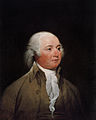
Official_Presidential_portrait_of_John_Adams_(by_John_Trumbull,_circa_1792)A good question, Adam. Hamilton has been the leading figure for the Federalists. But in a way, that’s been a problem: he’s a lightning rod for criticism. More importantly, the Founding Fathers are still trying to avoid confronting the reality that ideological differences are going to be a permanent part of American politics. There’s a sense that it’s John Adams’s turn. Adams himself is certainly thinking in such terms—both as a matter of trying to stay above the fray and in his conviction that he deserves the job. But there’s an undeniably partisan, and regional, cast to the voting. (And Hamilton is actually scheming behind Adams’s back to get someone he regards as less of a dweeb elected.) The South goes to Jefferson. New England goes to Adams. The swing state is New York, which puts Adams over the top.
Adams really wants to recapture the old spirit of the Founders, and reaches out to Jefferson, who’s now vice-president by virtue of finishing second. But James Madison tells him to keep his distance, and Jefferson rejects Adams’s overtures. The former friends, whose relationship really soured during the Washington administration, return to their frostiness.
Brand new president, same old issues. There are still fights over the nation’s finances, and still fights over whether it should tack closer to England or France. The difference now is that the fight between the two has gotten more intense, and Washington is not around to moderate internal political conflict. And the two superpowers are really pushing the United States around.
—How?
England and France are trying to choke off each other’s access to the outside world. England is an island nation that depends on its navy, and that navy depends on manpower, which is chronically short. Hey, Ethan.
—Yeah?
What’s your grandmother’s maiden name.
—Thompson.
 Wonderful. Ethan Thompson. Nice British name. Get on the boat.
—What are you talking about? I'm not Ethan Thompson!
I’m talking about you as a fugitive from the British navy. Obviously you jumped ship at some point, and now I’ve pulled over this American ship you’re on to reclaim lost sailors. Adam. Another fine English name. Get on the boat.
—Adam is my first name. My family is Greek and Italian. My grandmother's name was Montera.
Close enough. Go.
—Why should I?
Because I’m the British navy, dammit, and I’ll put you in chains and the U.S. ship you’re currently on in flames. We’re fighting a war here, son. Now get moving.
—They really did that?
They really did, Sadie. They even had a name for it: Orders in Council. It drove the U.S. government crazy. But there wasn’t a lot the Americans could do. Britain was too powerful militarily. It was too powerful economically, too: the U.S. was deeply dependent on Britain both as a customer and as a supplier of goods.
—So why didn’t we just turn to the French?
Wasn’t so simple, Jonah. First of all, to do that would really piss the Brits off, and again, the U.S. literally couldn’t afford that. For another, the French were playing hardball, too. The French government was mad that President Washington wasn’t honoring the Franco-American treaty of 1778, and really didn’t like Jay’s Treaty. The French were also making noises about trying to overthrow the U.S. government. On top of that, they were also engaged in privateering—that’s when the government secretly gives pirates official permission to foreign ships in exchange for a piece of the action—and were not shy about attacking U.S. shipping.
That said, your instincts are sound, Jonah. In fact, turning to the French was precisely what President Adams tried to do. He secretly sent a set of emissaries—so secret that they went by the names of X, Y, and Z—to Paris to try and cut a deal with the new French government. (There were a lot of new French governments in those days—the nation was in seemingly endless turmoil.)
—So what happened?
It was a fiasco. The French really jerked the American diplomats around, and when they finally agreed to see them made clear that they expected a bribe before there would be any discussion of a deal. Our friends X, Y, and Z left angrily, and returned to the States.
Now this is where things start to get interesting. Jefferson, Madison, and the Republican crowd smelled a rat. When they learned that there had been a diplomatic mission, and that it hadn’t gone well, they demanded to know what happened. What did the Adams administration do? Did they anger the French? Was this just one more example of feckless Federalist Francophilia?
—Feckless Federalist Francophilia?
All right; I’m getting a little carried away. But these are intense times, Emily. The Republicans are indignant. And that turns out to be a mistake.
—Why?
Because Adams makes public what happened, and when he does, the American public is outraged. Those damned French! “Millions for defense, but not one cent for tribute!”
—What’s that supposed to mean?
That the government will do whatever it takes to win a war, but not pay a penny for a bribe. Now, suddenly, for the first and only time in his life, President Dweeb—I mean President Adams—is popular. He’s thrilled. He starts walking around with a fancy uniform and a sword. Though it’s never declared, the United States and France are essentially at war. It’s known as the Quasi War.
—When is this?
We’re talking 1798-99. It doesn’t take long for Adams to begin to feel queasy. (It never does.) But the Federalists go wild.
 —Federalists go wild. Sounds like Spring Break.
Well, maybe more like a reunion weekend. Because Alex is back in town. And he’s looking to take the boys on a road trip. With guns.
Next: Seditious Resolutions

Wednesday, September 21, 2016


In which we trace the long sweaty road (back) to Philadelphia to reset the government


So, Paolo, ready to play some history?
—OK.
Excellent. Paolo, you’re George Washington. It’s early 1787 and you’re about three years into your retirement. You’ve been getting lots of visitors to Mount Vernon, and one of them is James Madison. Like you, Madison owns a plantation with lots of slaves. He served briefly in the Virginia militia during the Revolution, but spent those years in politics. In 1786, when angry and indebted veterans revolt under the leadership of Daniel Shays in Massachusetts, Madison is serving in Virginia’s House of Delegates. He’s very worried about this whole Shays thing. He fears that it’s the beginning of mob rule, and the only way to stop it is to reorganize the federal government, which has been operating under the clunky Articles of Confederation for the past ten years. But he knows that convincing people to undertake such a risky enterprise is going to be very hard. So he’s coming to you. He figures if you will throw your weight around an effort to reorganize the government, then maybe people will listen. So what say you, Paolo? Do you go to the meeting the Madison is planning, to be held in the nation’s largest city of Philadelphia?
—I guess so. I mean, why not.
Here’s why not: You made a big fuss about retiring three years ago. You went to Annapolis
—Oh yeah! The whole sword thing!
Right, Ethan. The whole turning in your sword thing. George III calling you the greatest man in the world because you walked away from it all. Now suddenly you want to come back? Really, Paolo?
—Well, maybe not.
—Go for it, Paolo!
—Go Paolo!
—Paolo Paolo he’s our man! If he can’t do it no one can!
I wouldn’t rush it, Paolo. I mean, even if people are willing to see you come back into public life, do you really want to stake your reputation on this? I mean, James Madison: he seems like a stand-up guy. And yes, there are problems in the country. But this whole meeting thing—Madison is trying to get the each state to send delegates so they can form a new government, and he wants to use you to publicize the whole project—could turn out to be a flop, or worse. You could come out of it looking foolish, or worse.
—Go for it Paolo!
—Don’t be a wuss!
Paolo, I need an answer.
—OK, I’ll go.
Paolo, are you responding inappropriately to peer pressure here?
—Naa. I think I want to go.
—He’s a patriot! He’s trying to do what’s best for his country.
Easy for you to say, Emily.
—No it isn’t! I fought for the Revolution, too! I want to save my country.
Who knew.
All right, so Paolo—I mean George Washington—is on board. Madison is a good organizer. Most of the states send people (Rhode Island, always the contrarian, sits this one out). These delegates gather in Independence Hall—the same place the Declaration of Independence was debated—from May to August of 1787. Their deliberations are on the down low. All the windows are closed. Everybody wears wool. Somebody forgot to turn on the air conditioner.
—Gross.
Actually, Sadie, wool is kind of an air conditioner. When you sweat and it gets saturated, it cools you off.
—Double gross.
Pop quiz: Adam, give me a quote from their secret deliberations.
—I can’t.
Correct. Why?
—Duh: secret deliberations.
Correct again. But Madison kept a diary that was published after his death. He also was apparently the primary author of the document that came out of it. So it’s time to ask: What were the big issues?
Anyone?
Hmm. Too big a question? Let me try and break this down a little. You’ve got twelve states represented there in Philly. There’s Virginia, Pennsylvania, New York. And there’s Delaware, Connecticut, New Jersey. Anything strike you about those two batches?
—They’re all in the middle of the country?
Well, yes. But that’s not what I was really thinking.
—Delaware is really small. Connecticut and New Jersey are, too.
Good, Sadie!
—Yeah, but is Virginia really that big?
Big in what sense?
—Size?
Well, it’s bigger than it would be later, because it includes what it now West Virginia, which broke off during the Civil War. But yes, Virginia is one of the larger states. So there’s size. What else?
—Population?
Yes, that’s what really matters. Though geography and population are more correlated than they would be later. But the realities aren’t always or what matters. In 1787, Georgia is considered a small state. But it’s growing rapidly. So it tends to think and act at the convention like a big one. So size matters. Even if it’s also a matter of perception.
You’re all laughing. Oh. Double entendre. Yes, Virginia, size matters. 
Let’s move on. So Yin, I’m going to guess you did the reading. How did this large state/small state play out? What was the bone of contention?
It was about who would have more power. Virginia wanted the biggest states to get the most votes. New Jersey said no: each state gets one vote.
Succinctly put. You’re describing the Virginia and New Jersey plans for the legislature. And who won?
—There was a deal. It was called the Connecticut Compromise.
And how did that work?
—There would be a House of Representatives, and membership would be based on how large a state was. And there would be a Senate, where each state was the same.
Excellent. Somebody else: what was another line of division at the Constitution Convention?
—Slavery.
Good, Sadie. And what was the nature of that controversy?
—Well, the slave states wanted slaves to count. And the free states didn’t.
Let’s back up a second. In 1776 how many states had slavery?
—Seven?
—Nine?
—Six?
The correct answer is all of them. All thirteen. Massachusetts was the first to abolish slavery, in 1780, before the Revolution was even over. All the New England states followed. But in a way, that’s not especially important. The real point is that there were some states, notably South Carolina and Georgia, which really depended on slavery as the basis of their economies. Northern states never really did. Slaves up there were typically household servants. But in the South, they were the core of the agricultural labor force. How did that play out in terms of how slaves were counted? Ah, I see you’re once again ready to wade into the fray, Yin.
—The slave states wanted the slaves to count as people when it came to counting up the numbers for Congress. The free states said no.
A little counterintuitive, isn’t it? The southern slaves wanted the slaves to count. But they wanted them to count as white votes. So who won?
—They compromised again. The 3/5 Compromise. Each slave is 3/5ths of a person.
—I don’t get it. Why wasn’t it 50/50?
—Here’s what I don’t get: why didn’t they compromise at all? The North was more powerful than the South.
No, Ethan, it wasn’t. Until the Civil War, most of the nation’s wealth was in the South, not the North. But that wasn’t really the issue. Actually, a lot of people thought that slavery was on the way out in the 1780s. The number of slaves was declining; some observers thought that Negroes were biologically inferior and would gradually die off, the way Indians seemed to be doing. But the biggest problem was that the states with the biggest investment in slavery effectively held the Constitutional Convention hostage. They basically said: our way or the highway. We’ll just leave, and then this whole thing will come crashing down.
—Were they right?
Hard to know for sure. Clearly, they got the better end of the bargain. Though they didn’t get everything.
            The large state/small state and slave state/free state were just two examples of the kinds of horse-trading that went on at the Constitutional Convention. In the most general sense, the issue was how much power the U.S. government was going to have, and how that power was going to be distributed. In the most basic sense, the delegates at the Constitution—
—How many were there?
Fifty five, though some came and went. Anyway, they agreed there needed to be more central power: that’s why they were there. (Plenty of people were skeptical, even suspicious about this whole thing; they stayed away, hoping the convention would lack credibility as a result.) The delegates wanted to make it easier to raise tax revenue. And facilitate trade. And conduct foreign policy. They wanted, in short, a more perfect union.
—Hmmm. Where have I heard that phrase?
Anyway, we’re going to walk through this document. The seven sections, what they say, from the Commerce Clause to the Electoral College, the Constitutional Amendments. You need to read the document and study it. I’m going to give you a review sheet. For the next few nights, you should review and memorize key facts and concepts. You’ll be test on this on Friday.
—Sounds like fun.
No pain, no gain, Jonah.
Next: Test prep

Friday, September 16, 2016

King's Survey: Pizza Money

In which we see that it's one thing to win one’s independence militarily, and another thing to keep one’s independence financially.
All right, kids: so thSupreme_pizzae Revolution is over. What happens now?
—Isn’t that something you’re supposed to tell us?
Is it?
— You’re the teacher, aren’t you?
Is that my job, Emily? To tell you what happens?
—What do you think your job is? Tell me that, Mr. ask-all-the-questions.
My job is to help you figure out what happened. By which I mean help you figure out. Help you figure out. Help you figure it out.
—What are we supposed to do? Guess?
Yup.
—Oh c’mon. You can be so frustrating, Mr. K.
Well, that’s part of the job, too: to frustrate your desire for easy answers. Right now I’m less interested in giving you information (though I will do that eventually) than asking you to think. It’s 1784 now. The Revolution has ended. So, yes, Emily, I’d like at least one of you to take a guess: what do you imagine is going on in the country? What kinds of issues do you think the American people are dealing with?
—They’re probably wondering what they’re going to eat for breakfast.
Well, yes, Ethan, they probably are. And where to you think that breakfast is going to come from?
—McDonalds?
Well, McDonald’s farm, maybe. Because virtually all breakfasts are coming from farms. That’s what virtually everybody does for a living. But it’s not easy. Why not? What are some of the issues the country is dealing with?
—Money. That’s always an issue, right?
Yes, Kylie. That’s true. But how is it an issue?
—Well, there’s never enough of it, right?
Yes. But why not?
—Debt?
Yes. Debt to who?
—The British?
—Not the British! They just fought the British!
Actually, Kylie is right, Ethan. For one thing, under the terms of the Treaty of Paris, the Americans are supposed to pay back the property of the Tories that they confiscated. For another, the Brits are kinda the only game in town. They’ve got the big banks that have been loaning lots of money—and charging lots of interest. And they’re the ones who are exporting any number of items (like tea, remember?) that Americans love to buy. But you’re also right, Ethan, in that the Americans owe other people, too. Like the Dutch. Who came through with a big loan during the Revolution that the U.S. government now has to pay back. So money is indeed an issue. What else is?
—Wait. Before you get to that. You’re telling me that Old McDonald on his farm is worried about how he’s going to pay back his loan to Great Britain while he’s eating his breakfast?
Doesn’t sound so plausible when you put it that way, Ethan, I admit. Actually, if you’re a rich planter like George Washington, that’s exactly what you’re thinking about. Well, no—not George Washington. Washington has actually worked very hard to break his dependence on the banks by redirecting his Mount Vernon estate away from export commodity crops like tobacco and making it more self-sufficient. Thomas Jefferson, yes. He was chronically in debt. Too much the shopper. Wine and books. An absolute addict. It’s true that most people aren’t thinking about the problem in quite this way. But the people who govern ordinary people, or the people who own them, are worried about such matters, and are coming up with strategies like taxes to deal with the financial problems the war has caused, so in one way or another it really does filter down to a lot of peoples’ breakfasts.
—How does any of this matter to a slave?
Well, Brianna, it may affect what kind of work a slave does, and if and when she gets sold. Let’s go back to Washington for a second. He had hoped to make Mount Vernon viable without slave labor. He was told by his managers he couldn’t do it—it wouldn’t work financially, and his peers would be very angry.
—Why would they care?
Because it would create peer pressure on them to free their slaves. And because having free black people around would make it harder to manage slavery, which is why most people who were freed were ordered to leave slave states. In the face of this resistance, Washington remained a slaveholder to the end of his life, after which he freed his slaves (actually they were to be freed after his wife’s death, but she freed them before that). In the meantime, he decided he would not sell a slave without that slave’s permission. They tended to stick around. Washington managed his financial affairs well. Jefferson did not. Jefferson’s slaves were never freed.
I’m straying a little bit from the topic at hand, though. Again, the debt issue was personal. But it was also a matter of public concern. And just as different individuals managed their affairs more and less well, so did different states. The state of Virginia, for example, didn’t have much debt. Connecticut did. Why do you think that would matter?
—Because they would have different ideas about what they needed to do.
Right. And how many states were there, Sadie?
—Thirteen.
Which meant how many different state governments?
—Thirteen.
—Yeah, but there was one big government, right? The United States government.
Yes, Jonah, that’s true. But the federal government wasn’t that powerful. The states were jealous of their powers. This is reflected in the way people talked: they said, “the United States are,” not “the United States is.”
—The United States are a nice place to visit.
Exactly.
—Sounds weird.
To you.
—Lots of things sound weird to Sadie.
—That’s because lots of things are weird. Like you, Ethan.
—Mr, K., Sadie is objectifying me! She called me a “thing!”
—Obviously that’s because she’s secretly in love with you.
—Emily!
I can see you’re crushed by Sadie’s objectification, Ethan. Lets keep our eye on the ball, kids. The point is that having thirteen separate governments made it hard to do pretty much anything: pay back debts, conduct foreign policy, order a pizza.
—I can see it now: I’d like an “American”: Pepperoni, peppers and anchovies.
—No anchovies!
—I hate peppers!
—What’s wrong with peppers?
—What’s “American” about pepperoni?
I guess I asked for this with the pizza reference. But you are illustrating my point. It was very difficult to coordinate just about anything when you needed thirteen different parties to agree.
—Was there anything they actually could agree on?
Well, there were a few things, Yin. We’ll get to them. And why there weren’t enough them.
Next: Rebelling against the Revolution

Monday, September 12, 2016

King's Survey: Upside Down

In which we see you can't believe—or rewrite—a story you don’t know. 
For a while there, kids, it looked like the Americans were actually going to win this thing. George Washington’s Continental Army had thrown small, but still significant, punches at Trenton in late 1776 and Princeton in early 1777. Then came the huge victory at Saratoga that fall. And France’s decision to enter the war on the American side early the next year. To be sure, there had been setbacks—British victories against Washington at Brandywine and Germantown were followed by the occupation of Philadelphia by the end of 1777. But there was a lot to be hopeful about as winter set in.
—And then?
And then, well, nothing.
—Nothing?
Well, not nothing, exactly.
—So why do you say so?
I guess I’m trying to keep this story interesting for you, Em.
—By lying?
Well, no, not lying. Here—let me try again:
Somehow, it had not quite been enough. Victories at Trenton, Princeton, and—especially—Saratoga had not been enough to break Britain’s imperial grip. News of a French alliance was exciting, but the fact remained that a British army occupied the infant nation’s capital.
You like that better?
—Well, yeah. But that’s because I know the outcome. So stretching out how bad it was makes the turnaround, when it comes, more satisfying.
—Whatever, Sadie. I’m still wondering what happens next.
Well, Em, no matter how I tell the story, the next step is the same—the same, that is, if I’m the guy telling it.
—You’re telling me every teacher has their own version of the Revolution?
Isn’t that obvious?
—Wait a second, Mr. K.
Yes, Kylie?
—You're telling me I could be in Ms. DiBono’s class and she’d be telling me that British won?
No. I’m not. The facts don’t change. But which facts, and what you do with them, change all the time. Well, maybe not all the time. There’s a fair amount of continuity.
—See, this is why I don’t like history. You never know what to think. At least with math you know the numbers add up.
Add up to what, is always the question.
—I’m really wondering what the point of all this is, then.
Well, look, I’d by lying to you—really lying—if I told you with any certitude that I know what the point is, either. Except this: you’ve got to have some story to work with. It may be a good story or a bad one. You might accept it, reject it, or—my hope—revise it. Because revising something means that it still contains something valuable, something you can work with. But you can’t really know even that until you actually hear the story. So, with that in mind, I’m going to keep going, OK?
—Hey, whatever you say, Mr. K. It’s your story.
Exactly. You’re stuck with it—temporarily. But I’m trying to keep it interesting, even if it means bending the facts for the sake of drama. So to answer your question, Em: what happens next is stalemate (which is what I meant by “nothing”). The British settled into their winter quarters in Philadelphia, and had a relatively pleasant winter of 1777-78—relative to the Yanks, that is. Washington’s troops froze their fannies off at nearby Valley Forge, where the army teetered on the verge of destruction. But—and again, this is key—they survived, living to fight another day. One reason for that is a German immigrant with an inflated title and an even more inflated ego: Baron von Steuben, who drilled the Continentals into shape.
When spring came, the Brits became concerned they could get stranded in Philly, and decided to return to their base in New York—which, by one reading of events, meant that the whole campaign had pretty much added up to nothing (an especially damning reading, since the General Howe had gone to Philly instead of helping out at Saratoga. Washington tried to pounce on Howe at the indecisive battle of Monmouth in New Jersey. The Americans had some success out west, but failed in their attempt to take Newport, Rhode Island, which they had lost in 1776. The French were in the picture now, but mostly they had their own agenda in the Caribbean. There were peace talks, but they didn’t get anywhere. Basically, this went on for years.
—So what broke the stalemate?
The British decided to change strategy. Remember that the war had begun in New England, and they had pulled out, choosing instead to base their operations in the middle colonies. That looked like it was going to work for a while, but they failed to gain a decisive victory. Now the British looked to the South; they believed that there was a lot of Loyalist sentiment down there.
—Was that true?
Yes. Especially because the Patriots of the South were nervous about slavery. There was fear that the Revolution could get out of hand and destabilize the social order. Two prominent South Carolinians, Henry Laurens and his son John, argued that the South should free it slaves. But that idea didn’t get anywhere, and Laurens was killed in battle.
The British opened what came to be known as the Southern Campaign by capturing Savannah in 1778. The campaign really got underway in earnest when a naval force invaded Charleston, South Carolina, capturing the city in the spring of 1780. The British then won yet another decisive victory that summer in Camden, also in South Carolina. The logjam was broken, and the British had momentum.
—But they lost the war? How did that happen?
Ironically, it was because they kept winning costly victories that sapped their strength, among them Cowpens and King’s Mountain. By this point, the British had pushed into North Carolina, and they kept going; at one point they chased Thomas Jefferson, who was serving as governor of Virginia, out of his home in Monticello. They were covering a lot of ground, but they were also in danger of getting isolated and cut off. So they decided to head to the coast, to the Virginia port of Yorktown, where they would meet up with the British navy again.
—I’ve heard of Yorktown.
For good reason, Ethan. Essentially, the battle was a complex maneuver orchestrated by George Washington. The plan required and U.S. French convergence on the British from three directions. His trusted lieutenant Nathaniel Greene, who had led the fight against the British in the Southern Campaign, would follow them as the Brits headed east. Washington’s army, aided by a French force led by Comte de Rochambeau, would secretly slip out away from the northern outskirts of New York City, and head south to Virginia. And the French fleet, led by an admiral named Comte de Grasse, would sail up from the Caribbean. All would meet at Yorktown. When they did, the British army there would find itself trapped on land as well as by sea. The plan required lots of planning and lots of luck, and it worked. For the second time, an entire British army was poached.
—How big a problem was losing this time?
What do you think?
—Well, they’re Great Britain, right? They lose one army, they can make another.
What do you think, Adam? Is Ethan right?
—I guess.
Well, you’re both right. The British raised another army, landed in Florida, and at the Battle of Disneyland crushed Washington’s army, ending the American Revolution. That’s why we all speak English rather than American now.
—Not me. I’m a native American speaker.
Choctaw, Jonah? Shawnee?
—Huh?
Exactly. Look, kids: you know I’ve been emphasizing that the British had the mightiest armed forces on the planet in 1781 (the French had a stronger army, but the British navy held the balance of power). Actually, there was fighting in Florida: the Spanish, who had declared war on England—but never formally allied with the Americans, for fear of sending the wrong message to their colonies—recovered some lost territory. But the American Revolution didn’t end because the Americans wiped out the British capacity to fight. Remember: there was still another whole army in New York, for starters. But Yorktown was important in breaking the British people’s will to fight. It was a long, costly—and, in a growing number of minds, pointless—war. The King really didn’t want to give up. But his key ministers convinced him that the government had to as a practical matter. Besides, the chances were that Americans would never survive on their own and would soon come begging anyway. And in the meantime, there would be money to be made in trading with them.
—So that’s how it ended?
Not exactly. The war sort of fizzled out. The Battle of Yorktown was fought in the fall of 1781, but the Treaty of Paris ending the Revolution wasn’t signed until two years later. Fighting between the British and the French continued in the Caribbean. The haggling over a treaty was interminable. And the American army almost fell apart.
—Really? Why?
Money. No one was getting paid. That’s because the Americans were broke. Their money was essentially worthless. The officers in the army were especially angry. In the upstate town of Newburgh, where the army was based in 1783, some officers planned a mutiny. Our friend Horatio Gates from Saratoga (who had really blown it at the Battle of Camden) may have been involved.
—Where was Washington in all of this?
That was the question, Yin. He was there, in Newburgh, but where did he stand? He was purposely vague. And then, at a key moment, he called a meeting, which led a lot of officers to show up out of sheer curiosity. What would he say?
—What did he?
He said: Are you out of your minds? Who are you rebelling against here? The government? You are the government! This revolution is about your wives and children! To abandon the cause is to abandon your families!
—Did it work?
After he was done yelling at them, he pulled out his glasses. "Gentlemen,” he said,
“you will permit me to put on my spectacles, for I have not only grown gray but almost blind in the service of my country.” The men started to cry.
—You’re kidding. Cry? Why?
They saw the sacrifice Washington himself had made. The war had worn him out. He refused a salary for his service in the army (though he did get reimbursed for his expenses). The glasses thing was probably a bit of theater, but it was effective. The conspiracy fizzled out. Soldiers angry about not getting paid actually did take over Independence Hall three months later, and Congress had to flee before order was restored. The Treaty of Paris—the negotiations of which were complicated, in part because France wanted to make sure the deal was to its liking—came in the nick of time.
When the war ended, Washington left New York, where the army had been based. He went to Annapolis, Maryland, where Congress was meeting. He went before them, and in another public statement he went before them and laid down his sword.
—Why?
Because he wanted to show his deference to the government: civilians, not soldiers, would run the country. His role model was the Roman general Cincinnatus, who reputedly left his plow to go to war, and when the war was over went back to his plow.
—Seems kind of showy to me.
Maybe it was, Em. Washington was very conscious of his image. But you only have to look at the rest of American history—by which I mean Latin American history—to see how unusual Washington was. “The Man on Horseback,” or the general who takes over, is a familiar figure. And often a disastrous one. As he was in many parts of the world. In the early 1780s King George III asked the American painter what he thought Washington would do once the war was over. West replied that he heard Washington would go back to his farm. “If he does that,” an amazed king replied, “He will be the greatest man in the world.”
The Revolution was over. “We” were born.
Next: John Adams and Benjamin Franklin, roommates

Friday, September 9, 2016

King's Survey: New York State of Mind


In which we see that the American Revolution was really won—in part by not being lost—in New York (city and state) 

—So where are we going today, Mr. K?
To New York, Ethan. Crucible of the American Revolution.
—Crucible?
Crucial moment, or place where different elements merge to form something new.
—Cool. And when are we going?
Right now.
—No, I mean when in New York’s history are we going?
Ah, yes. I like that. Today we’re going to 176-77.
—We’re going to cover two years in one class period?
Well, more like a 14 months. Hey, that’s time travel.
—Actually, that’s pretty slow. We were doing centuries at a time in the first few days of class.
That’s true, Jonah. Sometimes I get a little tired of traveling at such high speeds. But that’s the thing with a survey course. Can’t spend too much time in one place. Gotta keep moving.
—Dontcha ever wish you could slow down, just live someplace for a while?
Of course. And I do. That’s what’s nice about reading history. I usually make an annual trip to visit Abraham Lincoln, for example. Great guy to spend time with. You really should make a trip. There are a lot of books that can take you there very inexpensively.
—I hear the food is terrible in the 1800s.
Well, maybe. I don’t go for the cuisine. Anyway, kids, we land in the summer of 1776. Congress is meeting in Philadelphia. But as I mentioned to you in the last class, here on Staten Island, the largest invasion force that this side of the planet has ever seen is preparing to invade Manhattan, something George Washington and his new Continental Army is trying to stop.
—Hey, whatever happened to the Minutemen?
They’re still around, Adam, mostly in Massachusetts. But here’s the thing: they’re volunteers. Fighting for their homes. To really defeat the British, you need a professional army—guys who are required to stick around for a couple years rather than a few weeks, who are required to travel, and who have the training and discipline to stick it out for the long haul. In 1775, the Second Continental Congress authorized the creation of such a force, which was named the Continental Army. The next question was who should lead it. Which wasn't all that hard to figure out. George Washington, who had fought in the French and Indian War, was one of the few revolutionaries with any real military experience. He was nominated for the job by John Adams, who thought it would send an important message to have a Virginian lead an army that was still mostly New Englanders. (Adams experienced pangs of jealousy over this idea of his for the rest of his life.) So Washington headed up to Massachusetts to take over in 1775.
You may remember that after the of Lexington, Concord, and Bunker Hill, the British decided to pull out of Massachusetts. Washington had to try and determine where the Brits would show up next. His guess was New York: it had a deep harbor that would make it an excellent staging ground for a naval landing, and a strategic location more or less in the middle of the colonies. Washington was right. But in a way that didn’t matter, because he only had about as half as many troops as the British did, and at the Battle of Brooklyn on August 27th, 1776 the Continental army was surrounded by land and hemmed in by sea. Game over.
—But it wasn’t. Why not?
Luck. In the form of the weather. That night turned out to be exceptionally foggy. So foggy that Washington could ferry his troops across the East River and make it to Manhattan without being detected. In a way, you could argue that the Revolution was won there because the Revolution wasn’t lost there. Had British General William Howe and his naval commander Richard Clinton bagged the Continental Army on Long Island, the war would have been over. End of story.
—So where did Washington go then?
The army retreated up the island, which was a dangerous place for him to stay, since it could get trapped there. So after making a brief stand uptown, Washington ceded the city to the British, which they’d control for the rest of the war. Washington retreated into Westchester. He crossed the Hudson River into New Jersey and retreated some more. In fact, he kept retreating until he got to Pennsylvania, at which point it was winter and the general assumption was that major military operations were over for the year.
—How did he win the Revolution if all he ever did was retreat?
Well, one way of answering that question, Sadie, is to say that he won because he retreated. Washington knew that as long as he had an army, he had a Revolution. The British knew that, too. They wanted to maneuver the Continental Army into a decisive battle, and Washington’s grand strategy amounted to not allowing that to happen.
—So he was smart.
Yes. But that’s not to say this was an easy or painless experience for Washington, his army, or the Patriot cause. Remember that while all this retreating is going on, the Second Continental Congress is meeting. Washington is on the run when the Declaration of Independence is approved. Which, by the way, is no big deal.
—No big deal. This is where we’re supposed to disagree with you.
No, not really, Emily. The Congress had all kinds of things to worry about in the summer of 1776: raising money, forging alliances (two sides of the same coin), managing resources, and the like. The Founders all sat on multiple committees. The Declaration was considered necessary, but not an especially prestigious task. Thomas Jefferson was assigned it, with help from Adams and Franklin, among others, in part because he was known to be a good writer. But also because he was not a really big name among the heavyweight Virginia delegation who were in Philly. We all know he did a good job. But he himself didn’t consider it among his most important accomplishments until much later in his life. We can and should talk more about this. But what I want to emphasize now is that when, in the final line of that document, the Founders pledged “our lives, our Fortunes, and our sacred Honor,” it was by no means certain that the Revolution would survive. And if it didn’t they well knew their heads would be in a noose.
—Right. I still don’t get how the Americans could they win if all Washington ever did was retreat?
They couldn’t. Remember that a minute ago I said there was a general assumption that military operations ended with the start of winter? Washington exploited that assumption. On Christmas night of 1776, Washington took his troops across the Delaware River separating Pennsylvania and New Jersey and made a successful surprise attack on the British at the Battle of Trenton. He followed it up the following week with another victory at Princeton.
—Go Georgie go!
Don’t let him hear you talk like that, Emily. General Washington can be touchy when it came to his dignity.
—Oh, so sorry. I’m mortified.
I’m sure you are. Anyway, Trenton and Princeton were two victories that showed the Continental Army could fight and win. But in another sense, they were mere pinpricks. Washington was still outnumbered. And he faced a truly frightening scenario. Even as he was down in New Jersey, trying to protect the rebel capital at Philadelphia, another British army was in Canada preparing to march down the Hudson River. If that army marched down, and the army he was facing marched up—
—The colonies would be sliced in half.
Exactly right, Adam. New England—the place where so much of this trouble originated—would be cut off from the rest of the colonies. Fortunately for the Americans, the two British forces never managed to coordinate their plans. The British commander in the north, John Burgoyne, started making his way down the Hudson. But the commander in the south, William Howe, decided to go the other way and take Philadelphia instead.
—That seems dumb. Why did he do that?
Well, a lot of people at the time would have agreed with you. Actually, it’s not entirely clear why Howe and his brother did do that. He believed, plausibly, that capturing the capital city could be a decisive blow. And also, as decisive blows go, it would be relatively painless. The Howes were trying to avoid a vicious, protracted conflict. Their brother had died with the Americans fighting the French at Fort Ticonderoga in upstate New York during the French and Indian War, and Massachusetts men who had fought alongside him had paid for a monument to honor him.
Not that the Howes were anything but consummate professionals. They conquered New York. And, after defeating Washington’s army at Germantown and Brandywine in 1777, they conquered Philadelphia too. The British figured that capturing the rebel capital would bring about a quick end to the war. But it didn’t.
—Why not?
Because of what happened in the north. Burgoyne kept driving south, south, south, and as he did his supply lines got longer and longer. He believed Howe would be meeting him in the middle, and by the time he realized this wasn’t going to happen, he was dangerously exposed. Meanwhile, a series of American forces converged on him from the east, west, and south. The result of these moves was the Battle of Saratoga in October of 1777, in which Burgoyne’s entire army was surrounded and had to surrender.
—Where was Washington when this happened?
He was down south shadowing Howe.
—So who led the Americans?
A general named Horatio Gates. But a lot of people at the time and ever since believe the credit really should have gone to a man named Benedict Arnold.
—Wait. Wasn’t he a traitor?
That came later. In part because he felt he didn’t get the credit he deserved at Saratoga. Arnold was wounded, physically as well as psychologically, as a result of what happened there. Later, he ended up in Philadelphia, and married a woman with Loyalist ties. She convinced him to defect. His plan to give up the American fort at West Point in 1780 was foiled—another piece of luck, because if the plot worked that key nexus of the Hudson would have again cut off New England—but Arnold got away. He ended up in England.
But I’m getting ahead of myself. The key point here is that Saratoga was the turning point in the American Revolution. Unlike the surprise raid at Trenton, this was a major victory: capturing an entire army is a big deal. But the consequences of the victory weren’t only military ones. It was as a result of the battle that France decided to enter the war on the side of the Americans.
—Why didn’t they do it sooner? After all, the French hated the British, didn’t they?
Yes, and that's a fair question, Yin. But the French didn’t want to back a loser. If they were going to get into a fight with the Brits—again—they needed to feel like it was going to be worth it, literally and figuratively. Once the French saw that the Americans could hold their own and pin the British down to at least some degree, they concluded they could attack them in the Caribbean, which is where the real action was as far as they were concerned. So they pledged give the Americans financial and military assistance, and this in turn convinced the Spanish and the Dutch to get involved, too. All in all, these were much bigger problems for the British than the pesky Americans. Now the British had serious opponents.
—So that’s when the Americans began to win?
In retrospect, yes. But we’ve still got years to go.
Next: Waiting for the world to turn upside down