Showing posts with label John Adams. Show all posts

Wednesday, October 5, 2016

King's Survey: French Fried


In which we see a strong leader thread a weak nation through narrow straits—and passes the wheel his (somewhat more clumsy) successor
Papas_Fritas
So here’s where we are, kids. England and France at war; the United States is caught in the middle. Washington reluctantly agrees to serve a second term in 1792, and is handily re-elected.
—So what side does he take in the war?
Well, Sadie, there is that treaty the United States signed with France during the Revolution. Should he honor it?
—You’re asking me?
Of course.
—Duh, Sadie. You should know Mr. K. by now. This is what he does. Annoying as hell.
—I have no idea if Washington should honor the treaty. I guess I can flip a coin. I figure I have a 50% chance of being right.
Wrong.
—Wrong? How can I be wrong?
Here’s how: Washington does not formally nullify the treaty, as Hamilton wants. But he does make a proclamation of neutrality in 1793, effectively making clear that the United States will not participate in a military alliance with France. Washington is determined to steer a middle course. The coin lands on its edge.
—Congratulations, Mr. K. You asked me to guess, you told me I was wrong even before I did. Is there supposed to be some big lesson here?
You mean other than to testify to my brilliance? Than to feed my ego at your expense? What other reason could there be, Sadie?
—Oh my God, Mr. K. Emily is right: you are impossible.
—But she loves you anyway, Mr. K. I keep trying to talk her out of it, but she’s stubborn that way.
—Actually, I’m curious, Mr. K. Is there any good reason you tricked Sadie like that?
Well, I hope so, Kylie. My goal was to make the point that in statecraft—as in other arenas of daily life—sometimes you have to think outside the box a little. Things that may seem binary, one way or the other, may not be. I’m not sure what President Washington did with the Treaty of 1778 made perfect logical sense, but it was a way of actively antagonizing Britain or France if he didn’t have to. This is something Washington has shown again and again throughout his career: a sense of patience, of not committing to a course on someone else’s terms.
—Did it work? And can you just tell us now?
Yes.
—For both?
Yes, for both. But the foreign policy balancing act isn’t easy. Actually, Washington’s biggest headache about England and France rages most actively in his own cabinet. Hamilton and Jefferson are arguing with each other endlessly, over this and other matters. They’re also pushing their agendas in other ways. In the mid-1790s, the French send an emissary named Edmond Genet to the United States. He quickly becomes a confidant of Jefferson and the Republicans, and uses that position to meddle in American politics, angering Washington. Hamilton, for his part, is also doing things he shouldn’t. In 1794, Washington sends the U.S. diplomat John Jay (he of the Federalist Papers) to Great Britain to negotiate a treaty. Hamilton is so eager for a good relationship with Britain that he leaks U.S. bargaining positions to a British diplomat. Republicans in the U.S. Senate are angry about Jay’s Treaty and threaten not to approve it. Washington, himself angry, responds: approve the treaty, or impeach me. They cave. But they also seethe. Jefferson quits Washington’s cabinet early in Washington’s second term; Hamilton follows about a year later. They continue scheming and sniping long after they’re gone.  
Washington, for his part, is sick of all this. He can easily be elected to a third term in 1796, but has had enough. He also thinks it’s vitally important that he not die in office and that there be an orderly transition of power. At the end of his second term, he delivers his famous Farewell Address, in which he warns Americans about the dangers of “entangling alliances.” For Washington, independence is the central concept of the United States, and that applies to its foreign policy, the freedoms of its people, and the very creation of the nation itself.
—So what happens next?
Well, you have the presidential election of 1796, which is the first contested election in American history. Jefferson is the obvious candidate for the Republicans. His opponent is John Adams, who for the last eight years has served as vice-president under Washington.
—Why not Hamilton?
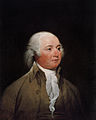
Official_Presidential_portrait_of_John_Adams_(by_John_Trumbull,_circa_1792)A good question, Adam. Hamilton has been the leading figure for the Federalists. But in a way, that’s been a problem: he’s a lightning rod for criticism. More importantly, the Founding Fathers are still trying to avoid confronting the reality that ideological differences are going to be a permanent part of American politics. There’s a sense that it’s John Adams’s turn. Adams himself is certainly thinking in such terms—both as a matter of trying to stay above the fray and in his conviction that he deserves the job. But there’s an undeniably partisan, and regional, cast to the voting. (And Hamilton is actually scheming behind Adams’s back to get someone he regards as less of a dweeb elected.) The South goes to Jefferson. New England goes to Adams. The swing state is New York, which puts Adams over the top.
Adams really wants to recapture the old spirit of the Founders, and reaches out to Jefferson, who’s now vice-president by virtue of finishing second. But James Madison tells him to keep his distance, and Jefferson rejects Adams’s overtures. The former friends, whose relationship really soured during the Washington administration, return to their frostiness.
Brand new president, same old issues. There are still fights over the nation’s finances, and still fights over whether it should tack closer to England or France. The difference now is that the fight between the two has gotten more intense, and Washington is not around to moderate internal political conflict. And the two superpowers are really pushing the United States around.
—How?
England and France are trying to choke off each other’s access to the outside world. England is an island nation that depends on its navy, and that navy depends on manpower, which is chronically short. Hey, Ethan.
—Yeah?
What’s your grandmother’s maiden name.
—Thompson.
 Wonderful. Ethan Thompson. Nice British name. Get on the boat.
—What are you talking about? I'm not Ethan Thompson!
I’m talking about you as a fugitive from the British navy. Obviously you jumped ship at some point, and now I’ve pulled over this American ship you’re on to reclaim lost sailors. Adam. Another fine English name. Get on the boat.
—Adam is my first name. My family is Greek and Italian. My grandmother's name was Montera.
Close enough. Go.
—Why should I?
Because I’m the British navy, dammit, and I’ll put you in chains and the U.S. ship you’re currently on in flames. We’re fighting a war here, son. Now get moving.
—They really did that?
They really did, Sadie. They even had a name for it: Orders in Council. It drove the U.S. government crazy. But there wasn’t a lot the Americans could do. Britain was too powerful militarily. It was too powerful economically, too: the U.S. was deeply dependent on Britain both as a customer and as a supplier of goods.
—So why didn’t we just turn to the French?
Wasn’t so simple, Jonah. First of all, to do that would really piss the Brits off, and again, the U.S. literally couldn’t afford that. For another, the French were playing hardball, too. The French government was mad that President Washington wasn’t honoring the Franco-American treaty of 1778, and really didn’t like Jay’s Treaty. The French were also making noises about trying to overthrow the U.S. government. On top of that, they were also engaged in privateering—that’s when the government secretly gives pirates official permission to foreign ships in exchange for a piece of the action—and were not shy about attacking U.S. shipping.
That said, your instincts are sound, Jonah. In fact, turning to the French was precisely what President Adams tried to do. He secretly sent a set of emissaries—so secret that they went by the names of X, Y, and Z—to Paris to try and cut a deal with the new French government. (There were a lot of new French governments in those days—the nation was in seemingly endless turmoil.)
—So what happened?
It was a fiasco. The French really jerked the American diplomats around, and when they finally agreed to see them made clear that they expected a bribe before there would be any discussion of a deal. Our friends X, Y, and Z left angrily, and returned to the States.
Now this is where things start to get interesting. Jefferson, Madison, and the Republican crowd smelled a rat. When they learned that there had been a diplomatic mission, and that it hadn’t gone well, they demanded to know what happened. What did the Adams administration do? Did they anger the French? Was this just one more example of feckless Federalist Francophilia?
—Feckless Federalist Francophilia?
All right; I’m getting a little carried away. But these are intense times, Emily. The Republicans are indignant. And that turns out to be a mistake.
—Why?
Because Adams makes public what happened, and when he does, the American public is outraged. Those damned French! “Millions for defense, but not one cent for tribute!”
—What’s that supposed to mean?
That the government will do whatever it takes to win a war, but not pay a penny for a bribe. Now, suddenly, for the first and only time in his life, President Dweeb—I mean President Adams—is popular. He’s thrilled. He starts walking around with a fancy uniform and a sword. Though it’s never declared, the United States and France are essentially at war. It’s known as the Quasi War.
—When is this?
We’re talking 1798-99. It doesn’t take long for Adams to begin to feel queasy. (It never does.) But the Federalists go wild.
 —Federalists go wild. Sounds like Spring Break.
Well, maybe more like a reunion weekend. Because Alex is back in town. And he’s looking to take the boys on a road trip. With guns.
Next: Seditious Resolutions

Wednesday, September 14, 2016

King's Survey: The Window

In which we see Franklin and Adams as roommates, 1776.  
95px-Benjamin_Franklin
Franklin

—Mr. K.?
Yes, Sadie? C’mon in. I’m just catching up on some paperwork. You need something? Is that your sweater back there on the chair?
—No, it isn’t, thanks. You said a while back that John Adams and Benjamin Franklin once slept together. Were you joking?
Well, sort of, Sadie. They did sleep together once, but not sleep together, if you know what I mean.
—You said you would tell us the story after class one day. I have a few minutes before I have to catch the bus. Could you—wait a second. There’s Emily. Em! You taking the bus home?
Official_Presidential_portrait_of_John_Adams_(by_John_Trumbull,_circa_1792)
Adams
—Yeah. I saw you and was coming to see if you wanted to walk over there together.

—Mr. K. was just about to tell me the story of how Benjamin Franklin and John Adams slept together. You wanna hear it?
—Sure. Why not. I love thinking about the Founding Fathers having sex.
In that case, Em, I’m going to disappoint you.
—I’m shocked. Go ahead. I’m curious.
All right then. So it’s September 9, 1776. And there they are, John Adams and Benjamin Franklin, one a youthful 70 and the other a fussy 41. They’re on their way from Philadelphia to Staten Island, part of a delegation sent by the Continental Congress to negotiate with Admiral Lord Richard Howe of the Royal Navy, who’s still hoping the American Revolution can be contained. Two weeks earlier, George Washington’s tiny army escaped complete destruction in Brooklyn and is for now, at least, alive to fight another day. Lord Howe hopes he can talk his American friends out of making a huge mistake. Adams considers Howe a phony. That’s why Congress chose him to be one of the negotiators. At the other end of the spectrum is Edward Rutledge of South Carolina, a man who had been reluctant to support independence (he’s worried about preserving slavery). And then there’s old Ben Franklin, who knew Howe back in England, to be the third member of the team.
The negotiators pause in their journey to spend the night in Brunswick, New Jersey. Unfortunately, there’s not much lodging to be had in the local taverns. Franklin and Adams have to share a tiny room, no fireplace, with a single bed and an open window. It’s chilly, and Adams, who’s a bit of a hypochondriac, is afraid of the night air and shuts it. “Oh!” says Franklin. “Don’t shut the window. We shall be suffocated.” When Adams relates his fears of coming down with an illness from the bad night air, Franklin, ever the scientist, replies by saying that the air in the room is far more likely to be a problem than the air outside. “Come!” he tells Adams. Open the window and come to bed and I will convince you. I believe you are not acquainted with my Theory of Colds.”
Adams agrees and joins Franklin in bed. He’s curious to hear Franklin’s reasoning. Lying there in the dark, side by side, Franklin begins his explanation, which literally puts him to sleep (“I left him and his Philosophy together,” he will later write, hearing Franklin trail off just as he does.) They will argue the point again, and Adams will consider Franklin’s reasoning but remain unconvinced.
At this point in his life, Adams admires Franklin. He likes to say that had Franklin done nothing more than invent the lightning rod, the world would justly honor this “great and good man.” But the next time they team up again, this time in Paris to negotiate an alliance with the French government, Adams begins to have his doubts. Mr. “Early to Bed and Early to Rise” sleeps late all the time. (He slept through a lot of the Continental Congress, and though Adams will not be there to catch him, Franklin will sleep through a lot of the Constitutional Convention as well.) He drinks too much; he spends too much. And his behavior with French women is downright embarrassing. Adams feels self-conscious about his French, but as he learns it himself he begins to realize that Franklin understands a lot less than he lets on. And when Adams annoys the French foreign minister, Franklin writes a letter to Congress telling them that Adams is getting in the way and should be sent home. Adams is. And he will never forget or forgive Franklin for that.
—Should Franklin really have done that?
My guess, Sadie, is yes. Adams is an intelligent and decent man. But he’s too stubborn, moralistic and vain to be a successful diplomat. He’s honest to a fault—he can’t play the game the way Franklin, who laughs right along when the King puts his image on the bottom his girlfriend’s chamber pot. Adams tries not to lie, even to himself. That’s why he probably knows in his heart that Franklin was right to dump him.  
Part of the reason why someone like Franklin is such a trial to Adams is that he understands that the man really does exhibit traits Adams himself would be lucky to have. Adams has a hunger for recognition that will never be satisfied. There’s a famous line he wrote that captures his frustration: “The history of our Revolution will be one continued lie from one end to the other. The essence of the whole will be that Dr. Franklin’s electrical rod smote the earth and out sprang General Washington. Then Franklin electrified him with his rod and thenceforth these two conducted all the policy, negotiations, legislatures, and war.” (It was Adams who had proposed Washington take command of the Continental Army – an excellent idea, and one he can’t help but regret.)
Adams had about as successful a career as any person could hope have. From modest beginnings as a shoemaker’s son, he became a self-educated lawyer, political activist, and diplomat. He collaborated with Thomas Jefferson on the Declaration of Independence, and his work on the Massachusetts constitution was a major influence on the federal one. He managed to spend eight years generally keeping his mouth shut as vice president—no small achievement, particularly for him—and went on to become president himself. And he had the good sense and good fortune to marry Abigail, who brought wisdom, humor, and joy into his life. He lived to see his son John Quincy, become president. We should all be so lucky.
But somehow, you rarely get the impression that John Adams was happy. To be sure, he had real sorrows, among them a son who drank himself to death and a daughter who died of cancer. He had powerful enemies, notably Alexander Hamilton and (for a while, anyway) Thomas Jefferson, who, despite hating each other, worked to deny Adams a second term as president. It’s to their credit that Adams and Jefferson were later able to patch things up—though perhaps it’s no accident that they did so while remaining 500 miles apart. Still, you get the sense that the hardest single thing about John Adams’s life is that he had to live with John Adams. Feeling that way is hard enough. But it’s even harder when you’ve got people like Franklin, so seemingly self-assured, by your side.
Adams recorded the scene of his night with Franklin in the autobiography he began writing after his forced retirement from politics following his failed bid for re-election in 1800. I see him at his estate, Peacefield, in Quincy, Massachusetts, an old man remembering himself as a younger one, with Franklin, who had been dead for ten years, alive and likeable. I imagine him chuckling at Franklin, and himself, as he remembers sharing that bed. I’m thinking that the memory of that night brings him pleasure and maybe even comfort in the long twilight of his life. Writing it down gives him something to do.
You two have a bus to catch. No go savor the company of each other.
—Thanks, Mr. K.
—Yeah, thanks.
Thanks, Mr. Adams. Thanks, Mr. Franklin. See you tomorrow.
Next: We’ve won. Now what?

Monday, July 1, 2013

The Window

In honor of our Founding Fathers, an archive edition of American History Now

So there they are, John Adams and Benjamin Franklin, one a youthful 70 and the other a fussy 41, sharing a bed at an inn in New Jersey. They’re on their way from Philadelphia to Staten Island, part of a delegation sent by the Continental Congress to negotiate with Admiral Lord Richard Howe of the Royal Navy, in the hopes of avoiding a full-blown war between England and her American colonies. Two weeks earlier, George Washington’s fledgling army escaped seemingly certain destruction in Brooklyn and is for now, at least, alive to fight another day. Lord Howe hopes he can talk his American friends out of making a huge mistake. Adams considers Howe a phony, his overtures nothing more than “Machiavellian maneuvers.” That’s why he was chosen to be one of the negotiators. Edward Rutledge of South Carolina, a man who had been reluctant to support independence (he has, and will, worry about the preservation of slavery) is another. And old Ben Franklin, who knew Howe back in England, will be the third.

It is the evening of September 9, 1776. The negotiators pause in their journey to spend the night in Brunswick, New Jersey. Unfortunately, there’s not much lodging to be had in the local taverns. Franklin and Adams agree to share a tiny room, no fireplace, with a single bed and a single open window. It is chilly, and Adams, a self described invalid, is “afraid of the air in the night” and shuts it. “Oh!” says Franklin. “Don’t shut the window. We shall be suffocated.” When Adams relates his fears of coming down with an illness from the bad night air, Franklin, ever the scientist, replies by saying that the air in the room is far more likely to be a problem than that outside. “Come!” he tells Adams. Open the window and come to bed and I will convince you. I believe you are not acquainted with my Theory of Colds.”


Adams complies and joins Franklin in bed. He is curious, even at “the risqué of a cold,” to hear Franklin’s reasoning. Lying there in the dark, side by side, Franklin begins his explanation, which, while apparently of some interest to Adams, literally puts him to sleep (“I left him and his Philosophy together,” he will later write, hearing Franklin trail off just as he does.) They will argue the point again, and in his account of their exchanges Adams will muse on Franklin’s reasoning but remain unconvinced.


At this point in his life, Adams admires Franklin. He likes to say that had Franklin done nothing more than invent the lightning rod, the world would justly honor this “great and good man.” But the next time they team up again, this time in Paris to negotiate an alliance with the French government
– a phase of the two men's careers brilliantly captured in the 2008 HBO series, John Adams, from which the above photo was taken – Adams begins to have his doubts. Mr. “Early to Bed and Early to Rise” sleeps late all the time. (He slept through a lot of the Continental Congress, and though Adams will not be there to catch him, Franklin will sleep through a lot of the Constitutional Convention as well.) He drinks too much; he spends too much. And his behavior with French women is downright embarrassing. Adams feels self-conscious about his French, but as he learns it himself he begins to realize that Franklin understands a lot less than he lets on. And when Adams – once again playing bad cop, albeit a bit over his head – annoys the French foreign minister, Franklin writes a letter to Congress telling them that Adams is foolishly tampering with Franklin’s own delicate diplomacy. Adams will never forget or forgive Franklin for that.

Franklin is probably right to dump Adams. Adams probably knows Franklin is right, too. He is over his head. Adams is an intelligent and decent man. But he’s too stubborn, moralistic and vain to be a successful diplomat. He’s honest to a fault – he can’t play the game the way Franklin, who laughs right along when the King puts his image on the bottom his courtesan’s chamber pot, does. He tries not to lie, even to himself.


Part of the reason why someone like Franklin is such a trial to Adams is that he understands that the man really does exhibit traits Adams himself would be lucky to have. Franklin’s cool cheerfulness is a rebuke to Adams’s repressed stolidity. But a hunger for recognition, a hunger that’s never really sated, will not give Adams rest. His wonderfully acidic expression of resentment in 1790 encapsulates his frustration: “The history of our Revolution will be one continued lie from one end to the other. The essence of the whole will be that Dr. Franklin’s electrical rod smote the earth and out sprang General Washington. That Franklin electrified him with his rod and thenceforth these two conducted all the policy, negotiations, legislatures, and war.” (It was Adams who had proposed Washington take command of the Continental Army – an excellent idea, and one he can’t help but at least partially regret.)


Adams had about as successful a career as any person could ever rationally hope. From modest beginnings as a shoemaker’s son, he became a self-educated lawyer, political activist, and diplomat. He collaborated with Thomas Jefferson on the Declaration of Independence, and his work on the Massachusetts constitution was a major influence on the federal one. He managed to spend eight years generally keeping his mouth shut as vice president (no small achievement, particularly for him), and went on to become president himself. And he had the good sense and good fortune to marry Abigail, who brought wisdom, humor, and joy into his life. He lived to see his son John Quincy, become president. We should all be so lucky.


But somehow, you rarely get the impression that John Adams was happy. To be sure, he had legitimate sorrows, among them a son who drank himself to death and a daughter who died of cancer. He had powerful enemies, notably Alexander Hamilton and his erstwhile friend Thomas Jefferson, who, despite hating each other, worked to deny Adams a second term as president. (It’s to their credit that Adams and Jefferson were later able to patch things up – though perhaps it’s no accident that they did so while remaining 500 miles apart.) Still, you get the sense that the hardest single thing about John Adams’s life is that he had to live with John Adams. Feeling that way is hard enough. But it’s even harder when you’ve got people like Franklin, so seemingly self-assured, by your side.


Adams recorded the scene of his night with Franklin in the autobiography he began writing after his forced retirement from politics following his failed bid for re-election in 1800. Though he had a diary to draw on, the editor of the Adams Papers, L.H. Butterfield, reported in 1961 that he wrote this scene “from unaided memory.” I see him at his estate, Peacefield, in Quincy, Massachusetts, an old man remembering himself as a younger one, with Franklin, who had been dead for years, alive and likeable. Adams had been upset earlier that September day when he saw what he regarded as the indiscipline and “dissipation” of the American soldiers he had seen on the road (my guess is that he was being prudishly unrealistic). But he was “determined that it should not dishearten me.” I can’t be sure, but it seems like he’s succeeding, and that the memory of that night brings him pleasure and maybe even comfort in the long twilight of his life. Writing it down gives him something to do.

And us something to celebrate. Thank you, Mr. Adams. And Mr. Franklin.

Friday, July 2, 2010

The Window

Franklin. Adams. Roommates. Summer, 1776


[In honor of our Founding Fathers, an archive edition of American History Now]

So there they are, John Adams and Benjamin Franklin, one a youthful 70 and the other a fussy 41, sharing a bed at an inn in New Jersey. They’re on their way from Philadelphia to Staten Island, part of a delegation sent by the Continental Congress to negotiate with Admiral Lord Richard Howe of the Royal Navy, in the hopes of avoiding a full-blown war between England and her American colonies. Two weeks earlier, George Washington’s fledgling army escaped seemingly certain destruction in Brooklyn and is for now, at least, alive to fight another day. Lord Howe hopes he can talk his American friends out of making a huge mistake. Adams considers Howe a phony, his overtures nothing more than “Machiavellian maneuvers.” That’s why he was chosen to be one of the negotiators. Edward Rutledge of South Carolina, a man who had been reluctant to support independence (he has, and will, worry about the preservation of slavery) is another. And old Ben Franklin, who knew Howe back in England, will be the third.

It is the evening of September 9, 1776. The negotiators pause in their journey to spend the night in Brunswick, New Jersey. Unfortunately, there’s not much lodging to be had in the local taverns. Franklin and Adams agree to share a tiny room, no fireplace, with a single bed and a single open window. It is chilly, and Adams, a self described invalid, is “afraid of the air in the night” and shuts it. “Oh!” says Franklin. “Don’t shut the window. We shall be suffocated.” When Adams relates his fears of coming down with an illness from the bad night air, Franklin, ever the scientist, replies by saying that the air in the room is far more likely to be a problem than that outside. “Come!” he tells Adams. Open the window and come to bed and I will convince you. I believe you are not acquainted with my Theory of Colds.”


Adams complies and joins Franklin in bed. He is curious, even at “the risqué of a cold,” to hear Franklin’s reasoning. Lying there in the dark, side by side, Franklin begins his explanation, which, while apparently of some interest to Adams, literally puts him to sleep (“I left him and his Philosophy together,” he will later write, hearing Franklin trail off just as he does.) They will argue the point again, and in his account of their exchanges Adams will muse on Franklin’s reasoning but remain unconvinced.


At this point in his life, Adams admires Franklin. He likes to say that had Franklin done nothing more than invent the lightning rod, the world would justly honor this “great and good man.” But the next time they team up again, this time in Paris to negotiate an alliance with the French government
– a phase of the two men's careers brilliantly captured in the 2008 HBO series, John Adams, from which the above photo was taken – Adams begins to have his doubts. Mr. “Early to Bed and Early to Rise” sleeps late all the time. (He slept through a lot of the Continental Congress, and though Adams will not be there to catch him, Franklin will sleep through a lot of the Constitutional Convention as well.) He drinks too much; he spends too much. And his behavior with French women is downright embarrassing. Adams feels self-conscious about his French, but as he learns it himself he begins to realize that Franklin understands a lot less than he lets on. And when Adams – once again playing bad cop, albeit a bit over his head – annoys the French foreign minister, Franklin writes a letter to Congress telling them that Adams is foolishly tampering with Franklin’s own delicate diplomacy. Adams will never forget or forgive Franklin for that.

Franklin is probably right to dump Adams. Adams probably knows Franklin is right, too. He is over his head. Adams is an intelligent and decent man. But he’s too stubborn, moralistic and vain to be a successful diplomat. He’s honest to a fault – he can’t play the game the way Franklin, who laughs right along when the King puts his image on the bottom his courtesan’s chamber pot, does. He tries not to lie, even to himself.


Part of the reason why someone like Franklin is such a trial to Adams is that he understands that the man really does exhibit traits Adams himself would be lucky to have. Franklin’s cool cheerfulness is a rebuke to Adams’s repressed stolidity. But a hunger for recognition, a hunger that’s never really sated, will not give Adams rest. His wonderfully acidic expression of resentment in 1790 encapsulates his frustration: “The history of our Revolution will be one continued lie from one end to the other. The essence of the whole will be that Dr. Franklin’s electrical rod smote the earth and out sprang General Washington. That Franklin electrified him with his rod and thenceforth these two conducted all the policy, negotiations, legislatures, and war.” (It was Adams who had proposed Washington take command of the Continental Army – and excellent idea, and one he can’t help but at least partially regret.)


Adams had about as successful a career as any person could ever rationally hope. From modest beginnings as a shoemaker’s son, he became a self-educated lawyer, political activist, and diplomat. He collaborated with Thomas Jefferson on the Declaration of Independence, and his work on the Massachusetts constitution was a major influence on the federal one. He managed to spend eight years generally keeping his mouth shut as vice president (no small achievement, particularly for him), and went on to become president himself. And he had the good sense and good fortune to marry Abigail, who brought wisdom, humor, and joy into his life. He lived to see his son John Quincy, become president. We should all be so lucky.


But somehow, you rarely get the impression that John Adams was happy. To be sure, he had legitimate sorrows, among them a son who drank himself to death and a daughter who died of cancer. He had powerful enemies, notably Alexander Hamilton and his erstwhile friend Thomas Jefferson, who, despite hating each other, worked to deny Adams a second term as president. (It’s to their credit that Adams and Jefferson were later able to patch things up – though perhaps it’s no accident that they did so while remaining 500 miles apart.) Still, you get the sense that the hardest single thing about John Adams’s life is that he had to live with John Adams. Feeling that way is hard enough. But it’s even harder when you’ve got people like Franklin, so seemingly self-assured, by your side.


Adams recorded the scene of his night with Franklin in the autobiography he began writing after his forced retirement from politics following his failed bid for re-election in 1800. Though he had a diary to draw on, the editor of the Adams Papers, L.H. Butterfield, reported in 1961 that he wrote this scene “from unaided memory.” I see him at his estate, Peacefield, in Quincy, Massachusetts, an old man remembering himself as a younger one, with Franklin, who had been dead for years, alive and likeable. Adams had been upset earlier that September day when he saw what he regarded as the indiscipline and “dissipation” of the American soldiers he had seen on the road (my guess is that he was being prudishly unrealistic). But he was “determined that it should not dishearten me.” I can’t be sure, but it seems like he’s succeeding, and that the memory of that night brings him pleasure and maybe even comfort in the long twilight of his life. Writing it down gives him something to do.

And us something to celebrate. Thank you, Mr. Adams (and Mr. Franklin).