Showing posts with label Quasi War. Show all posts

Friday, October 7, 2016

King's Survey: Seditious Resolution

In which we see a quasi war abroad become fully divisive at home


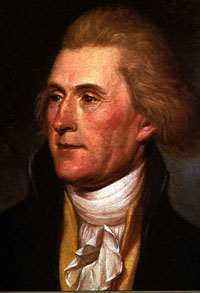
Thomas_Jefferson_rev
Thomas Jefferson
It’s 1798, kids, and a war is underway.

—Did I miss something? Who are we at war with?
—France, dummy.
—Really? Since when?
—Mr. K. told us: 1798.
—I don’t remember talking about this.
—I have it my notes from the last class: the Quasi War.
—But is a quasi war a real war? Doesn’t “quasi” mean fake?
—More like “semi"
—Well is a “semi” war a real war?
—Mr. K. says it is.
—On what basis?
A fair question, Adam. Congress had not formally declared war. But the government is gearing up for one, and no one is more excited about the prospect than our old friend Alexander Hamilton. Because the United States now faces the prospect of armed conflict, it has to build up its military. President Adams wants to concentrate on the navy, but there’s pressure from the Federalists to build up the army. He turns to ex-president Washington, but Washington turns him down: he’s too old and tired to come out of retirement. Washington recommends his old deputy, Hamilton. This is about the last thing Adams wants to hear. His suspicion of Hamilton has been growing steadily (Hamilton has been trash-talking about Adams for years). Adams reluctantly offers Hamilton the job, which he’s only too eager to accept. Hamilton likes the idea of a bigger army—and he likes the idea of using it not only to fight foreign enemies, but to keep order at home, the way he did with the Whiskey Rebellion back in 1794. But now there’s no Washington to hold him in check. Hamilton has his eyes on those pesky Republicans.            
—This doesn’t sound too good.
99px-James_Madison
James Madison

It isn’t, Kylie. The Republican decision to challenge the Adams administration on the XYZ Affair, that whole thing where the French demanded bribes before negotiating with the Americans, really backfires. The mood of the country turns decisively against them, and the Federalists decide this is an opportunity to deal them a mortal blow. They ram a series of bills through Congress known as the Alien and Sedition Acts, and Adams makes the fateful decision to sign them. Three of these laws are directed against immigrants (with the meddling French diplomat Edmond Genet in mind): they extend the number of years you have to be in the United States to become a citizen, allow the government to detail citizens they deemed dangerous, and also to expel them. But it’s the fourth law, the Sedition Act, which proves to be a real flashpoint. It allows the government to jail and impose fines on Americans who write, print or speak “false, scandalous, and malicious” statements against the government or the president (notably, the vice president, i.e. Jefferson, wasn’t included).
—Write, print, or speak?
Yup.
—How can that be?
What’s the problem, Yin?
—Isn’t that against the law?
What law?
—The Constitution?
Where in the Constitution?
—The Bill of Rights.
Where in the Bill of Rights?
—Isn’t it the First Amendment?
Excellent, Yin. Took you a little while, but you got there.
—But I don’t understand how they could do that!
Well they did. Na na na na na na.
—Na na na na na na, Mr. K? Really?
—So what happened?
Well, fourteen Republicans were sent to jail, most of them journalists, one of them Benjamin Franklin’s grandson.
—That’s so outrageous.
I’m really pleased to see you so upset, Yin.
—Mr. K!
I’m impressed by Yin’s outrage, Sadie. I’ve always been impressed by her curiosity. I’m glad to see this other dimension of her intellectual life. In any event, you’ll be glad to know that there were plenty of people, not all of them die-hard Republicans, who were as upset as Yin.
—Like I said, this is not good.
Well, Kylie, by some reckonings—I’ll be interested to hear what you think—things are about to get worse. An outraged Jefferson and an outraged Madison decide they need to respond. They agree on a plan to issue protests against the Alien and Sedition Acts. Madison writes a statement that passes the Virginia legislature and comes to be known as the Virginia Resolution. Jefferson, following suit, writes what comes to be known as the Kentucky Resolution.
—What do they say?
In brief, they both say a state doesn’t have to accept a federal law it regards as unconstitutional. What do you think about that, Kylie?
—Well, I guess that makes sense. I mean, if a law is wrong, you shouldn’t have to obey it.
 Ethan, you’re shaking your head.
—That’s nuts.
Why is that?
—Because you can’t just go around saying you’re not go to obey any law you don’t like. That’s how the Civil War happened.
Oh it is, is it?
—Yeah. It’s like the South didn’t like Lincoln getting elected so they said ‘we quit.’
—That’s different, Ethan. Lincoln won fair and square. But what are these guys supposed to do? Do you have to obey a law that’s clearly wrong, like this one is?
—You have to accept it. And then try and change it.
—I agree with Adam.
—But who’s to say you can change it? What if they saying that trying to change it is speaking out against the government? And they send you to jail for that?
—This is a horrible situation. Here you have one set of people who pass a bad law, and then another set of people who pass another bad law?
Were they equally bad laws, Sadie?
—I don’t know. That’s why I say this is a horrible situation. What ends up happening?
Well, I told you that the Republicans got into this situation because they overplayed their hand with the XYZ affair. But now it’s the Federalists who overplay their hand: the Alien and Sedition Acts really boomerang on them. The Republicans really start to make a comeback.
—Yeah, but what about the war?
Good question. As you heard at a few minutes ago, it’s known as the Quasi War.
—OK. But did it ever become an actual war?
Well, there are some shots exchanged on the high seas. But as it turns out, the American government isn’t the only one that’s distracted by internal turmoil. By 1799, there’s another new government in France. And Adams, about as scared as Jefferson by the prospect of Alexander Hamilton in charge of an army, does a really smart thing: he quietly tries again with France. This time the French are more receptive, and they come to an understanding. Which means that Adams can disband the army. Hamilton is pissed; lots of other people are relieved. A bullet has been dodged.
This doesn’t mean, however, that the Republicans are backing off. They’re more determined than ever to defeat the Federalists who have been running the country for ten long years now. They want to get control of the government. And they form a plan to do it.
—So what happens next?
It gets worse. See you tomorrow.
Next: Aaron Burr in the saddle

Wednesday, October 5, 2016

King's Survey: French Fried


In which we see a strong leader thread a weak nation through narrow straits—and passes the wheel his (somewhat more clumsy) successor
Papas_Fritas
So here’s where we are, kids. England and France at war; the United States is caught in the middle. Washington reluctantly agrees to serve a second term in 1792, and is handily re-elected.
—So what side does he take in the war?
Well, Sadie, there is that treaty the United States signed with France during the Revolution. Should he honor it?
—You’re asking me?
Of course.
—Duh, Sadie. You should know Mr. K. by now. This is what he does. Annoying as hell.
—I have no idea if Washington should honor the treaty. I guess I can flip a coin. I figure I have a 50% chance of being right.
Wrong.
—Wrong? How can I be wrong?
Here’s how: Washington does not formally nullify the treaty, as Hamilton wants. But he does make a proclamation of neutrality in 1793, effectively making clear that the United States will not participate in a military alliance with France. Washington is determined to steer a middle course. The coin lands on its edge.
—Congratulations, Mr. K. You asked me to guess, you told me I was wrong even before I did. Is there supposed to be some big lesson here?
You mean other than to testify to my brilliance? Than to feed my ego at your expense? What other reason could there be, Sadie?
—Oh my God, Mr. K. Emily is right: you are impossible.
—But she loves you anyway, Mr. K. I keep trying to talk her out of it, but she’s stubborn that way.
—Actually, I’m curious, Mr. K. Is there any good reason you tricked Sadie like that?
Well, I hope so, Kylie. My goal was to make the point that in statecraft—as in other arenas of daily life—sometimes you have to think outside the box a little. Things that may seem binary, one way or the other, may not be. I’m not sure what President Washington did with the Treaty of 1778 made perfect logical sense, but it was a way of actively antagonizing Britain or France if he didn’t have to. This is something Washington has shown again and again throughout his career: a sense of patience, of not committing to a course on someone else’s terms.
—Did it work? And can you just tell us now?
Yes.
—For both?
Yes, for both. But the foreign policy balancing act isn’t easy. Actually, Washington’s biggest headache about England and France rages most actively in his own cabinet. Hamilton and Jefferson are arguing with each other endlessly, over this and other matters. They’re also pushing their agendas in other ways. In the mid-1790s, the French send an emissary named Edmond Genet to the United States. He quickly becomes a confidant of Jefferson and the Republicans, and uses that position to meddle in American politics, angering Washington. Hamilton, for his part, is also doing things he shouldn’t. In 1794, Washington sends the U.S. diplomat John Jay (he of the Federalist Papers) to Great Britain to negotiate a treaty. Hamilton is so eager for a good relationship with Britain that he leaks U.S. bargaining positions to a British diplomat. Republicans in the U.S. Senate are angry about Jay’s Treaty and threaten not to approve it. Washington, himself angry, responds: approve the treaty, or impeach me. They cave. But they also seethe. Jefferson quits Washington’s cabinet early in Washington’s second term; Hamilton follows about a year later. They continue scheming and sniping long after they’re gone.  
Washington, for his part, is sick of all this. He can easily be elected to a third term in 1796, but has had enough. He also thinks it’s vitally important that he not die in office and that there be an orderly transition of power. At the end of his second term, he delivers his famous Farewell Address, in which he warns Americans about the dangers of “entangling alliances.” For Washington, independence is the central concept of the United States, and that applies to its foreign policy, the freedoms of its people, and the very creation of the nation itself.
—So what happens next?
Well, you have the presidential election of 1796, which is the first contested election in American history. Jefferson is the obvious candidate for the Republicans. His opponent is John Adams, who for the last eight years has served as vice-president under Washington.
—Why not Hamilton?
Official_Presidential_portrait_of_John_Adams_(by_John_Trumbull,_circa_1792)A good question, Adam. Hamilton has been the leading figure for the Federalists. But in a way, that’s been a problem: he’s a lightning rod for criticism. More importantly, the Founding Fathers are still trying to avoid confronting the reality that ideological differences are going to be a permanent part of American politics. There’s a sense that it’s John Adams’s turn. Adams himself is certainly thinking in such terms—both as a matter of trying to stay above the fray and in his conviction that he deserves the job. But there’s an undeniably partisan, and regional, cast to the voting. (And Hamilton is actually scheming behind Adams’s back to get someone he regards as less of a dweeb elected.) The South goes to Jefferson. New England goes to Adams. The swing state is New York, which puts Adams over the top.
Adams really wants to recapture the old spirit of the Founders, and reaches out to Jefferson, who’s now vice-president by virtue of finishing second. But James Madison tells him to keep his distance, and Jefferson rejects Adams’s overtures. The former friends, whose relationship really soured during the Washington administration, return to their frostiness.
Brand new president, same old issues. There are still fights over the nation’s finances, and still fights over whether it should tack closer to England or France. The difference now is that the fight between the two has gotten more intense, and Washington is not around to moderate internal political conflict. And the two superpowers are really pushing the United States around.
—How?
England and France are trying to choke off each other’s access to the outside world. England is an island nation that depends on its navy, and that navy depends on manpower, which is chronically short. Hey, Ethan.
—Yeah?
What’s your grandmother’s maiden name.
—Thompson.
 Wonderful. Ethan Thompson. Nice British name. Get on the boat.
—What are you talking about? I'm not Ethan Thompson!
I’m talking about you as a fugitive from the British navy. Obviously you jumped ship at some point, and now I’ve pulled over this American ship you’re on to reclaim lost sailors. Adam. Another fine English name. Get on the boat.
—Adam is my first name. My family is Greek and Italian. My grandmother's name was Montera.
Close enough. Go.
—Why should I?
Because I’m the British navy, dammit, and I’ll put you in chains and the U.S. ship you’re currently on in flames. We’re fighting a war here, son. Now get moving.
—They really did that?
They really did, Sadie. They even had a name for it: Orders in Council. It drove the U.S. government crazy. But there wasn’t a lot the Americans could do. Britain was too powerful militarily. It was too powerful economically, too: the U.S. was deeply dependent on Britain both as a customer and as a supplier of goods.
—So why didn’t we just turn to the French?
Wasn’t so simple, Jonah. First of all, to do that would really piss the Brits off, and again, the U.S. literally couldn’t afford that. For another, the French were playing hardball, too. The French government was mad that President Washington wasn’t honoring the Franco-American treaty of 1778, and really didn’t like Jay’s Treaty. The French were also making noises about trying to overthrow the U.S. government. On top of that, they were also engaged in privateering—that’s when the government secretly gives pirates official permission to foreign ships in exchange for a piece of the action—and were not shy about attacking U.S. shipping.
That said, your instincts are sound, Jonah. In fact, turning to the French was precisely what President Adams tried to do. He secretly sent a set of emissaries—so secret that they went by the names of X, Y, and Z—to Paris to try and cut a deal with the new French government. (There were a lot of new French governments in those days—the nation was in seemingly endless turmoil.)
—So what happened?
It was a fiasco. The French really jerked the American diplomats around, and when they finally agreed to see them made clear that they expected a bribe before there would be any discussion of a deal. Our friends X, Y, and Z left angrily, and returned to the States.
Now this is where things start to get interesting. Jefferson, Madison, and the Republican crowd smelled a rat. When they learned that there had been a diplomatic mission, and that it hadn’t gone well, they demanded to know what happened. What did the Adams administration do? Did they anger the French? Was this just one more example of feckless Federalist Francophilia?
—Feckless Federalist Francophilia?
All right; I’m getting a little carried away. But these are intense times, Emily. The Republicans are indignant. And that turns out to be a mistake.
—Why?
Because Adams makes public what happened, and when he does, the American public is outraged. Those damned French! “Millions for defense, but not one cent for tribute!”
—What’s that supposed to mean?
That the government will do whatever it takes to win a war, but not pay a penny for a bribe. Now, suddenly, for the first and only time in his life, President Dweeb—I mean President Adams—is popular. He’s thrilled. He starts walking around with a fancy uniform and a sword. Though it’s never declared, the United States and France are essentially at war. It’s known as the Quasi War.
—When is this?
We’re talking 1798-99. It doesn’t take long for Adams to begin to feel queasy. (It never does.) But the Federalists go wild.
 —Federalists go wild. Sounds like Spring Break.
Well, maybe more like a reunion weekend. Because Alex is back in town. And he’s looking to take the boys on a road trip. With guns.
Next: Seditious Resolutions