Showing posts with label James Madison. Show all posts

Monday, October 17, 2016

King's Survey: The Dumbest War

In which we see a foolish war, and its less foolish legacy.

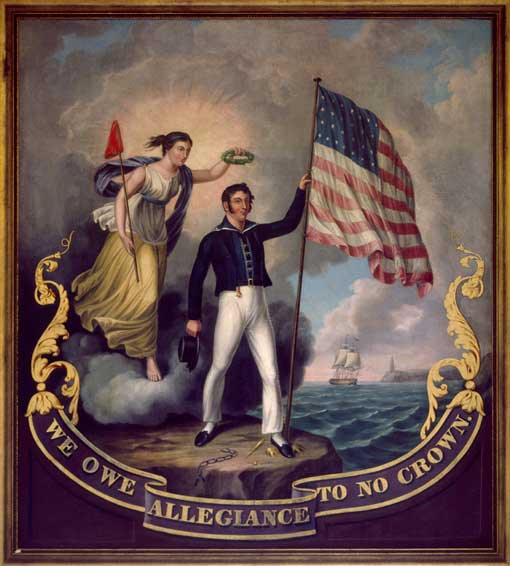
We_Owe_Allegiance_To_No_Crown
John Archibald Woodside, "We Owe No Allegiance to No Crown" (1814)
England and France are at it again, kids. It’s been going on, more or less continuously, for almost twenty years now.
—When are we?
We’re in 1807, Jonah. Well into Thomas Jefferson’s second term.
—So easy to lose track of time.
When you’re having fun.
—Yeah, sure.
So it’s 1807, England and France are still fighting, and President Jefferson thinks he has a solution for the United States. Rather than take sides, or worry about getting caught in the middle, the United States should simply opt out. He backs the passage of the Embargo Act, which prohibits trade with England and France. Jefferson likes this law because it serves his domestic agenda as well: he wants the United States to be more self-sufficient. Developing internal trade is good economics as far as he’s concerned.
—Sounds reasonable. Does it work?
What Jefferson doesn’t quite get—or maybe what he doesn’t quite care about—is that shutting down trade is terrible for the New England economy. The United States is still in effect a British colony when it comes to pretty much any kind of manufactured good, and that’s not something that can be changed by a law. The region goes into a severe depression. New Englanders flout the Embargo Act, especially in terms of trade with Canada, which make the Jefferson administration mad but unable to do much about it.
Jefferson finishes his second term in 1809. His chosen successor is James Madison, who wins easily, notwithstanding the lack of votes he gets in New England. Madison, of course, has long been the architect of Jeffersonianism—he’s been the one to frame and implement Jefferson’s ideas—so his administration is one of continuity more than change. But that means dealing with a lot of the same problems, notably how do to deal with the ongoing problem of the Orders in Council, that British habit of pulling over American ships and forcing sailors to join the British navy. By this point, there are some new faces on the scene, like Representative John Calhoun of South Carolina, and Representative Henry Clay of Kentucky, who are pushing for a hard line with the British. They’re known as War Hawks.
The Madison administration stumbles along with this issue until 1812 (the year Madison is up for re-election, which he secures, on pretty much the same terms that had prevailed in 1800, 1804, and 1808), when the United States declares war on Great Britain. I call the War of 1812. The dumbest war in American history.
—Why?
I say so for a couple reasons, and the first is this: Britain had just agreed to stop the impressment (as it was known) of Americans, but the news didn’t reach Congress before the war broke out. So the two sides went to war even though the reason they went to war was no longer happening.
—You don’t hear much about the War of 1812. What happened with it?
Well, it was kind of a mess. The British were distracted by the ongoing fallout from the French Revolution, which had moved into a climactic phase: 1812 was the year Napoleon invaded Russia. The United States thought it could take advantage of this by invading Canada, a campaign that went poorly. Americans never understood that Canadians were just not interested in joining the United States. There was also a lot of naval warfare on the Great Lakes, which went relatively well. But overall, the first half of the war was pretty much a draw.
But then the situation abroad changed. Napoleon’s invasion of Russia was a disaster. He wrecked the French army, which was driven back to Paris. Napoleon himself was driven into exile. Now the Brits could really focus their attention on the United States. An invasion force was dispatched to Washington, and it wrecked the city (the White House was set on fire, and President Madison had to flee). The Americans managed to defend Baltimore, an event memorialized in the Star Spangled Banner, a set of lyrics written by Francis Scott Key that was set to a saloon song.
—Wow. That sounds pretty bad. How come we didn’t lose?
Here’s the thing: by 1814, Great Britain had been at war almost continuously for 25 years. The British public was exhausted. So the government decided to open negotiations with the Americans in the Belgian city of Ghent. There a deal was cut where the Brits agreed to do what they had already agreed to do: stop with the impressment of U.S. sailors. Which they didn’t need to do any more anyway. (Napoleon came back once more, and was defeated once more, at the Battle of Waterloo. But that happened later.) And so, in December of 1814, the Treaty of Ghent was signed.
Which brings us to one more dumb aspect of the War of 1812.
—Wait.
Yes, Adam?
—Were there many people who fought in the Revolution who fought in the War of 1812?
Not many. The two wars were almost 40 years apart, after all. But I can think of one person who was involved in both. He was a child when the Revolution happened. He saw his brother killed, and his mother died taking care of American soldiers on a prison ship. He himself was caught by the Brits, and when a British soldier told him to polish his boots, the kid in effect told him to you-know-what himself, he got slashed in the face with a scar he had for the rest of his life.
Now, in January of 1815, the kid has become an American general. He’s assembled a multiracial force—red, white, and black—to face a British invasion of New Orleans. None of these people has gotten word of the treaty, so the British proceed with the attack. And they are utterly crushed by the Americans. One of the greatest military victories in the nation’s history.
—What a waste.
Yeah, Sadie, it was, like I’ve been saying, kind of dumb. But it wasn’t necessarily a waste. Had the Americans lost, it’s easy to believe that the British would have tried to renegotiate the treaty. In any event, the Battle of New Orleans was a tremendous morale boost for the United States. It inaugurated a period known as the Era of Good Feelings, that would last for the rest of the decade. And it made that general, a man named Andrew Jackson, a force to be reckoned with in years to come.
The Battle of New Orleans was important for another reason as well. It really marked the end of this period I’m talking about when the United States was buffeted by stronger powers. From this point on, it would be more and more in control of its destiny. A new era was dawning.
—And another class is ending.
Go forth, young Americans.
Next: The Transportation Revolution

Friday, October 7, 2016

King's Survey: Seditious Resolution

In which we see a quasi war abroad become fully divisive at home


Thomas_Jefferson_rev
Thomas Jefferson
It’s 1798, kids, and a war is underway.

—Did I miss something? Who are we at war with?
—France, dummy.
—Really? Since when?
—Mr. K. told us: 1798.
—I don’t remember talking about this.
—I have it my notes from the last class: the Quasi War.
—But is a quasi war a real war? Doesn’t “quasi” mean fake?
—More like “semi"
—Well is a “semi” war a real war?
—Mr. K. says it is.
—On what basis?
A fair question, Adam. Congress had not formally declared war. But the government is gearing up for one, and no one is more excited about the prospect than our old friend Alexander Hamilton. Because the United States now faces the prospect of armed conflict, it has to build up its military. President Adams wants to concentrate on the navy, but there’s pressure from the Federalists to build up the army. He turns to ex-president Washington, but Washington turns him down: he’s too old and tired to come out of retirement. Washington recommends his old deputy, Hamilton. This is about the last thing Adams wants to hear. His suspicion of Hamilton has been growing steadily (Hamilton has been trash-talking about Adams for years). Adams reluctantly offers Hamilton the job, which he’s only too eager to accept. Hamilton likes the idea of a bigger army—and he likes the idea of using it not only to fight foreign enemies, but to keep order at home, the way he did with the Whiskey Rebellion back in 1794. But now there’s no Washington to hold him in check. Hamilton has his eyes on those pesky Republicans.            
—This doesn’t sound too good.
99px-James_Madison
James Madison

It isn’t, Kylie. The Republican decision to challenge the Adams administration on the XYZ Affair, that whole thing where the French demanded bribes before negotiating with the Americans, really backfires. The mood of the country turns decisively against them, and the Federalists decide this is an opportunity to deal them a mortal blow. They ram a series of bills through Congress known as the Alien and Sedition Acts, and Adams makes the fateful decision to sign them. Three of these laws are directed against immigrants (with the meddling French diplomat Edmond Genet in mind): they extend the number of years you have to be in the United States to become a citizen, allow the government to detail citizens they deemed dangerous, and also to expel them. But it’s the fourth law, the Sedition Act, which proves to be a real flashpoint. It allows the government to jail and impose fines on Americans who write, print or speak “false, scandalous, and malicious” statements against the government or the president (notably, the vice president, i.e. Jefferson, wasn’t included).
—Write, print, or speak?
Yup.
—How can that be?
What’s the problem, Yin?
—Isn’t that against the law?
What law?
—The Constitution?
Where in the Constitution?
—The Bill of Rights.
Where in the Bill of Rights?
—Isn’t it the First Amendment?
Excellent, Yin. Took you a little while, but you got there.
—But I don’t understand how they could do that!
Well they did. Na na na na na na.
—Na na na na na na, Mr. K? Really?
—So what happened?
Well, fourteen Republicans were sent to jail, most of them journalists, one of them Benjamin Franklin’s grandson.
—That’s so outrageous.
I’m really pleased to see you so upset, Yin.
—Mr. K!
I’m impressed by Yin’s outrage, Sadie. I’ve always been impressed by her curiosity. I’m glad to see this other dimension of her intellectual life. In any event, you’ll be glad to know that there were plenty of people, not all of them die-hard Republicans, who were as upset as Yin.
—Like I said, this is not good.
Well, Kylie, by some reckonings—I’ll be interested to hear what you think—things are about to get worse. An outraged Jefferson and an outraged Madison decide they need to respond. They agree on a plan to issue protests against the Alien and Sedition Acts. Madison writes a statement that passes the Virginia legislature and comes to be known as the Virginia Resolution. Jefferson, following suit, writes what comes to be known as the Kentucky Resolution.
—What do they say?
In brief, they both say a state doesn’t have to accept a federal law it regards as unconstitutional. What do you think about that, Kylie?
—Well, I guess that makes sense. I mean, if a law is wrong, you shouldn’t have to obey it.
 Ethan, you’re shaking your head.
—That’s nuts.
Why is that?
—Because you can’t just go around saying you’re not go to obey any law you don’t like. That’s how the Civil War happened.
Oh it is, is it?
—Yeah. It’s like the South didn’t like Lincoln getting elected so they said ‘we quit.’
—That’s different, Ethan. Lincoln won fair and square. But what are these guys supposed to do? Do you have to obey a law that’s clearly wrong, like this one is?
—You have to accept it. And then try and change it.
—I agree with Adam.
—But who’s to say you can change it? What if they saying that trying to change it is speaking out against the government? And they send you to jail for that?
—This is a horrible situation. Here you have one set of people who pass a bad law, and then another set of people who pass another bad law?
Were they equally bad laws, Sadie?
—I don’t know. That’s why I say this is a horrible situation. What ends up happening?
Well, I told you that the Republicans got into this situation because they overplayed their hand with the XYZ affair. But now it’s the Federalists who overplay their hand: the Alien and Sedition Acts really boomerang on them. The Republicans really start to make a comeback.
—Yeah, but what about the war?
Good question. As you heard at a few minutes ago, it’s known as the Quasi War.
—OK. But did it ever become an actual war?
Well, there are some shots exchanged on the high seas. But as it turns out, the American government isn’t the only one that’s distracted by internal turmoil. By 1799, there’s another new government in France. And Adams, about as scared as Jefferson by the prospect of Alexander Hamilton in charge of an army, does a really smart thing: he quietly tries again with France. This time the French are more receptive, and they come to an understanding. Which means that Adams can disband the army. Hamilton is pissed; lots of other people are relieved. A bullet has been dodged.
This doesn’t mean, however, that the Republicans are backing off. They’re more determined than ever to defeat the Federalists who have been running the country for ten long years now. They want to get control of the government. And they form a plan to do it.
—So what happens next?
It gets worse. See you tomorrow.
Next: Aaron Burr in the saddle

Friday, September 30, 2016

King's Survey: Party, a 4-Letter Word

In which we see politics befall the Founding Fathers
Portrait of Alexander Hamilton
Alexander Hamilton
Sadie.
—Hey, Mr. K.
Yesterday you asked whether the growing rift between (Federalist) Alexander Hamilton and (Democratic-Republican, or just Republican for short) James Madison marked the beginning of party politics.
—I remember.
The short answer is no. And Emily has a wry expression on her face.
—Because now you’re going to give us the long answer.
Gotta earn my paycheck, Em. So here we go: It’s hard to call the Federalists and Republicans parties, because the Founding Fathers hated the very idea of parties. They believed any American involved in politics should put the country first, and if intelligent patriots of good will got together to solve a problem, an objectively fair solution would emerge. The idea that intelligent patriots of good will might actually have honest differences, that there might be more than one legitimate way to solve a problem, was hard for them to accept. And when confronted with this prospect, they tended to say the other guy belonged to a “faction,” a group of selfish intriguers who were pursuing their own agenda. The notion of a modern political party came later.
That said, there are threads that connect these factions to our modern political parties. The Democratic-Republican, or Republican, faction that was led by Jefferson with Madison as his lieutenant, was the party of the little guy. For most of U.S. history, being the party of the little guy was a matter of favoring limits on the government, because the perception was that government power tended to side with business interests against the people. That would change, and in our time, the little guy—and gal—has often favored more government rather than less. But that’s a matter of means. The end has always been the same: favoring ordinary people.
—So what does that make the other party? The party of Darth Vader?
Not exactly, Em. Hamilton’s faction, the Federalists, are the party of the big dogs—and little dogs who believe they will become big dogs. As we’ll see, there are philosophical connections that link them to a party known as the Whigs, and then later the Republican Party. The Federalists and these heirs have been the money party. The business party. The Federalists and their successors were the party of the strivers, like Hamilton himself—an immigrant who became a paragon, even architect, of the American Dream. They saw themselves as champions of opportunity, of the promise of success, variously construed, for those who were willing to work for it. For most of American history, these people believed the government needed to lend a hand to their enterprises, whether by giving them lucrative contracts, or in imposing taxes on foreign goods so that their own seemed cheaper and better, or other means. Later, once American business became a global force, they came to conclude that government should stay out of their way. But here too, the issue was means, not ends.
Let’s be clear: there were elements of hypocrisy and delusion in both these visions. Jefferson, who considered himself the champion of ordinary working people, was a rich slaveholder (as was Madison). And a strong strain of elitism and exclusion ran through every version of American politics that followed in their wake. And Hamilton, who himself was very honest in his public life (less so in his private life) labored on behalf of those more interested in a quick buck than earned rewards. The Federalists also kept on insisting, and getting, government help even as they complained about the way government constrained them. But these two visions of American life, and the conflict between them, have proven amazingly durable. As has the basis of that fight, whose essence is the proper role of government. In the early life of the republic, the Federalists wanted more, and the Republicans less.
There were other fights along these lines. One concerned taxes. There was all kind of debts in the infant nation. Some of it was personal debt. And some of it was government debt, notably state debt. But there were thirteen states, with widely varying situations regarding the debt. Some states, like Virginia, had little or none. Others, particularly Northern states, had a lot. Hamilton pushed for the U.S. government to absorb those debts—to make them national, rather than state debts—and he was actually eager for the government to borrow more money.
—Why would he want that?
For a couple different reasons, Adam. One is that it would strengthen the indebted states financially and bind them to the nation. Another is that by borrowing money, and then paying it back, he would increase the financial community’s confidence in the nation. That money could be used, by the way, to strengthen the country in other ways, too, like supporting industry and building up its military.
—But how was the government going to pay back all that money?
At least three different ways. One was by selling land. The United States didn’t have much money, but it had a lot of territory that could be carved up and sold off for cash. Another—and this is something I want you to remember kids, because it’s going to come up again and again—was by slapping taxes, or tariffs, on foreign goods coming into the United States. This killed two birds with one stone: it raised money, but it also made imports more expensive, which gave consumers an incentive to buy home-grown products. And helping industry grow was a big part of Hamilton’s program. Last but not least were consumption taxes, taxes on stuff you buy. The most notable of these was on whiskey, something a lot of people drank. But again, Hamilton was as at least as interested in the idea of vigorous government was he was actually raising money.
—How did the Madison crowd feel about this?
You tell me.
—They hated it.
Right. Why?
—Because it helped the rich. And it made the government more powerful.
Right. But this wasn’t just a philosophical argument. People in the states where there wasn’t a lot of debt resented having to pay for other states. And people really cared about that whiskey tax. Here’s the thing: whiskey was made from grain. Grain was really hard to move, and thus really hard to sell. (At this point, Americans depended upon water transportation—shipping stuff was literally ten times more expensive by land than by sea, which is why rivers and coastline were so important, and determined where most Americans lived.) But distilling that grain—corn into bourbon whiskey; wheat into scotch whiskey, rye into rye whiskey—made it much more compact, durable, and easy to sell. So taxing spirits, as they were called, really hit people where they lived, and they really objected to it. Out in western Pennsylvania, some farmers were so mad about this that they marched on the house of a particularly hated tax collector. Shots were fired, and following week thousands of insurrectionists gathered to attack Pittsburgh. In response to the Whiskey Rebellion, as it was known, President Washington raised an army that he personally led with Hamilton into Pennsylvania. By the time the government forces got there the rebels had dispersed; some were arrested, tried, and convicted, though Washington ultimately pardoned them. Federal authority had ultimately been affirmed. And Hamilton’s program, backed by Washington, prevailed. For the decade of the 1790s, the Federalist faction dominated the U.S. government.
So, Adam, let’s go back to you. Who are you with? Mr. Hamilton? Those angry farmers in western Pennsylvania? Someone else?
—Gosh, Mr. K. I don’t know. I understand Hamilton. But I also understand those farmers.
Are you being indecisive, Sadie?
—Do I have to decide?
No. You don’t. Understanding is enough, at least for now. That’s what you’re here for.
Now go.
Next: Where the hell is Narbone? 

Wednesday, September 21, 2016


In which we trace the long sweaty road (back) to Philadelphia to reset the government


So, Paolo, ready to play some history?
—OK.
Excellent. Paolo, you’re George Washington. It’s early 1787 and you’re about three years into your retirement. You’ve been getting lots of visitors to Mount Vernon, and one of them is James Madison. Like you, Madison owns a plantation with lots of slaves. He served briefly in the Virginia militia during the Revolution, but spent those years in politics. In 1786, when angry and indebted veterans revolt under the leadership of Daniel Shays in Massachusetts, Madison is serving in Virginia’s House of Delegates. He’s very worried about this whole Shays thing. He fears that it’s the beginning of mob rule, and the only way to stop it is to reorganize the federal government, which has been operating under the clunky Articles of Confederation for the past ten years. But he knows that convincing people to undertake such a risky enterprise is going to be very hard. So he’s coming to you. He figures if you will throw your weight around an effort to reorganize the government, then maybe people will listen. So what say you, Paolo? Do you go to the meeting the Madison is planning, to be held in the nation’s largest city of Philadelphia?
—I guess so. I mean, why not.
Here’s why not: You made a big fuss about retiring three years ago. You went to Annapolis
—Oh yeah! The whole sword thing!
Right, Ethan. The whole turning in your sword thing. George III calling you the greatest man in the world because you walked away from it all. Now suddenly you want to come back? Really, Paolo?
—Well, maybe not.
—Go for it, Paolo!
—Go Paolo!
—Paolo Paolo he’s our man! If he can’t do it no one can!
I wouldn’t rush it, Paolo. I mean, even if people are willing to see you come back into public life, do you really want to stake your reputation on this? I mean, James Madison: he seems like a stand-up guy. And yes, there are problems in the country. But this whole meeting thing—Madison is trying to get the each state to send delegates so they can form a new government, and he wants to use you to publicize the whole project—could turn out to be a flop, or worse. You could come out of it looking foolish, or worse.
—Go for it Paolo!
—Don’t be a wuss!
Paolo, I need an answer.
—OK, I’ll go.
Paolo, are you responding inappropriately to peer pressure here?
—Naa. I think I want to go.
—He’s a patriot! He’s trying to do what’s best for his country.
Easy for you to say, Emily.
—No it isn’t! I fought for the Revolution, too! I want to save my country.
Who knew.
All right, so Paolo—I mean George Washington—is on board. Madison is a good organizer. Most of the states send people (Rhode Island, always the contrarian, sits this one out). These delegates gather in Independence Hall—the same place the Declaration of Independence was debated—from May to August of 1787. Their deliberations are on the down low. All the windows are closed. Everybody wears wool. Somebody forgot to turn on the air conditioner.
—Gross.
Actually, Sadie, wool is kind of an air conditioner. When you sweat and it gets saturated, it cools you off.
—Double gross.
Pop quiz: Adam, give me a quote from their secret deliberations.
—I can’t.
Correct. Why?
—Duh: secret deliberations.
Correct again. But Madison kept a diary that was published after his death. He also was apparently the primary author of the document that came out of it. So it’s time to ask: What were the big issues?
Anyone?
Hmm. Too big a question? Let me try and break this down a little. You’ve got twelve states represented there in Philly. There’s Virginia, Pennsylvania, New York. And there’s Delaware, Connecticut, New Jersey. Anything strike you about those two batches?
—They’re all in the middle of the country?
Well, yes. But that’s not what I was really thinking.
—Delaware is really small. Connecticut and New Jersey are, too.
Good, Sadie!
—Yeah, but is Virginia really that big?
Big in what sense?
—Size?
Well, it’s bigger than it would be later, because it includes what it now West Virginia, which broke off during the Civil War. But yes, Virginia is one of the larger states. So there’s size. What else?
—Population?
Yes, that’s what really matters. Though geography and population are more correlated than they would be later. But the realities aren’t always or what matters. In 1787, Georgia is considered a small state. But it’s growing rapidly. So it tends to think and act at the convention like a big one. So size matters. Even if it’s also a matter of perception.
You’re all laughing. Oh. Double entendre. Yes, Virginia, size matters. 
Let’s move on. So Yin, I’m going to guess you did the reading. How did this large state/small state play out? What was the bone of contention?
It was about who would have more power. Virginia wanted the biggest states to get the most votes. New Jersey said no: each state gets one vote.
Succinctly put. You’re describing the Virginia and New Jersey plans for the legislature. And who won?
—There was a deal. It was called the Connecticut Compromise.
And how did that work?
—There would be a House of Representatives, and membership would be based on how large a state was. And there would be a Senate, where each state was the same.
Excellent. Somebody else: what was another line of division at the Constitution Convention?
—Slavery.
Good, Sadie. And what was the nature of that controversy?
—Well, the slave states wanted slaves to count. And the free states didn’t.
Let’s back up a second. In 1776 how many states had slavery?
—Seven?
—Nine?
—Six?
The correct answer is all of them. All thirteen. Massachusetts was the first to abolish slavery, in 1780, before the Revolution was even over. All the New England states followed. But in a way, that’s not especially important. The real point is that there were some states, notably South Carolina and Georgia, which really depended on slavery as the basis of their economies. Northern states never really did. Slaves up there were typically household servants. But in the South, they were the core of the agricultural labor force. How did that play out in terms of how slaves were counted? Ah, I see you’re once again ready to wade into the fray, Yin.
—The slave states wanted the slaves to count as people when it came to counting up the numbers for Congress. The free states said no.
A little counterintuitive, isn’t it? The southern slaves wanted the slaves to count. But they wanted them to count as white votes. So who won?
—They compromised again. The 3/5 Compromise. Each slave is 3/5ths of a person.
—I don’t get it. Why wasn’t it 50/50?
—Here’s what I don’t get: why didn’t they compromise at all? The North was more powerful than the South.
No, Ethan, it wasn’t. Until the Civil War, most of the nation’s wealth was in the South, not the North. But that wasn’t really the issue. Actually, a lot of people thought that slavery was on the way out in the 1780s. The number of slaves was declining; some observers thought that Negroes were biologically inferior and would gradually die off, the way Indians seemed to be doing. But the biggest problem was that the states with the biggest investment in slavery effectively held the Constitutional Convention hostage. They basically said: our way or the highway. We’ll just leave, and then this whole thing will come crashing down.
—Were they right?
Hard to know for sure. Clearly, they got the better end of the bargain. Though they didn’t get everything.
            The large state/small state and slave state/free state were just two examples of the kinds of horse-trading that went on at the Constitutional Convention. In the most general sense, the issue was how much power the U.S. government was going to have, and how that power was going to be distributed. In the most basic sense, the delegates at the Constitution—
—How many were there?
Fifty five, though some came and went. Anyway, they agreed there needed to be more central power: that’s why they were there. (Plenty of people were skeptical, even suspicious about this whole thing; they stayed away, hoping the convention would lack credibility as a result.) The delegates wanted to make it easier to raise tax revenue. And facilitate trade. And conduct foreign policy. They wanted, in short, a more perfect union.
—Hmmm. Where have I heard that phrase?
Anyway, we’re going to walk through this document. The seven sections, what they say, from the Commerce Clause to the Electoral College, the Constitutional Amendments. You need to read the document and study it. I’m going to give you a review sheet. For the next few nights, you should review and memorize key facts and concepts. You’ll be test on this on Friday.
—Sounds like fun.
No pain, no gain, Jonah.
Next: Test prep